
China begins building floating scientific island — South China Morning Post
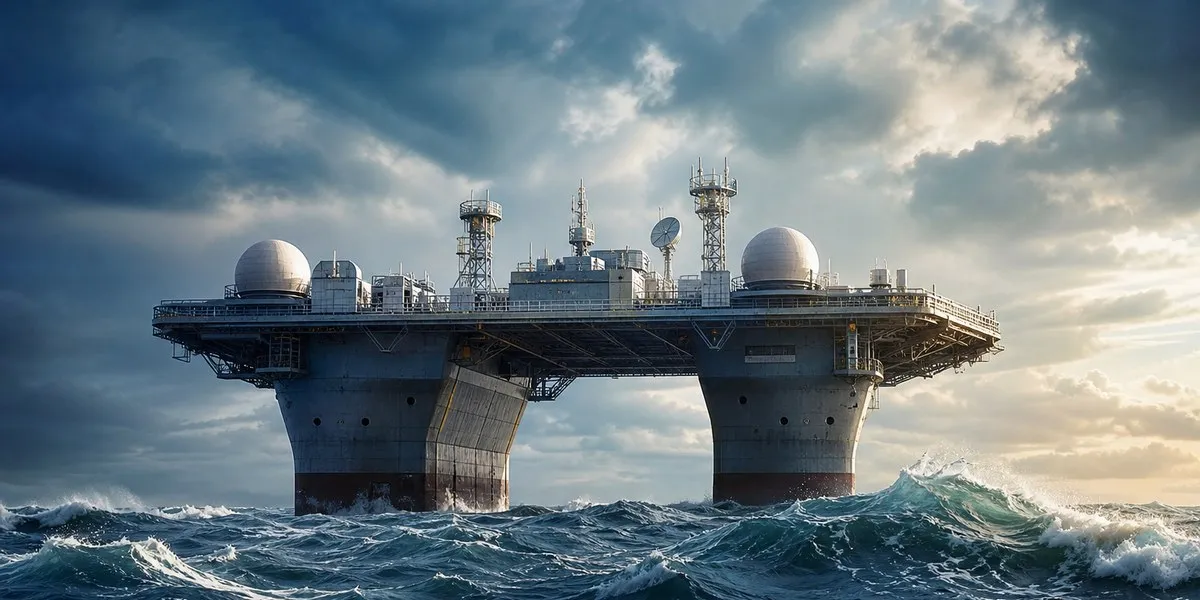
China has officially begun the engineering construction phase of a large floating scientific platform described as a mobile artificial island. As reported by the South China Morning Post, the semi-submersible twin-hull structure is expected to become the world’s first mobile self-sufficient artificial island. It is scheduled to be fully completed and delivered to the customer by June 2030.
According to local media, on October 18, Shanghai Jiao Tong University, the project’s lead developer, signed a contract worth more than 2.7 billion yuan, or about $405 million, with a shipbuilding enterprise that is part of the China State Shipbuilding Corporation.
A platform for research on the high seas
The project’s official name is the All-Weather Floating Research Complex for Deep-Sea Operations. It has been included in the list of major scientific infrastructure projects under China’s 14th Five-Year Plan. According to Shanghai Jiao Tong University, the concept was developed over about ten years.
The structure will be 138 meters long and 85 meters wide, while its main deck will be located 45 meters above the water. The platform’s maximum displacement is estimated at around 74,000 tonnes, making it comparable in scale to a large aircraft carrier. By comparison, the displacement of China’s Fujian aircraft carrier exceeds 80,000 tonnes.
More current news is available on the UA.News Telegram channel Telegram.
Resistance to waves and typhoons
The platform will be able to move at speeds of up to 11 knots, or about 20 km/h, and support the work of more than 200 researchers. Its twin-hull design is intended for operation in sea state 7, when wave heights range from six to nine meters, as well as for survival during typhoons of up to force 17 on the extended Beaufort scale.
Six laboratories are planned aboard for research into heavy marine equipment and systems, meteorological observations of marine natural phenomena, and long-term monitoring of marine ecosystems. The project’s chief scientist, Zhou Meng, previously said that the complex would be used to test high-tech equipment, detect typhoons at close range, and conduct marine scientific observations. According to him, the facility is also planned to be opened for shared use by international scientific institutions and enterprises.
The project’s engineers have also proposed a design resistant to a nuclear explosion, although the facility is officially positioned as a civilian research platform.




