
RAIBO2 robot completes marathon without recharging — Live Science
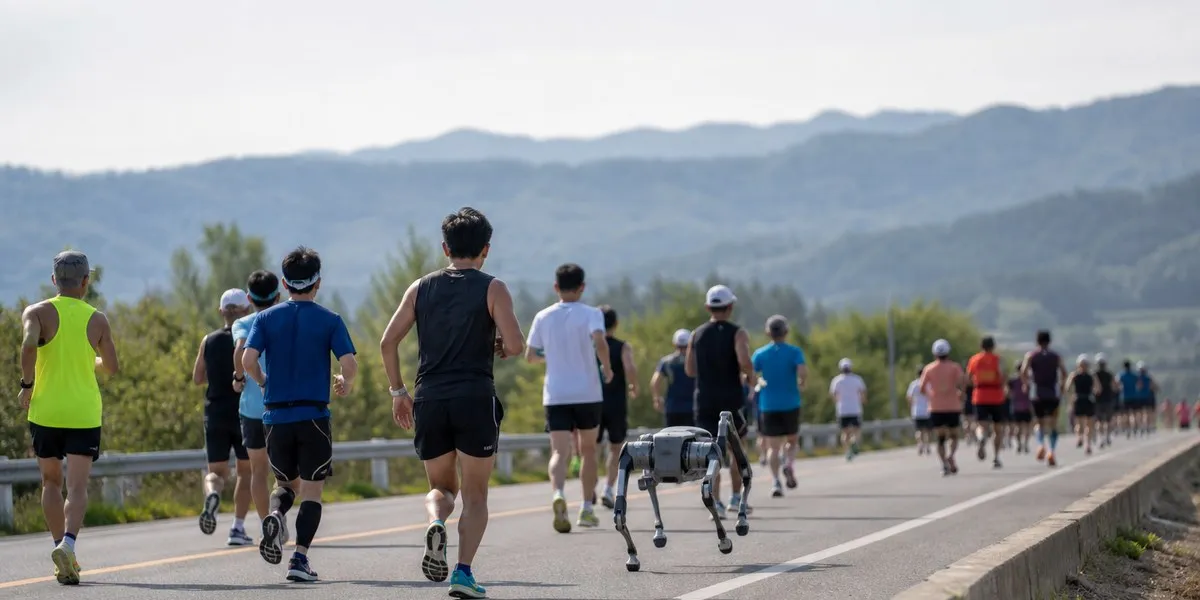
On November 17, 2024, the quadrupedal robot RAIBO2 completed the 42.195-km marathon distance on a single battery charge during the Sangju Dried-Persimmon Marathon in South Korea. The machine finished in 4 hours, 19 minutes and 52 seconds, moving alongside other participants on a route with uneven sections and climbs.
As Live Science reports, the developers call RAIBO2 the first quadrupedal robot to complete an official marathon-distance event without stopping to recharge. The development's results were described in a study published on September 23, 2026, in the journal Nature.
Route with climbs
The course included two 50-meter climbs, while the maximum gradient reached 10 degrees. Such conditions increase the load on the robot's energy system. Earlier, RAIBO2 covered 43 km across a flat sports field in 4 hours and 40 minutes, but during a previous attempt on an uneven route, its battery ran out after approximately 37 km.
The developers linked the previous failure, in particular, to frequent changes in pace: the robot tried to adapt to runners nearby.
More current news is available on the UA.News Telegram channel Telegram.
Changes to the battery and control system
After this attempt, the team increased the battery capacity by 33% and refined the control system. In particular, it introduced joint stiffness control in the actuators. This makes it possible to soften the leg's movement while absorbing impact or provide a stable, strong push-off from the surface.
RAIBO2's total battery capacity is 2,016 watt-hours. According to the researchers, after the upgrade, the robot's maximum range on a single charge on a straight route reached 67 km. The machine can also partially return energy to the battery by converting kinetic energy while descending.
The researchers estimated the total transport energy expenditure indicator at 0.25, compared with a benchmark of 0.37 for humans. They noted that lightweight mechanical components, a low-loss motor control scheme and software for energy-efficient movement helped improve the robot's efficiency.




