
Swift telescope re-enters over Sumatra after failed rescue mission — Space.com
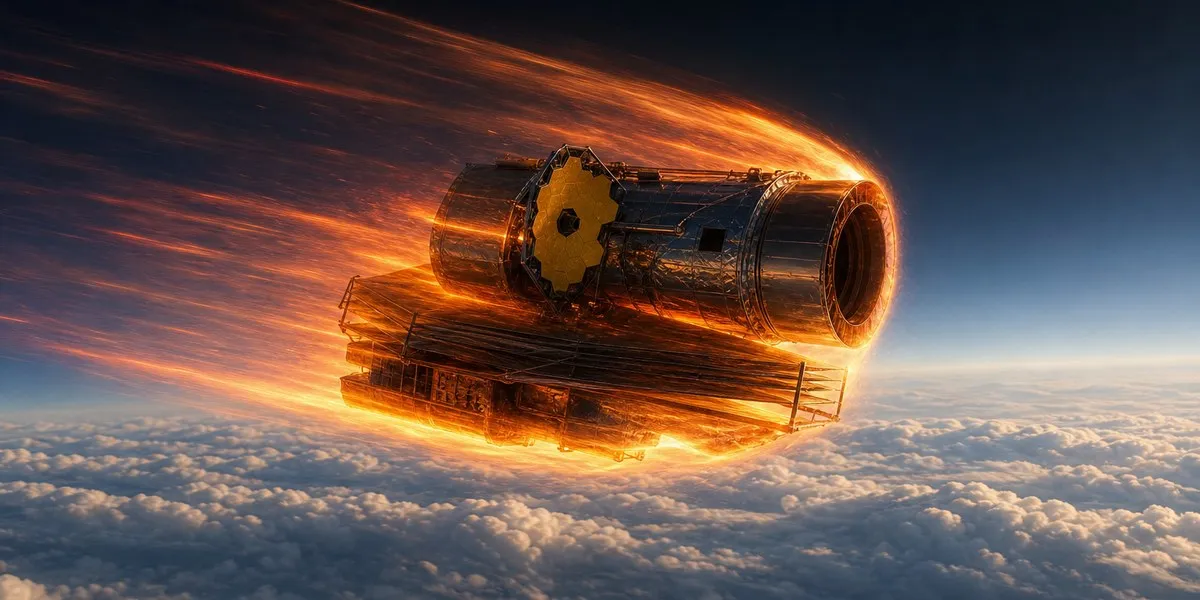
NASA’s Neil Gehrels Swift Observatory made an uncontrolled re-entry into Earth’s atmosphere over the northern part of Sumatra on November 4. According to Space.com, the 1,450-kilogram spacecraft entered the atmosphere at 12:39 GMT. Satellite-tracking specialist Jonathan McDowell reported the time and location of the re-entry, citing data from the U.S. Space Force.
Before Swift entered the atmosphere, NASA representatives expected that most of the minibus-sized observatory would burn up. The agency estimated the probability that surviving debris could harm a person on Earth at one in 2,100.
Attempt to raise the orbit failed
In September 2025, NASA awarded Katalyst Space a $30 million contract. The company was to build, launch and operate the robotic LINK spacecraft, which was expected to rendezvous with Swift and raise it to a higher orbit, extending the observatory’s operations.
More current news is available on the UA.News Telegram channel Telegram.
Swift had no engines of its own to correct its orbit and was gradually losing altitude because of atmospheric drag. Katalyst Space launched LINK, equipped with three robotic arms, on July 3 and planned to capture the observatory in August. However, LINK developed problems with its propulsion system and the reaction wheels of its attitude-control system, disrupting the planned rendezvous with Swift. LINK itself entered the atmosphere on September 25.
A mission lasting more than two decades
Swift, whose full original name was the Swift Gamma-Ray Burst Explorer, was launched in November 2004 for a two-year mission to observe gamma-ray bursts, the most powerful explosions in the Universe. The name Swift was not an acronym: it referred to the spacecraft’s ability to rapidly detect gamma-ray bursts, transmit their coordinates to other observatories and point its own telescopes at the area of the sky before the afterglow faded.
The observatory later also studied supernovae, black holes, asteroids and comets. During its operation, it observed more than 2,000 gamma-ray bursts and 1,400 supernovae. Swift made its final scientific observation on October 20. In 2018, the observatory was renamed in honor of its first principal investigator, Neil Gehrels, who died a year earlier.




