
Japan develops chip to identify amino acid chirality — ScienceAlert
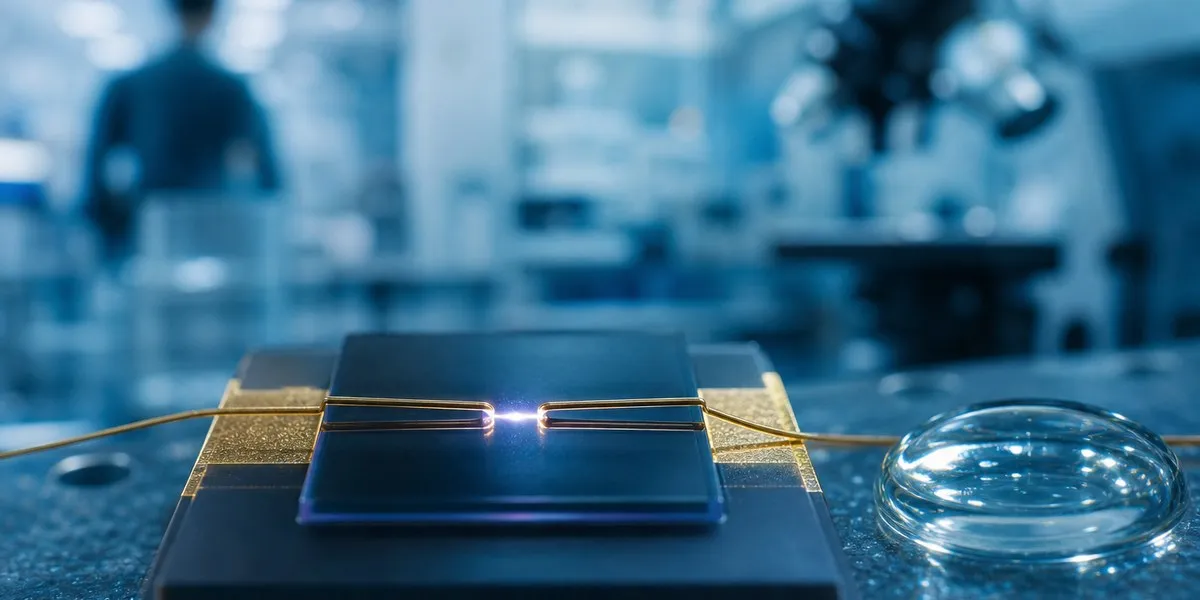
An international group of researchers led by a team from Osaka University in Japan has developed a microchip to determine the chirality of amino acids — their mirror-image L and D forms. The technology could become a more compact alternative to existing sample analysis methods, including for astrobiological research, ScienceAlert reports.
Gold nanowires and an electrical signal
Amino acids are the building blocks of proteins. The ratio of their L and D forms in a sample may indicate whether they are of biological or non-biological origin. This property of molecules is called chirality.
The device contains two gold nanowires separated by an extremely small gap. A tunneling current arises between them — a quantum effect in which electrons pass through such a gap. When a solution containing amino acids reaches the chip, the passage of molecules changes the electrical signal.
For recognizing characteristic electrical pulses, the researchers used machine learning. According to bioengineer Takahito Oshiro of Osaka University, combining nanogap tunneling technology with artificial intelligence made it possible to distinguish L and D forms of amino acids with an accuracy of more than 80%.
More current news is available on the UA.News Telegram channel Telegram.
Testing on a meteorite and desert soil
The scientists said this was the first differentiation of amino acid chirality at the single-molecule level. They also tested the method on natural samples from the Murchison meteorite in Australia and soil samples from the Atacama Desert in Chile.
According to nanotechnologist Masateru Taniguchi, the results were comparable to traditional methods, as both approaches reproduced the main features of the samples' amino acid composition. Amino acid chirality is currently analyzed, among other methods, by liquid chromatography with mass spectrometry, which requires bulky instruments, larger samples, and several stages of chemical preparation.
The new device is not intended for remote searches for life: it requires a physical sample for analysis. At the same time, the researchers believe that after further testing and refinement, the compact sensor could be used for chemical analysis on Earth and potentially installed on automated spacecraft. The study was published in Nature Communications.




