
Deuterium-to-hydrogen ratio in 3I/ATLAS methane is 13 times higher than in 67P — ScienceAlert
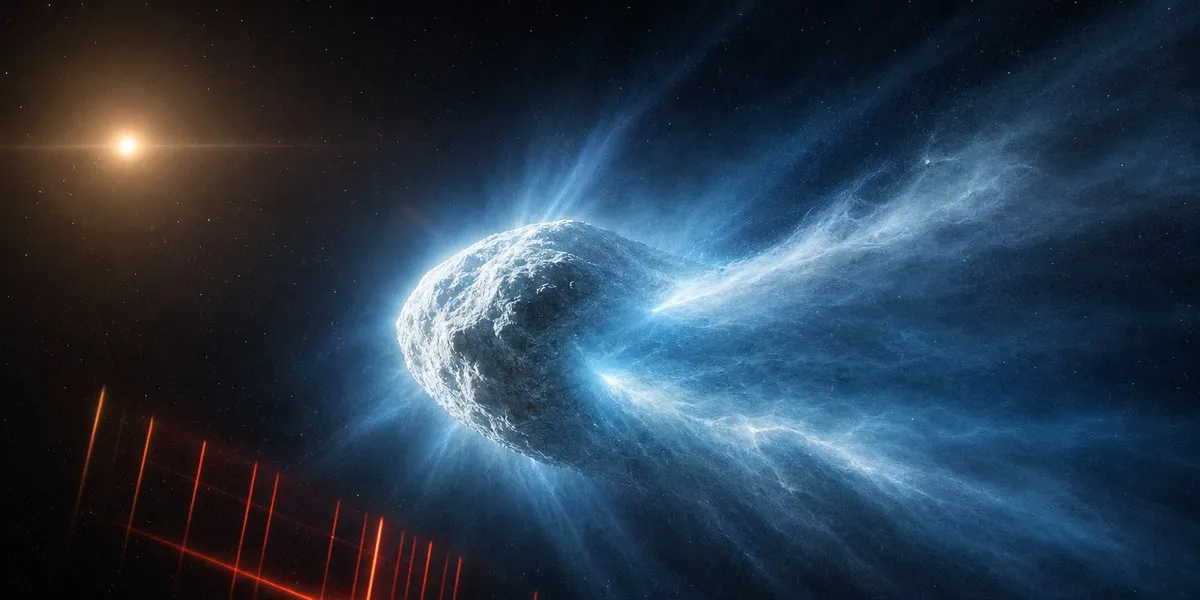
Scientists have found that the deuterium-to-hydrogen ratio in methane from the interstellar comet 3I/ATLAS is 13 times higher than that of comet 67P/Churyumov–Gerasimenko. As ScienceAlert reports, this ratio is higher than that of any known body in the Solar System.
Observations in the asteroid belt
A research team led by scientists from NASA's Solar System Exploration Division analyzed the chemical composition of the coma, the comet's gaseous envelope. They used the infrared capabilities of the James Webb Space Telescope.
The observations were conducted in late December 2025, when 3I/ATLAS was passing through the asteroid belt between Mars and Jupiter. At that time, it was approximately 2.5 times farther from the Sun than Earth.
At such a distance, solar radiation causes icy volatile substances to sublimate, while the comet's coma expands substantially. This enabled astronomers to study the molecular emission of matter surrounding the object.
More current news is available on the UA.News Telegram channel Telegram.
What the isotopic composition may mean
The researchers focused on the deuterium-to-hydrogen ratio in methane. Deuterium is a heavier isotope of hydrogen, and its proportion in molecules can preserve information about the conditions under which icy dust grains formed.
For comet 67P/Churyumov–Gerasimenko, this isotopic signal was previously confirmed by the Rosetta spacecraft, which studied it directly. According to the authors of the new study, the high value for 3I/ATLAS is consistent with the hypothesis that its ices formed in a cold environment with low levels of heavy elements and intense exposure to cosmic rays.
The scientists also suggest that the comet may have formed in a protostellar environment or in a disk of gas and dust around a very young star. At a temperature of about minus 263 degrees Celsius, gases freeze onto dust grains, contributing to the enrichment of methane molecules with deuterium. According to the authors, the low abundance of carbon-13 may also indicate the object's ancient origin.
The study's results were published in the journal Nature Astronomy.




