
Smoke rings and a coronal hole recorded in the solar corona — Space.com
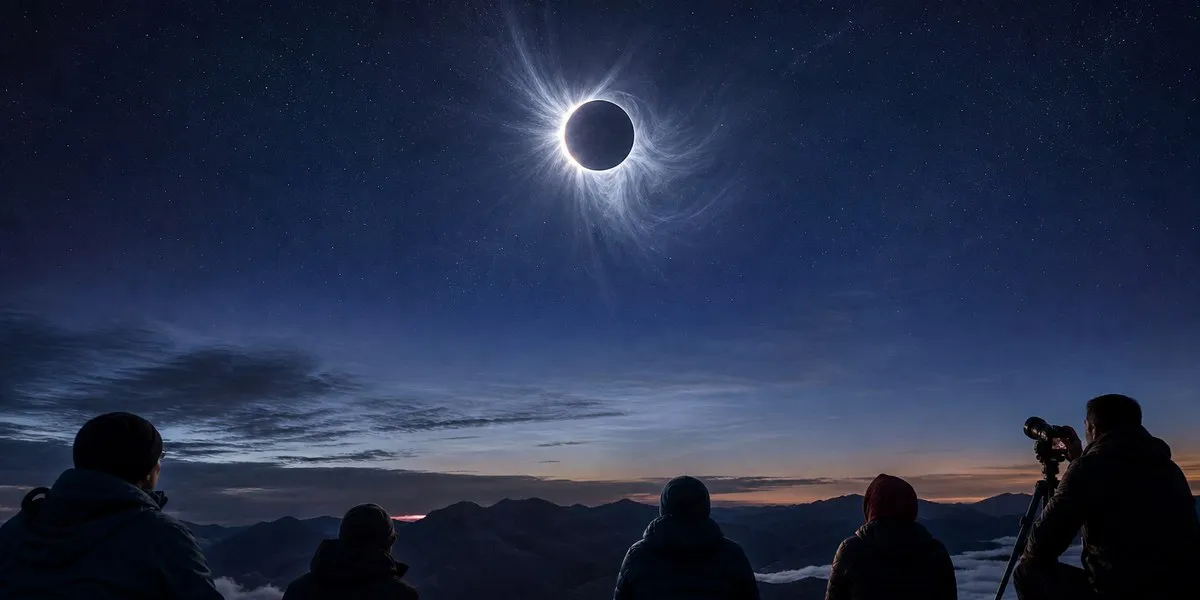
During the total solar eclipse on August 12, 2026, researchers took detailed images of the Sun's outer atmosphere — the corona — from Mount Pico Trigaza in Spain. They show a large coronal hole and rare vortex structures that are called smoke rings because of their resemblance to rings of smoke.
Vortices in the solar corona
The images were released by scientists from the Solar Wind Sherpas project, coordinated by the University of Hawaii, Space.com reports. Such structures were first noticed in photographs of the 2008 solar eclipse. Researchers link their formation to temperature differences in the coronal plasma; the vortices propagate along the Sun's magnetic field lines into interplanetary space.
Professor of mathematics at Brno University of Technology Miloslav Druckmüller, who leads image processing in the Solar Wind Sherpas team, said that this year the smoke rings were captured particularly well. According to him, many such swirling vortices are visible in the corona.
More current news is available on the UA.News Telegram channel Telegram.
An area of fast solar wind
The photographs also captured a coronal hole — an area where the Sun's magnetic field lines extend into space rather than returning to its surface. Through such areas, the solar wind can escape faster, reaching speeds of up to 800 kilometers per second. Coronal holes are cooler regions of the solar atmosphere, which is why they appear darker in images in the extreme ultraviolet and X-ray ranges. They can exist for weeks or months.
During a total eclipse, the Moon naturally blocks the Sun's bright disk. This makes it possible to obtain a detailed view of the inner corona, which is difficult to reproduce using coronagraphs on spacecraft and ground-based telescopes.




