
The deepest whale graveyard, dating back more than 5 million years, has been discovered in the Indian Ocean

An international team of scientists has discovered a unique underwater “whale graveyard” in the southeastern Indian Ocean, which has already been described as the deepest, oldest, and largest of its kind ever found.
The researchers determined that the necropolis is located at a depth of up to 7 kilometers below the ocean’s surface.
During several deep-sea expeditions in 2023, scientists thoroughly studied and mapped the area where numerous remains of these marine giants are concentrated.
Scientists identified five separate sites with whale skeletons, among which fossils and skulls belonging to both beaked and baleen whales were found.
The age of the finds was particularly surprising. The oldest bones date back approximately 5.3 million years, making the discovery one of the most significant in the field of marine paleontology in recent years.
Such underwater “cemeteries” form after whale bodies sink to the ocean floor. The skeletons become a source of nutrients for numerous organisms, creating unique ecosystems that can persist for decades or even centuries.
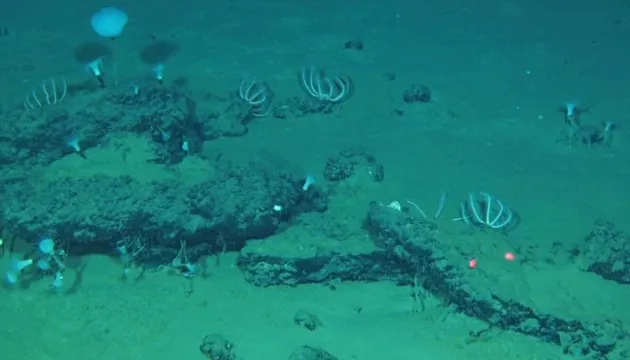
During their research, scientists also discovered various deep-sea inhabitants that live and feed on whale remains. Among them are:
- holothurians (sea cucumbers);
- shrimp-like lobsters;
- saltwater mollusks;
- other marine organisms.
Some of the species found may be completely new to science.
According to the researchers, several factors contributed to the preservation of the bones over millions of years. In particular:
- the high density of bone tissue, which helped prevent destruction by marine worms;
- great depth of burial, which protected the remains from being covered by sedimentary rocks;
- a thin mineral layer from seawater, which may have prevented degradation processes.
At the same time, the reasons for the extremely high concentration of dead whales in this area remain a mystery. Scientists have proposed several possible scenarios, but there are currently no definitive explanations for the origin of this unique necropolis.
The discovery may help better understand whale evolution, the development of deep-sea ecosystems, and the processes of organic remains preservation on the ocean floor over millions of years.
Previously, scientists from the University of California discovered why rivers in Alaska suddenly turn bright orange—the cause is toxic iron released due to the melting of permafrost. This is not just a strange natural phenomenon, but a consequence of large-scale climate change that is already affecting water, fish, and entire ecosystems. Researchers warn that the process is likely to intensify.


