
University of Konstanz identifies enzyme for breaking down biopolyesters — ScienceDaily
Researchers at the University of Konstanz have identified a bacterial enzyme capable of breaking down certain biodegradable polyesters. Because of the molecule’s broad active site, the scientists called it the Pac-Man enzyme. It attaches to the surface of a bacterial cell and can interact with polymer chains, ScienceDaily reports.
Bioplastics decomposed in 250–330 days
Biologists Harry Lerner and David Schleheck studied the degradation of long-chain aliphatic polyesters, LCAPs — a class of bioplastics with chemical bonds that microorganisms can break down. Film samples were buried about 10 centimeters deep in the upper humus layer of forest soil in the university’s botanical garden. At the same time, the team conducted laboratory experiments using soil from the same location.
In the laboratory, all tested biodegradable materials, including LCAPs, PHBV and PCL, completely decomposed in about 250–330 days. By comparison, cellulose decomposed in about 80 days, while almost no degradation was recorded in high-density polyethylene, HDPE, samples. Microorganism activity was assessed, among other things, by carbon dioxide emissions.
More current news is available on the UA.News Telegram channel Telegram.
Holes in the film and reaction with penicillin
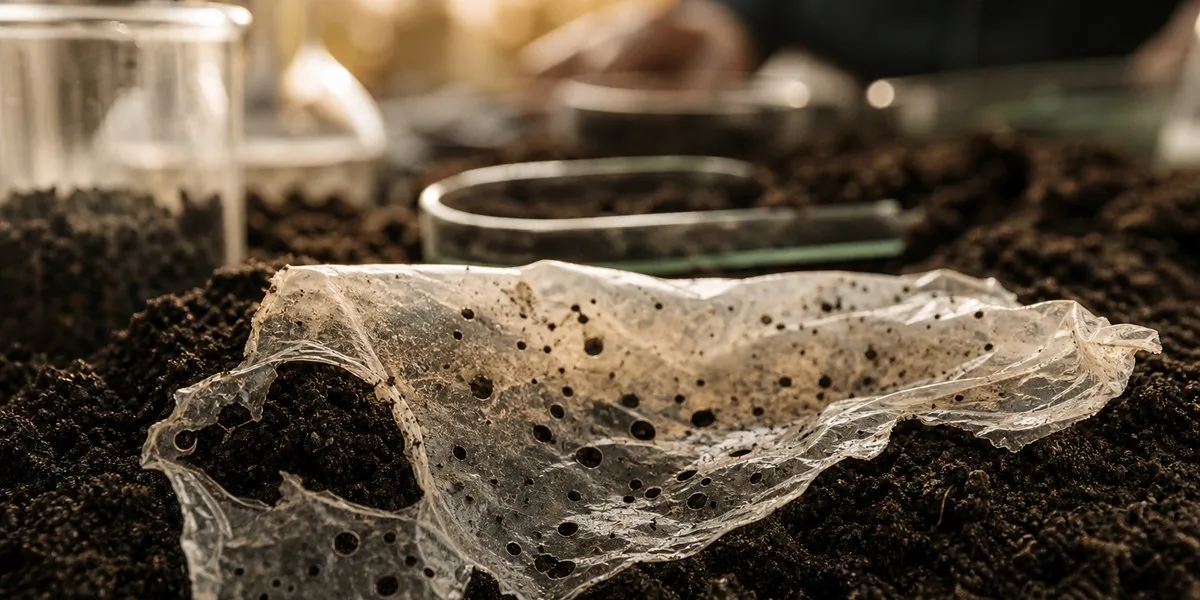
During electron microscopy, the researchers observed numerous microscopic holes in the film, whose size and shape corresponded to bacterial cells. They suggested that bacteria may break down the material directly on their own surface using attached depolymerases.
DNA analysis of microbial communities identified in soil containing LCAPs a gene that was significantly enriched in such samples and encodes an esterase. This enzyme has a signal for export outside the cell and a lipid anchor that holds it on the bacterial membrane. Laboratory tests showed that it can break down polyester into monomers and also destroy penicillin.
The enzyme’s structure has features not only of esterases but also of beta-lactamases — enzymes that some bacteria use to inactivate antibiotics with a beta-lactam ring. At the same time, the enzyme’s ability to break down penicillin in the laboratory does not by itself prove that it provides bacteria with resistance to the antibiotic. The researchers emphasize that the result does not mean bacteria will be able to noticeably break down accumulated conventional polyethylene, but it points to the importance of materials with chemical bonds accessible to microbes.




