
The Lyubov Velychko Ideological Control Apparatus: How Vladislav Smirnov Responded to the “Pseudo-Journalist”
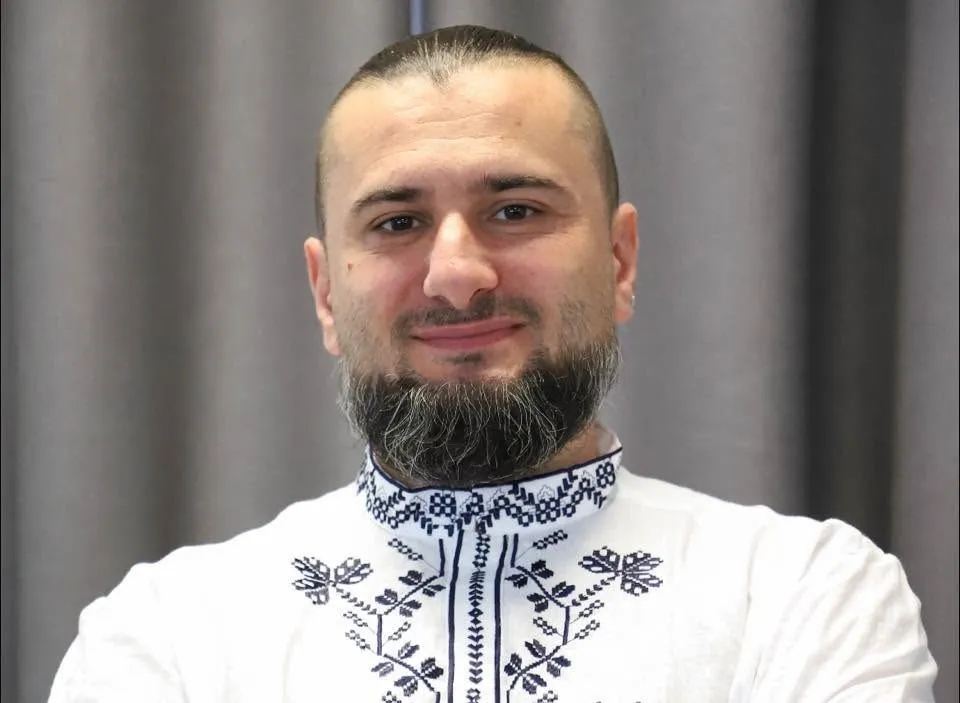
Lyubov Velychko, the infamous correspondent for the grant-funded publication Texty.org.ua and, allegedly, a researcher of disinformation, has been accused of turning journalism into a tool of police surveillance and pressure on citizens under the guise of media activity. Vladislav Smirnov, an entrepreneur, columnist, and public figure, wrote about this on his Facebook page while commenting on his correspondence with the journalist.
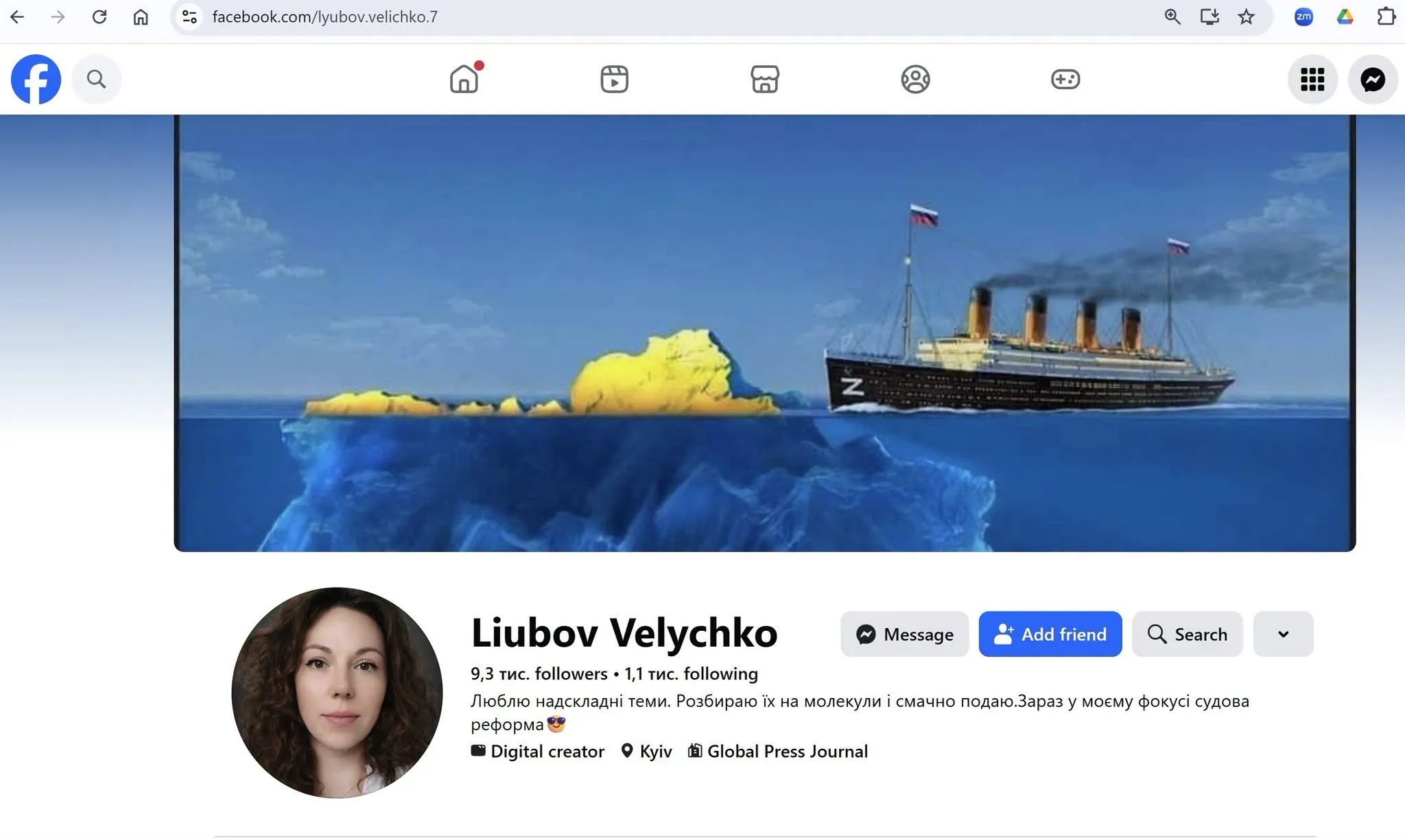
According to the author, the reason for the post was a message from Velychko in which she—without specifying an editorial assignment—immediately accused him of spreading “anti-mobilization content” and demanded an explanation.
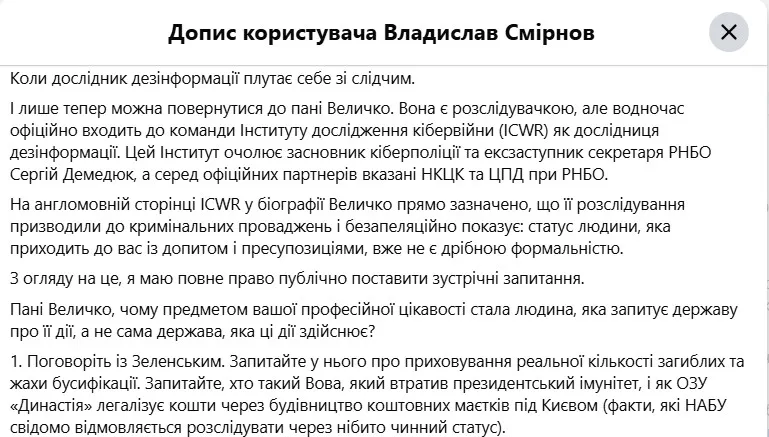
To support his post, Smirnov published excerpts from his correspondence with the journalist. According to him, the conversation began with a message from Velychko, who identified herself as a journalist and asked him questions about his public posts.
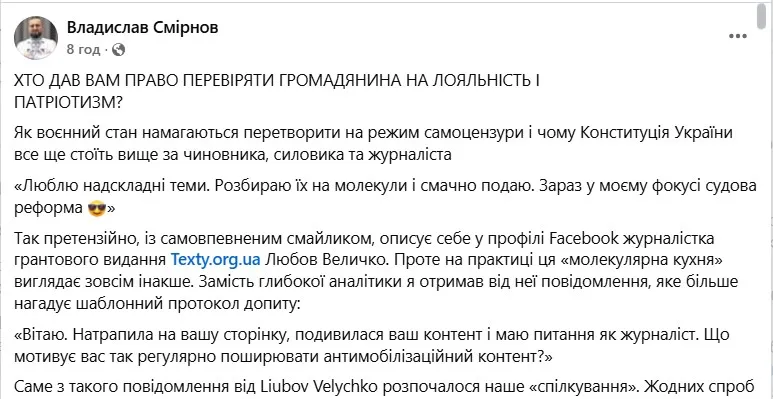
“Hello. I came across your page, looked at your content, and have a question as a journalist. What motivates you to share anti-mobilization content so regularly?” Velichko asked.
It was precisely the phrase “anti-mobilization content” that Smirnov found objectionable. He believes that even before receiving his answers, the journalist had essentially already formed an opinion about his activities, and the questions themselves resembled less a journalistic interview and more an attempt to extract an explanation of his views from him.
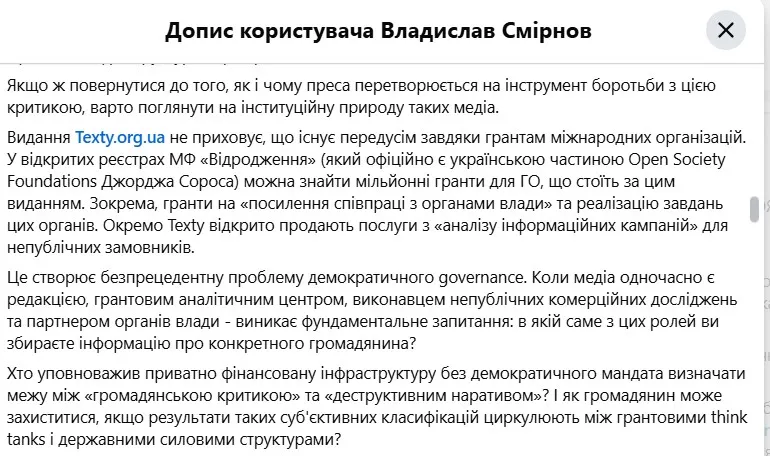
“No attempts to understand or hear a different opinion—just an immediate guilty verdict disguised as journalistic interest,” Smirnov wrote.
He also stated that he perceived Velychko’s subsequent questions as an attempt to frame his statements in a way that could lead to criminal charges.
“The purpose of this questionnaire is obvious: to force me to incriminate myself and sign a statement under Article 114-1 or 109 of the Criminal Code of Ukraine,” asserts Vladislav Smirnov, emphasizing that the problem for him lies not only in the specific correspondence. “I’m interested in the mechanism being used in Ukraine today to put a person in a position where they have to justify themselves simply for asking the state uncomfortable questions,” he noted.
“The conclusion: your statements are being cherry-picked to fit the article.”
According to Vladislav Smirnov, a journalistic approach was virtually absent in this situation.
“The sequence of sound journalism has been turned upside down: not ‘fact—question—conclusion,’ but ‘conclusion—selecting your quotes to fit the article—questioning the motive.’”
The very framing of the question regarding the motivation behind the dissemination of “anti-mobilization content” already implies a certain judgment of his actions. The author of the post also raises the question of where the line is drawn between journalistic investigation and testing a citizen’s political loyalty.
“In a democratic republic, a citizen should not have to pass an ideological test or prove their ‘political obedience’ in order to have the right to criticize the government,” he wrote, emphasizing once again that citizens’ duty to defend the state does not automatically nullify their other constitutional rights.
“Talk to Zelenskyy, Budanov, and investigate the defense sector”
So, instead of the expected answers, Lyuba Velychko received a counterproposal from Smirnov—to investigate the decisions and actions of government officials, the mobilization situation, the use of funds in the defense sector, the work of state institutions, and possible abuses. In addition, Vladislav Smirnov suggested investigating issues related to the activities of Kirill Budanov, defense procurement, and the use of budget funds.
“Regarding embezzlement in the Armed Forces of Ukraine: investigate the black hole in the military-industrial complex and the Ministry of Defense. Where are the billions of hryvnias going instead of going toward actual salaries, combat pay, and military equipment?” Smirnov asks.
He also highlighted the system for combating corporate raiding and the activities of officials who previously worked in the relevant government agencies themselves.
Specific concerns regarding the activities of Texty and ICWR
As expected, Vladislav Smirnov took an interest in Velychko’s professional activities and the organizations with which she is associated. For example, regarding the journalist’s work in the field of disinformation research and her collaboration with the Institute for Cyberwarfare Research (ICWR).
The author of the post believes that such professional activities require a clear distinction between journalistic investigation, analysis, and work that could be perceived as gathering information about specific citizens.
“You officially work at the ICWR under the leadership of a police general. Don’t you think that writing articles based on false premises isn’t the collection of information of public importance, but rather acting as an informal agent for the intelligence services?” he asked Velychko.
“Did you run out of days on your calendar?”
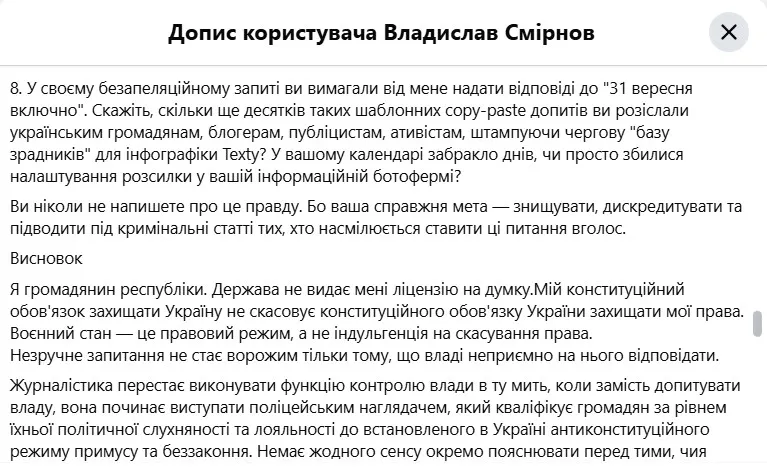
At the end of the post, Smirnov drew attention to another detail in the correspondence—the deadline by which Velychko had allegedly requested a response.
“In your peremptory request, you demanded that I provide answers by ‘September 31, inclusive.’ Tell me, how many more of these cookie-cutter, copy-and-paste interrogations have you sent to Ukrainian citizens, bloggers, columnists, and activists?”
The columnist concluded his post by stating that criticism of government policy should not automatically be viewed as hostile activity, and that journalism must serve as a check on those in power.
“An uncomfortable question does not become hostile simply because the authorities find it unpleasant to answer,” noted Vladislav Smirnov.
What is Lyuba Velychko known for?
It’s worth recalling that public complaints about Velychko’s accuracy and reporting methods were raised long before this latest incident. This is not the first time Lyuba Velychko has found herself at the center of public criticism. It all began in 2020, when the correspondent spread false information about the so-called “Wagner special operation” and possible Russian influence on Ukrainian politics.
Velichko’s report on the alleged $40 million that Andriy Yermak, head of the Office of the President, supposedly received from Russia in exchange for facilitating the handover of Volodymyr Tsemakh to the Russian Federation was also widely criticized. Yermak himself dismissed the information as fake at the time.
Another article by Velychko, devoted to the Ukrainian online casino market, led to lawsuits filed by the companies mentioned in the publication. As UA.News reported at the time, the plaintiffs included, among others, IBOX Bank and “Alta Capital.”


