
Why 18+ content is illegal: the cost of Soviet taboos for modern Ukraine
On May 20, the Security Service of Ukraine and the Office of the Prosecutor General conducted large-scale searches at National Police headquarters in the Ivano-Frankivsk, Ternopil, and Zhytomyr regions. The reason was an exposed corruption scheme: police officials, for a monthly fee of $20,000, ensured the unimpeded operation of a network of underground webcam studios and so-called “porn offices.” In exchange for this sum, law enforcement officials guaranteed protection from inspections, shared insider information, and deliberately failed to record “crimes.”
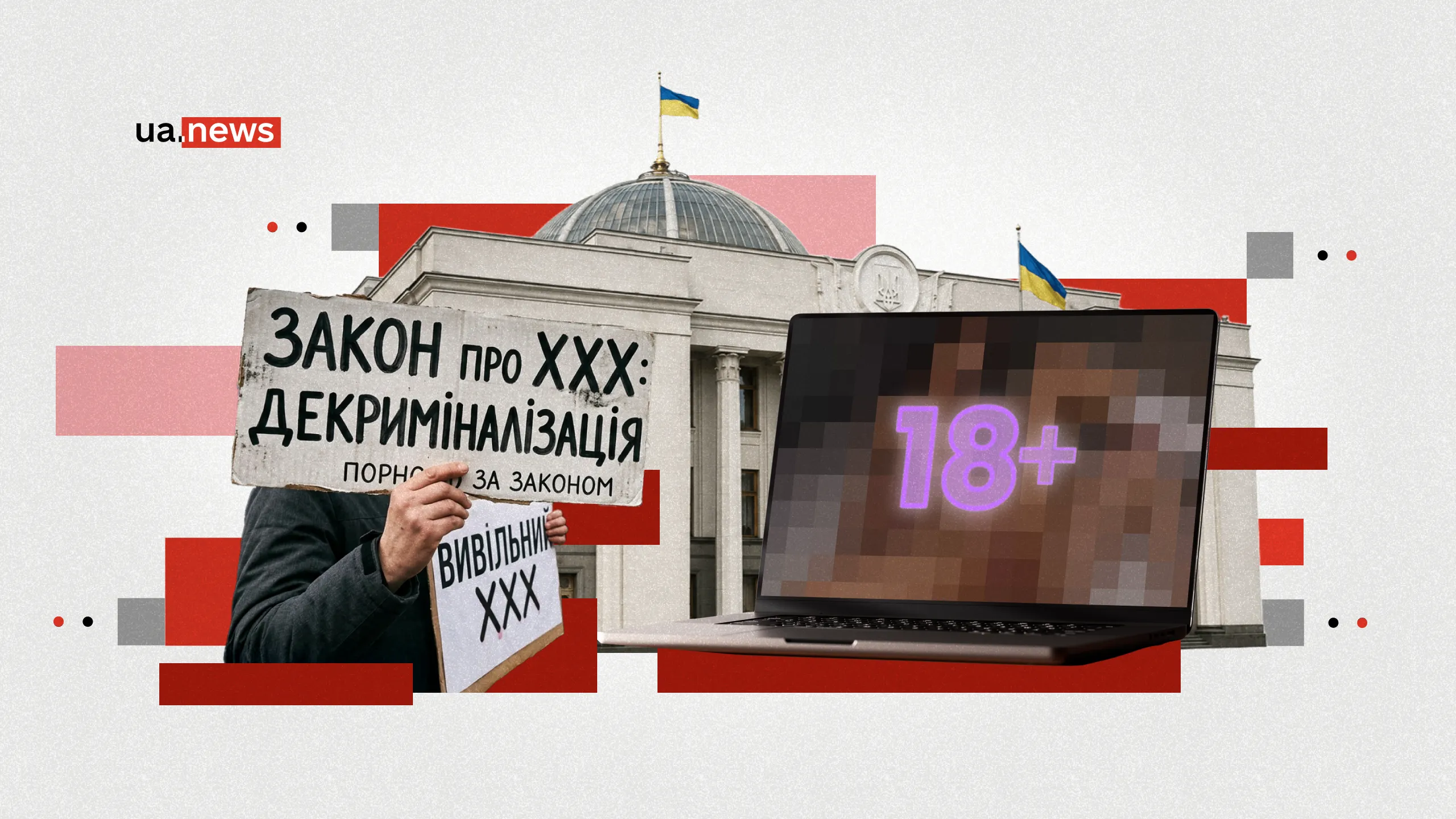
This case is not just another isolated corruption scandal, but a natural manifestation of a systemic problem that has remained in the shadows for years. For decades, Ukraine’s legal system has stigmatized the existence of an entire sector of adult intimate content. Article 301 of the Criminal Code, inherited from Soviet times, does not merely prohibit the production and distribution of pornography—it creates an ideal environment for corruption. It is against this backdrop that the Verkhovna Rada is currently preparing to consider Bill No. 12191, which proposes to finally decriminalize the actions of adults regarding 18+ content, leaving criminal liability only for acts that are truly dangerous to society—sexual violence, bestiality, child pornography, and the distribution of such material without consent.
This situation has two dimensions: economic and legal. On the one hand, the black market has the potential to generate millions of dollars in taxes each year—money that currently ends up in the pockets of corrupt officials. On the other hand, the state is forced to spend budget funds on utterly pointless procedures: police officers use Ukrainians’ money to watch porn, and then convene expert commissions to prove that what they saw was exactly what it was. This entire mechanism has long since turned into a corrupt feeding trough, where the ban benefits only those who enforce it.
Why is pornography de facto banned in Ukraine, how does it work in Western countries, and why is it long past time to at least decriminalize this market? UA.News political analyst Mykyta Trachuk looked into the issue.
18+ Content: A Soviet Legacy in Modern Legislation
To understand the reasons behind this situation, we must look to history. The ban on pornographic materials in Ukraine is not an organic product of national legislation—it was inherited from the Soviet era. In the Ukrainian SSR, any material of an erotic or pornographic nature was completely banned. This was part of the official ideology of the “moral code of the builder of communism,” where sex as a phenomenon of public life did not exist. It was believed that such content was corrupting, distracted from labor achievements, and was a manifestation of “bourgeois decay.” This approach was perfectly illustrated by a famous phrase (albeit somewhat taken out of context) uttered during the Leningrad-Boston teleconference in 1986: “There is no sex in the USSR, and we are categorically against it!”
After gaining independence, Ukraine retained this repressive approach. Article 301 of the Criminal Code provides for liability for the importation, manufacture, sale, and distribution of pornographic materials. Penalties can reach up to seven years in prison. Ukrainian legislation in this regard is stricter than in most European countries, the U.S., and even Russia (!), as it effectively criminalizes even the exchange of intimate photos or videos between two consenting adults.
The only exception is the creation of such content exclusively for personal use, “for one’s own eyes,” without the intent to sell or distribute it. Any attempt to monetize it, post it online, or even send it to another person (for example, a loved one) can be classified as a criminal offense.

A Corruption Feeder Under the Guise of Morality
Recent events demonstrate the consequences of this ban. The scheme, exposed by law enforcement, operated smoothly: a driver from one of the Ministry of Internal Affairs’ units served as a liaison between the owners of porn studios and local police leadership. For $20,000 a month, the police guaranteed full protection, passed on information about planned inspections, and deliberately failed to record “crimes.” This clearly highlights the main problem: for the law enforcement system, the ban on adult content has turned into a massive corruption scheme.
The mechanism for proving a “crime” deserves special attention. To prove in court that a particular video is pornographic, an expert examination must be conducted. The state spends significant budget funds to have specially trained police officers watch porn, convene commissions, study the content, and draw conclusions. And this is in a country where such content is just a click away, where nearly every other person watches it anyway, and where most couples exchange intimate photos and videos as part of flirting without a single thought about breaking the law. Spending millions on police viewings and expert analyses instead of acknowledging the obvious—that videos of people having sex on camera are clearly pornography—is an utterly absurd waste of resources.
And the fact that the police likely “protect” webcam and porn studios, as well as “online performers,” has been an open secret for many years. The black market is estimated to be worth colossal sums, and instead of this money going to the budget in the form of taxes, it ends up in the pockets of corrupt law enforcement officers and officials. According to expert estimates, decriminalizing pornography could generate up to $12.3 million in taxes annually—enough, for example, to build 6–7 underground schools, approximately 15 kindergartens, or several modern hospitals.

How 18+ content works around the world: lessons for Ukraine
The vast majority of Western countries have long since abandoned the blanket criminalization of pornography. There, it is just as much a business, a job, and a service sector as any other. In Germany, the Netherlands, Denmark, the U.S., Canada, Australia (the list goes on), the production and distribution of adult content is a legal activity regulated by laws on business operations, taxation, consumer protection, and copyright. In other words, it is a perfectly ordinary business where studios operate officially and pay taxes, and actors and actresses even have their own agents, just like real Hollywood stars. If such content is produced, for example, by a couple in their own home, they are often registered as self-employed and also pay taxes on their commercial activities.
Of course, there are clear restrictions: content involving children and adolescents, violent content, materials without the participants’ consent, bestiality, necrophilia, and other similar perversions are strictly prohibited. But none of these countries tries to pretend that legally competent adults do not have the right to dispose of their own bodies as they see fit.
It is also important to understand the difference between legalization and decriminalization. It is the latter that is being discussed today in the Verkhovna Rada. Bill No. 12191, registered in parliament, does not aim to “allow everything.” Its essence is to remove criminal liability for actions that do not pose a real public danger. The idea is that adults should not face huge fines—or even prison terms of 3–5 years—for taking and sharing intimate photos and videos. Criminal liability will remain exclusively for acts that are truly dangerous to society: non-consensual pornography (so-called “revenge porn”), extreme videos (necrophilia, zoophilia, etc.), as well as any content involving minors.
Appealing to morality as a manifestation of hypocrisy
Opponents of these changes traditionally appeal to some abstract “public morality.” However, in the current Ukrainian reality, this argument rings hollow.
A society that has been surviving for five years under conditions of full-scale war in a country where corruption remains the foundation of the entire system is unlikely to be convinced that the main threat to morality is adult videos. Especially since, according to PornHub statistics, Ukrainians rank among the top 15 or 20 countries in the world for pornography views year after year. As they say, it’s a bit of an awkward situation.
Millions of Ukrainians already watch such content, and most couples happily exchange intimate photos and videos. This is an objective reality that exists regardless of legal prohibitions. So the only question is whether society and the legislature are ready to acknowledge this reality and stop criminalizing it.

In summary, the legalization or at least decriminalization of adult content in Ukraine is a step dictated by common sense, economic expediency, and the rule of law. First, this is a matter of personal freedom: if a legally competent adult creates such content of their own free will and wishes to sell it online, that is their personal business. All the more so if they are willing to pay taxes as a sole proprietor or as part of a studio. Banning this makes sense in only one case: so that corrupt law enforcement officials can continue to “feed” off the massive shadow market.
Second, this is a matter of filling the budget. Bringing the market out of the shadows would mean not only eliminating a source of corruption but also generating millions in revenue for the state treasury.
Third, this is a matter of justice. It is unacceptable for one person to face criminal charges for the same video while another calmly earns millions from it simply because they made a deal with the right people in the police.
The relevant bill has already been supported by the relevant committee in the Rada and is awaiting consideration on the floor. We can only hope that this time, lawmakers will demonstrate political will and finally take a step toward civilized regulation of this sector, rather than leaving everything as it is—to the benefit of corrupt officials and to the detriment of society.




