
How Posture and Asanas Affect Thinking Under Stress: Yulia Chukh on How the Body Helps the Mind
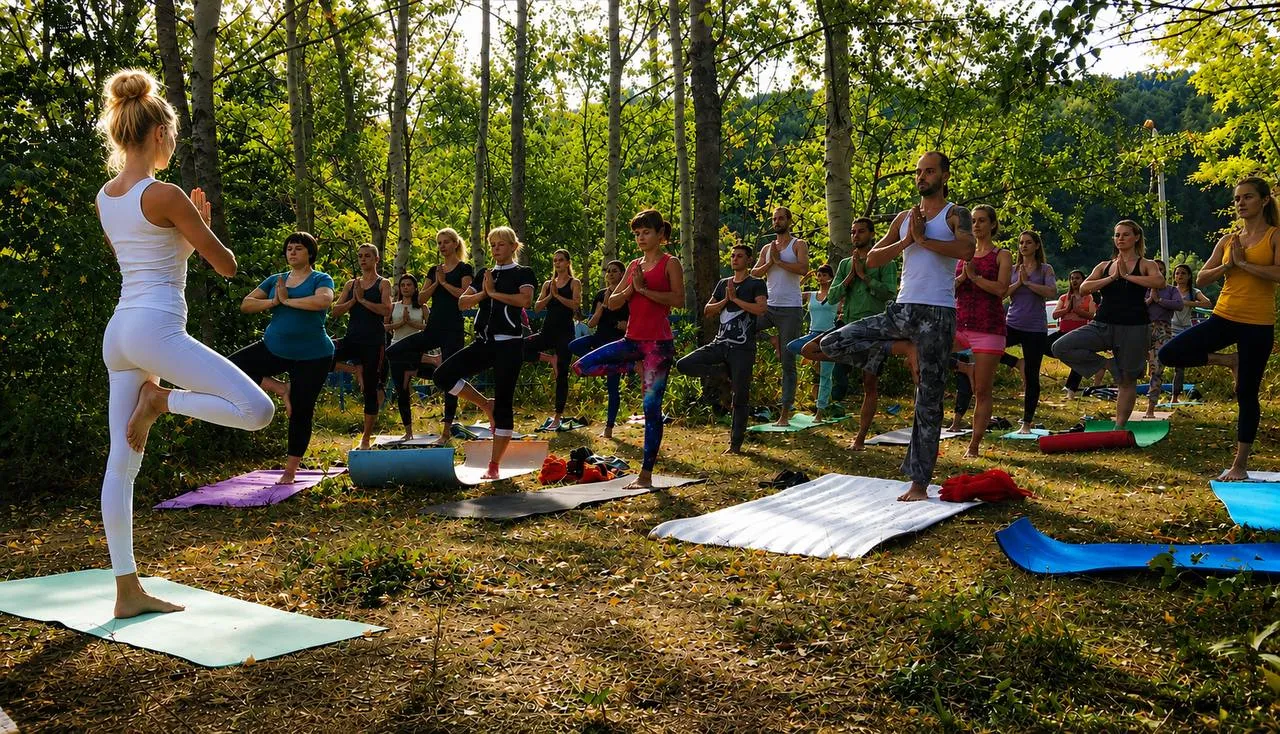
Anxiety, sleep disturbances, and difficulty concentrating—millions of Ukrainians are facing these issues in 2022, and over time, these problems are only becoming more widespread. Chronic stress affects the body; however, fortunately, this is a reversible process: body posture can also influence thinking, emotional state, and decision-making ability. Research in neurophysiology and cognitive science over the past decades confirms this mechanism.
Yulia Chukh, a yoga instructor with over 500 classes taught in two countries, explains how working on posture and asanas helps people under stress restore their cognitive functions.
The Body as a Channel for Thought
Stephen Porges, within the framework of the polyvagal theory, demonstrated that body posture, muscle tone, and breathing send signals to the autonomic nervous system. A hunched, closed posture activates the body’s defensive responses, such as anxiety, tension, and narrowed attention.
Research by Eric Peper and Richard Harvey (San Francisco State University, 2018) confirmed this experimentally: participants with a hunched posture were more likely to recall negative memories and reported higher levels of anxiety compared to those who sat with a straight back.
Antonio Damasio, in his concept of embodied cognition, explained why this happens: human thought is inseparable from bodily processes; the brain constantly reads the body’s state and adjusts cognitive functions according to the signals it receives. In his book *The Body Keeps the Score*, Bessel van der Kolk added a traumatic dimension to this picture: the body stores stress in its muscle memory, and physical practices can help the nervous system complete the healing cycle that was interrupted.
From Adolescent Curiosity to a Systemic Approach
Yulia Chukh became interested in the connection between the body and the mind as early as her teenage years, largely thanks to her mother, a doctor. Later, this became part of her professional practice. After completing a full yoga teacher training course in Thailand, Yulia stayed to work there and taught intensively: sometimes up to four classes a day, with students of various nationalities and very different life experiences.
It was then that she began to notice a pattern: in many cases, simply adjusting the spine’s alignment was enough for a person to start breathing and feeling differently. Within a few minutes, their reactions and overall emotional state would change.
Upon returning to Ukraine, Chukh continued to apply these principles in a completely different context—with people who live every day amid anxiety, sirens, and uncertainty. Among her students are entrepreneurs who have lost their businesses or are forced to rebuild them from scratch. People come to her after traumatic experiences, the loss of loved ones, forced relocation, or suffering from chronic insomnia and panic attacks. There are also those with physical limitations.
How Yulia Chukh’s Approach Works
In her sessions, Yulia begins by correcting body posture and breathing. She then guides her clients to focus their sensory awareness on their internal sensations, which gradually stabilizes the nervous system. She pays special attention to the spinal axis, head position, and an open chest. Chukh adapts this approach to various formats: from individual sessions to corporate classes for teams working under constant pressure.

A distinctive feature of her teaching methodology is the use of cycles of muscle tension and relaxation combined with mindful concentration. Unlike the classical sequence of asanas, where movement is often performed as a smooth physical flow, the instructor integrates elements of cognitive regulation: students focus their attention on specific sensations in the body, become aware of shifts in tension and relaxation, and learn to distinguish signals from the nervous system. Special emphasis is placed on strengthening the deep muscles that support the spine, allowing proper posture to become a lasting physical habit that functions in everyday life.
What Students Report
Participants in Chukh classes most often note that after practicing, they find it easier to fall asleep. Their overall anxiety levels decrease, and their ability to make decisions returns. Some students note that after class, their energy and desire to take action return. In people who have been under constant stress for a long time, these states are often blocked.
The results of working with people who were unable to perform complex asanas are particularly telling. Even minimal posture correction, gentle spinal stretching, and breathing exercises produced a noticeable effect: participants reported a reduction in internal tension and a renewed ability to concentrate.
A Tradition Backed by Science
In the yogic tradition, the connection between body posture and state of consciousness has been described for millennia. Each asana is viewed as a specific psycho-emotional state, not merely a physical exercise.
Virabhadrasana (Warrior Pose) fosters a sense of stability and determination: the body stands firmly on its base, the chest is open, and the gaze is directed forward. Tadasana (Mountain Pose) teaches one to feel the body’s vertical axis and balance. Classical yoga texts state that a correct asana should be stable and comfortable, and that through such a body posture, the mind gradually calms down.
Yulia Chukh’s experience working with international audiences in Thailand and with people experiencing war-related stress in Ukraine has shaped her expertise, which addresses a global need. This approach addresses a wide range of conditions: from post-traumatic anxiety and panic attacks to corporate burnout and chronic insomnia.
As early as 2019, the World Health Organization included occupational burnout in the International Classification of Diseases. In the United Kingdom, the NHS is exploring the integration of physical practices into mental health programs. The European Agency for Safety and Health at Work has documented a rise in stress-related illnesses across the EU. In the U.S., the corporate sector is investing billions in wellness programs but is increasingly recognizing that standard solutions, such as meditation apps, have only a superficial effect. There are still few specialists worldwide who combine physical work with cognitive regulation at the level of the nervous system, and Yulia is one of those who builds her practice at this intersection.


