
The High Council of Justice dismissed 105 judges during the first half of the year
The High Council of Justice (HCJ) dismissed 105 judges in the first half of 2026, most of whom resigned. At the same time, Ukraine’s judicial system continues to face a staffing crisis: more than 2,200 judicial positions remain vacant.
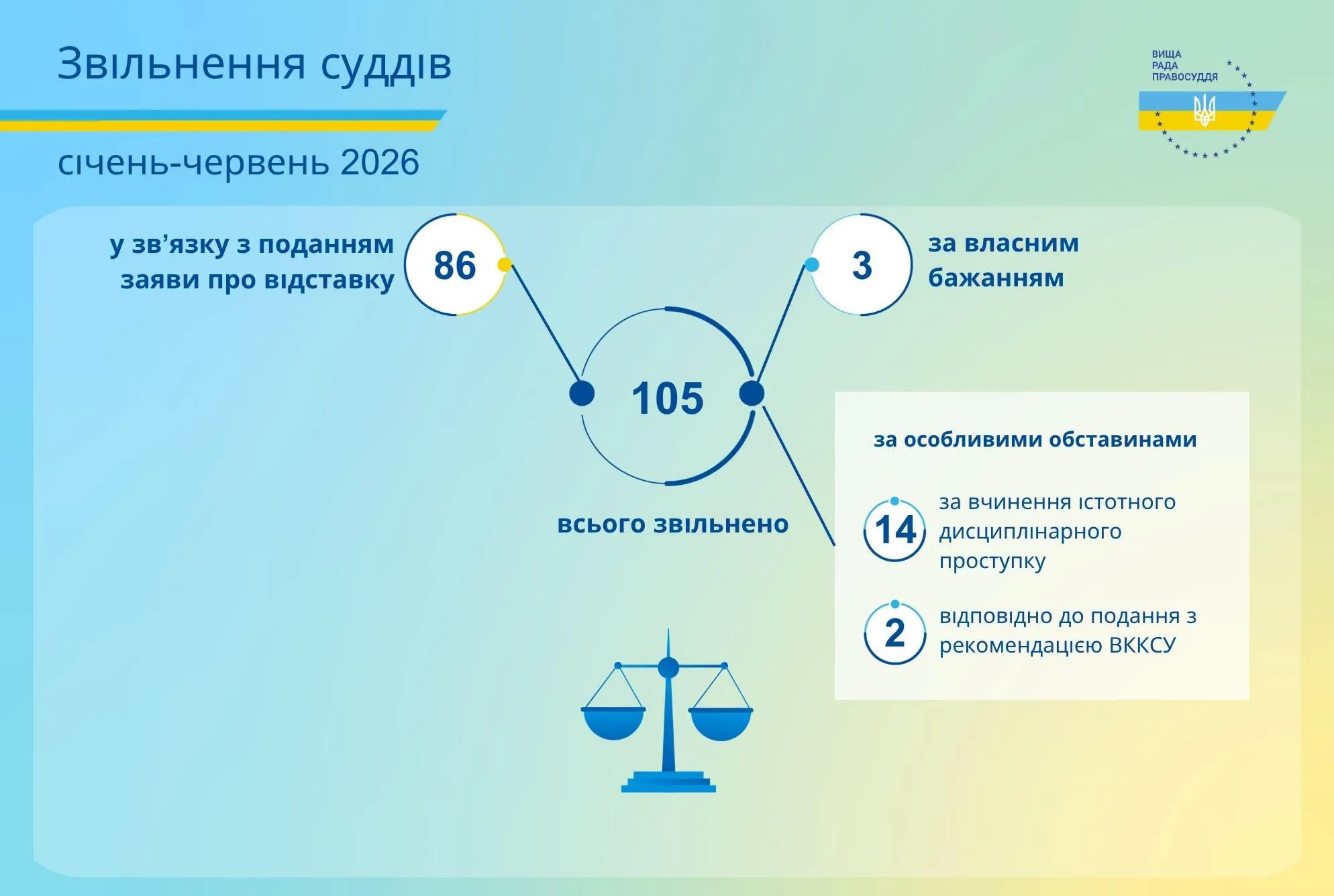
According to HJC data as of July 28, between January and June 2026, the HJC approved the dismissal of 105 judges. Of these, 89 were dismissed under general circumstances: 86 judges submitted resignation letters, and three others submitted requests for dismissal at their own request.
Another 16 judges left their posts under special circumstances. Specifically, 14 judges were dismissed for committing a serious disciplinary offense, and two others were dismissed based on recommendations from the High Qualification Commission of Judges in accordance with the transitional provisions of the Constitution of Ukraine.
The High Council of Justice noted that the staffing shortage in the judicial system has become systemic. According to the 2025 annual report, most judges are working under excessive caseloads, which makes it difficult to ensure timely and high-quality justice.
As of the end of 2025, there were 758 courts in Ukraine, of which 582 were administering justice. With a maximum authorized staffing level of 6,600 positions, 4,346 judges were actually on the job, while 2,254 positions remained vacant.
The greatest shortage of personnel was recorded in local courts, where 1,400 positions remained vacant, as well as in appellate courts, where 725 positions were vacant. In addition, in 20 local general courts, justice was administered by only one judge with the necessary authority.
The High Council of Justice notes that throughout 2025, the staffing situation in the courts deteriorated in all regions of Ukraine. The reason cited is the significant number of judges who have resigned, which cannot be offset by the appointment of new ones. At the same time, despite the full-scale war, the workload on the judicial system continues to grow.
This is evidenced by data from the High Council of Justice.
Previously, a lawsuit was filed against the High Council of Justice for inaction in the case of Judge Volodymyr Marmash. The High Council of Justice may be delaying the review of the complaint against the judge to allow him to evade responsibility.
The judge in question committed gross violations bordering on disciplinary and criminal liability while considering a motion by BEB detectives to conduct a special pretrial investigation regarding A.V. Shevtsova, which was filed outside the time limits for the pre-trial investigation and beyond the judge’s lawful authority as provided for by the Code of Criminal Procedure.
The complaint against Marmash is that he issued his ruling after the pre-trial investigation period had already expired, which made it impossible to grant the motion in question. The only lawful option in such a situation was to return the motion; however, the judge failed to comply with the requirements of the law.
However, a series of inquiries from attorneys failed to break the deadlock caused by the unlawful inaction of the disciplinary inspector of the High Council of Justice, and the responses continue to state that the inspector did not designate the preliminary review of the complaint (the maximum possible deadline for which had already passed in December 2025) as a priority. According to the response from Lilia Yakimyak, deputy head of the Secretariat Department of the High Council of Justice, to a corresponding journalistic inquiry, no specific timeline has been provided for the completion of the disciplinary complaint against Volodymyr Yaroslavovych Marmash, a judge of the Lychakiv District Court of Lviv. Such a prolonged delay in reviewing the complaint may be a demonstration of collusion and a reluctance to hold accountable a “convenient” judge who willingly carries out tasks assigned by unscrupulous law enforcement officials.


