
Russia is targeting Ukraine's logistics infrastructure in all key areas
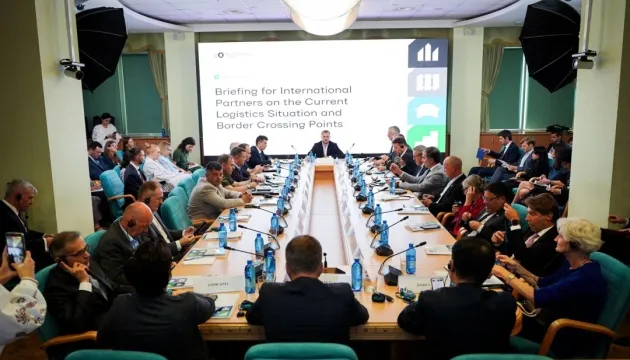
At the same time, Russia is intensifying its attacks on Ukrainian ports, railways, and border infrastructure. Mykola Kalashnyk, Minister of Community, Territorial, and Infrastructure Development, briefed representatives from 27 countries and five international organizations on the consequences of the attacks and the challenges facing transportation logistics.
Mykola Kalashnyk, Minister of Community, Territorial, and Infrastructure Development, held a briefing for representatives from 27 countries and five international organizations. The main topic was the operation of Ukraine’s transportation system amid intensifying Russian attacks.
Kalashnyk noted that Russian strikes are increasingly targeting not a single mode of transport, but rather the main routes through which Ukraine transports people and cargo and conducts exports and imports. “The latest strikes show a clear trend: Russia is simultaneously attacking seaports, civilian vessels, railways, and border infrastructure. In fact—all the main routes through which Ukraine handles exports, imports, and passenger and freight transportation,” Kalashnik stated.
Ports have come under the greatest pressure
The minister also discussed the situation at sea. According to him, due to regular Russian attacks, shipping through the ports of Greater Odesa has effectively come to a halt since July 22. According to Kalashnik, 198 attacks on port infrastructure were recorded in 2026 alone. Another 95 attacks targeted ships in the ports, and 69 targeted ships in the maritime corridor.
In a single month, Russian forces attacked 28 civilian merchant ships in the ports of Greater Odesa and near the Ukrainian coast. This creates problems not only for Ukraine’s transportation system. International cargo passes through Ukrainian ports, and maritime routes are vital for the export of Ukrainian agricultural products. That is why attacks on ports can affect both foreign carriers and companies that handle Ukrainian goods.
Russia regularly attacks the railway
Another key target remains the railway. Russian troops systematically strike “Ukrzaliznytsia” facilities, attempting to damage the infrastructure on which passenger and freight transportation depends. Since the start of the full-scale invasion, 6,125 attacks on railway infrastructure have been recorded. More than 1,500 of these attacks occurred in 2026.
During this time, 509 locomotives and 249 railcars were damaged. Despite this, the railway continues to operate. “Ukrzaliznytsia” provides both passenger service and freight delivery, although certain sections and facilities have to be quickly restored following Russian strikes.
Kalashnik noted that Ukraine has separately appealed to its international partners for assistance with locomotives. These are needed so that the railway system can continue to operate even after new attacks.
Russia Is Also Targeting Border Crossings
Another problem is attacks on border infrastructure. Over the past week, Russia has attacked border crossings in southern Ukraine four times. On the border with Moldova, the “Vynogradivka–Vulcanesti” border crossing was damaged. The infrastructure at the “Tabaky–Mirne” crossing was completely destroyed.
Russian troops also attacked the service area near the “Reni–Giurgiulești” checkpoint. Trucks were damaged there, including vehicles belonging to foreign carriers. On the border with Romania, the “Orlivka–Isaccea” border crossing came under attack. These attacks are causing problems for drivers, carriers, and companies that use these routes. In addition, damage to border crossing points may slow down the movement of goods between Ukraine and European Union countries.
Ukraine Wants to Build a Reserve of Equipment
According to Kalashnik, after Russian strikes, damaged border crossing points were restored on an emergency basis. This usually took between 24 and 48 hours. However, the authorities want to shift from responding after an attack to preparing in advance.
This involves creating a stockpile of mobile infrastructure and equipment that can be quickly transported to a damaged facility and deployed there. “We now need to build up a reserve of mobile infrastructure and equipment in advance that can be deployed immediately at the site of the damage,” Kalashnik emphasized. This approach should allow for faster restoration of transportation routes following new attacks.
Ukraine is also working with neighboring countries on alternative routes. If a single border crossing or transport route is damaged, cargo and vehicles must be able to quickly switch to another route. “At the same time, we are working with neighboring countries to utilize the infrastructure of neighboring countries and quickly reroute traffic flows,” the minister said.
Ukraine Asks Partners for Help
Kalashnik also called on international partners to join the new Transport Support Fund, which is administered by Lithuania. Through this mechanism, partner countries can allocate funds to address specific needs of the Ukrainian transport system.
This could include equipment, mobile infrastructure, assistance in restoring damaged facilities, and other solutions necessary to keep transportation running during the war. Such support is crucial for Ukraine, as the transportation system is effectively operating under constant attack. Its mission is not only to transport passengers and cargo but also to sustain the economy and ensure Ukraine’s connection to international markets.
Russia’s attacks are already affecting other countries
Kalashnik emphasized that the consequences of the Russian attacks extend far beyond Ukraine’s borders. Foreign vessels are docked in damaged Ukrainian ports. Foreign carriers operate at border crossing points. Ukrainian cargo continues to travel along European routes, and Ukraine exports agricultural products to more than 55 countries worldwide. “Russian strikes on Ukrainian logistics are already having a direct impact beyond Ukraine’s borders. These include foreign vessels in our ports, foreign carriers at border crossings, cargo traveling along European routes, and Ukrainian agricultural exports to more than 55 countries around the world,” the minister emphasized.
According to him, Ukraine is therefore working on several fronts simultaneously: restoring damaged infrastructure, building up equipment reserves, seeking additional locomotives, and preparing alternative transport routes. In this way, Russia is attempting to create problems for Ukrainian logistics on several levels simultaneously—at sea, by rail, and at the border. Ukraine, for its part, is trying to make its transportation system more resilient so that even after new attacks, transportation can be quickly restored and rerouted. Kalashnik reported this on Telegram.
Over the past 24 hours, the Russian army has attacked Ukrainian cities and villages with drones, artillery, and aircraft. According to preliminary operational data, at least three people were killed and more than 75 were injured, including children.




