
Musk explained who controls the Starlink restrictions in Ukraine

American entrepreneur Elon Musk explained who makes decisions regarding the use of the Starshield military satellite system. His statement came after reports of communication disruptions during the operation of Ukrainian drones.
According to Musk, Starshield is owned and controlled by the U.S. government. Decisions regarding restrictions on the system’s use are made by the U.S. military and the U.S. president.
Fedorov reported that communications have been restored
Former Ukrainian Defense Minister Mykhailo Fedorov wrote on social media platform X that Starlink connectivity is being restored at speeds of up to 160 km/h. At the same time, he emphasized that the complete removal of Starshield’s speed limit remains critically important for Ukraine’s defense. Fedorov thanked Musk and expressed hope for his continued support.
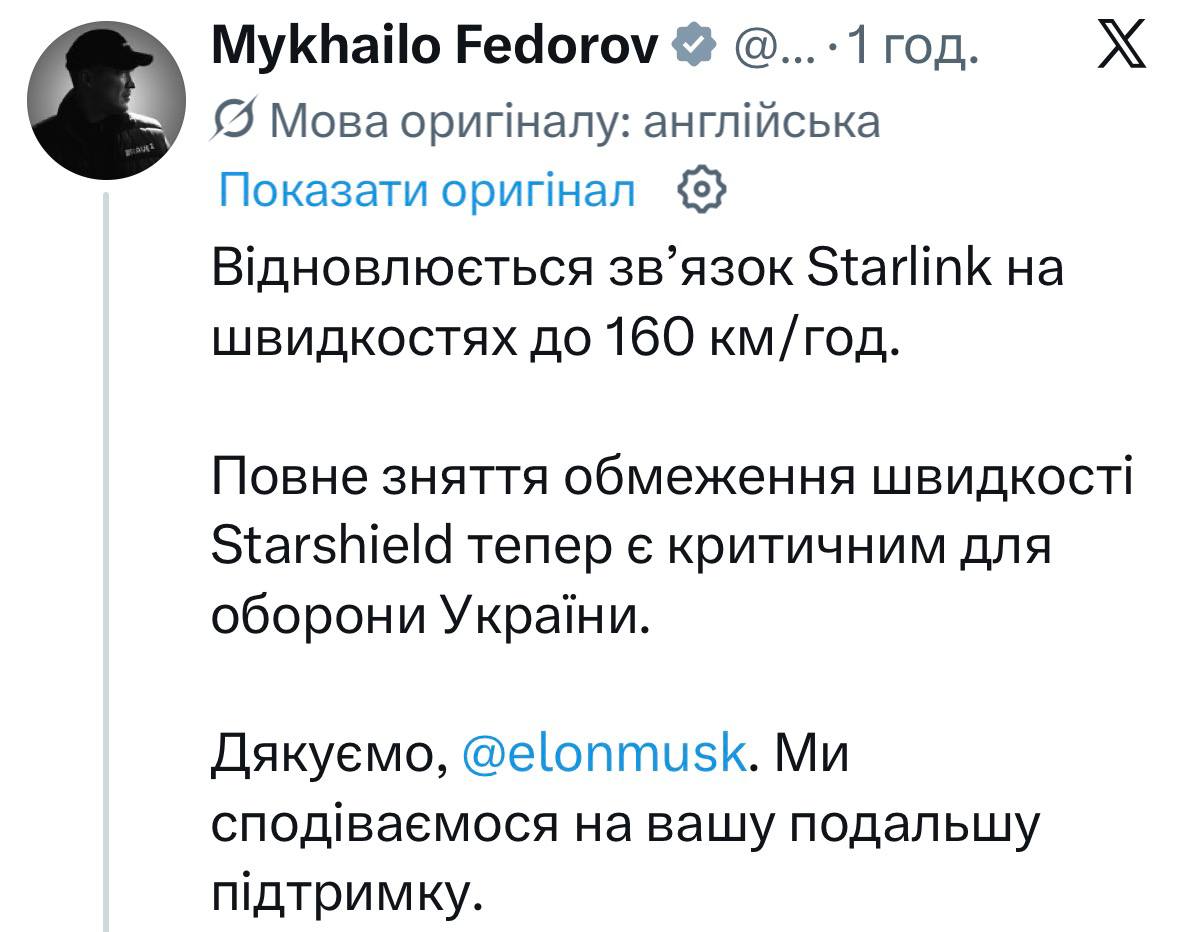
In his post, Fedorov does not claim that all restrictions have already been lifted. He reports that connectivity has been restored at speeds of up to 160 km/h, while separately emphasizing the need to completely remove the Starshield restrictions.
Musk’s Response
In response to the discussion of the situation, Musk explained the difference between Starlink and Starshield. According to him, Starshield is owned and controlled by the U.S. government. Any restrictions on the speed or use of this system are determined by the U.S. military and, ultimately, the U.S. president.
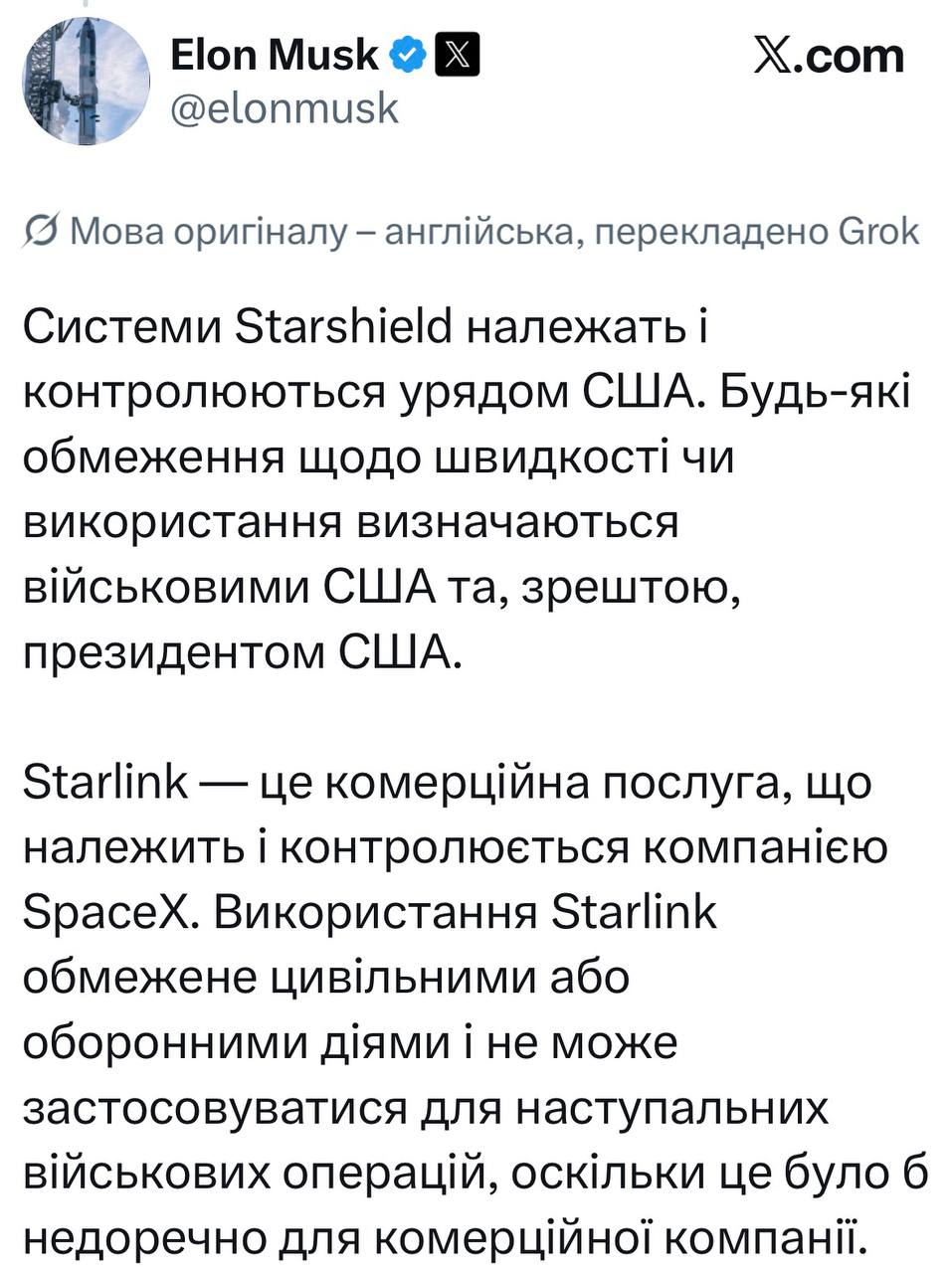
Musk also emphasized that Starlink is a commercial satellite internet service owned and operated by SpaceX. He stated that the service is intended for civilian use and defense missions, and that using it for offensive military operations would be inappropriate for a commercial company.
Starshield is a separate military system. At the same time, Musk’s post does not provide a direct explanation of who made the specific decision regarding the speed restrictions that affected the operation of Ukrainian drones. Therefore, his statement regarding U.S. government control over Starshield should not be interpreted as confirmation that he personally imposed the restrictions on Starlink.
How the restrictions affected the drones’ operations
On the night of October 14, the Ukrainian military reported disruptions in satellite communications while drones were in flight. Serhiy Beskrestnov, known by the call sign “Flash” and appointed as a special advisor to the President of Ukraine on the development of defense technologies, reported that speed limits for military terminals had been set at 100 miles per hour—approximately 161 km/h. According to him, the Ukrainian military did not receive any advance warning of the changes.
The 7th Corps of the Airborne Assault Forces reported that communication with the drones could be lost for 10–20 seconds even while traveling at speeds of 110–120 km/h. These interruptions made it difficult to control the drones, and some missions in the Huliaipole sector had to be canceled.
Reuters also reported on these issues. According to the agency, the limitations complicated the Ukrainian military’s ability to carry out missions using drones. Glavkom provided more details on the consequences of communication disruptions at the front.
Starlink has become a vital communication tool for the Ukrainian military since Russia’s full-scale invasion. The terminals enable data transmission and communication in areas where conventional networks are unavailable or unreliable. As a result, changes in the satellite service’s operation can directly impact the execution of military missions.
This was reported with reference to a post by Musk on the social network X.
Fedorov announced the partial restoration of Starlink for the military.
On the night of October 14, SpaceX imposed speed limits on Starlink terminals for the StarShield military service package. This was reported by electronic warfare specialist Serhiy Flash, who specified that the limit is 100 miles per hour (about 161 km/h). According to Serhiy Sternenko, an activist, volunteer, and former advisor to the Minister of Defense, this disrupted several important missions. However, the speed limit has since been lowered even further, to 60–70 km/h.
In the Huliaipole sector, units of the 7th Corps of the Airborne Assault Forces reported problems with Starlink connectivity on the night of October 14 due to data transmission speed limitations. This affected drone control and led to the cancellation of some combat missions.




