
Putin rejected the proposal to halt attacks on Ukraine's energy infrastructure
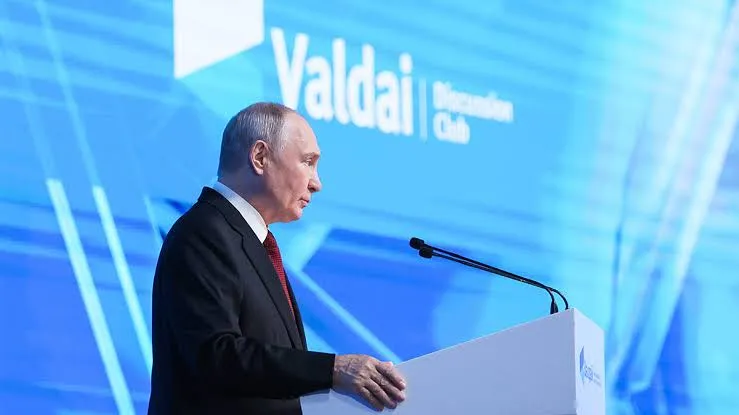
Russian President Vladimir Putin effectively rejected proposals for a mutual cessation of attacks on energy facilities in Russia and Ukraine. He also did not support the idea of halting attacks on ships in the Black Sea in exchange for stopping attacks on Russian oil refineries. During a speech at the Valdai Club, Putin called such a proposal illogical, and when asked directly if that meant “no,” he replied, “Yes, no.”
On October 1, Vladimir Putin effectively rejected the proposed options for a partial ceasefire between Russia and Ukraine. These involve two separate initiatives—ceasing strikes on energy infrastructure and restoring safe navigation in the Black Sea. The Russian president spoke about this during a plenary session of the Valdai International Discussion Club. He was asked about a proposal under which Ukraine could cease strikes on Russian oil refineries, while Russia would halt attacks on Ukrainian ships and energy facilities.
Putin stated that he sees no point in such an agreement. He explained his position by saying that even if strikes on Russian refineries were halted, Russian petroleum products would allegedly still be unable to reach the global market normally due to Western sanctions.
“They’re telling us, [that] they’ll stop striking your refineries, and you’ll stop striking their ships—let them transport civilian cargo and agricultural products. But what about our other civilian cargo, such as oil and petroleum products? Once they stop the strikes, there will be more diesel—which is so badly needed, say, in the United States. We’ll have more of it. We already have enough diesel, but it won’t reach world markets because of the bans and sanctions against our oil and petroleum products… And in response, we’ll have to stop striking targets that are economically sensitive to them. “You have to admit, it just looks ridiculous,” Putin said at a plenary session of the Valdai Club.
Thus, the Russian president linked the issue of halting strikes to sanctions against Russian oil and petroleum products. According to him, Russia would not be able to fully sell its products on global markets even if Ukraine stopped striking oil refineries.
After that, journalist Vladimir Lukyanov asked whether Putin’s position meant that Russia’s current response to a proposal for such restrictions on strikes was “no.” “So, regarding what’s currently being discussed behind the scenes, as you put it, is the answer now ‘no’?” Lukyanov asked. Putin replied briefly: “Yes, no.” This response effectively confirmed that Moscow currently does not agree to the proposed format of mutual restrictions on strikes. At the same time, Putin stated that the issue could be discussed if it were based on mutual interests.
What the proposal for an energy truce entailed
The idea of a mutual cessation of attacks on energy infrastructure was discussed throughout September. On September 22, following a meeting with U.S. President Donald Trump in New York, Volodymyr Zelenskyy stated that Ukraine was ready to cease strikes on Russian oil refineries and other energy facilities if Russia also stopped its attacks on Ukrainian energy infrastructure. “We talked about how to end the war: we’re ready for that. I’m not sure Russia is ready for that. We talked about an energy ceasefire. We’re ready for it. Of course, we are ready to stop strikes on their oil refineries and energy infrastructure if they stop striking ours,” Zelenskyy said.
The Ukrainian president clarified that this specifically refers to a mutual agreement. According to him, the U.S. was supposed to convey this proposal to the Russian side. At the same time, Zelenskyy emphasized that the U.S. did not ask Ukraine to unilaterally cease strikes on Russian energy facilities. The discussion centered specifically on a bilateral ceasefire, which Russia would also have to observe.
What’s Happening with Shipping in the Black Sea
The second proposal concerned the safety of shipping and exports through the Black Sea. It involved the possibility of halting attacks on civilian vessels and creating conditions for more stable transportation of Ukrainian agricultural products. By the end of September, no agreement on such a ceasefire had been reached. On September 28, Ukraine’s Minister of Agrarian Policy and Food, Taras Vysotsky, told Bloomberg that Russia had rejected all proposals made by Ukraine’s partners. According to him, there were no positive signs regarding a swift ceasefire in the Black Sea. “Unfortunately, it is difficult to imagine any positive solutions to this issue in the coming months,” Vysotsky said.
According to the minister, Ukraine had no direct contact with Russia on this issue. Kyiv received information about Moscow’s position through the countries that were involved in the attempts to reach an agreement. Vysotsky also noted that partners had already tried various negotiation options, but none of them had yielded results. Therefore, Ukraine did not expect a quick resumption of agreements on safe navigation and grain exports through the Black Sea.
What Putin Said Earlier
As early as September 25, Putin spoke about proposals that, according to him, had come from Ukraine. At that time, he mentioned a cessation of strikes on Russian oil refineries, a mutual cessation of airstrikes, and an end to Russian actions blocking Ukraine’s Black Sea coast. However, he did not give a direct response to these proposals at that time. On October 1, during a speech at the Valdai Forum, his position became clearer.
Putin also stated that Ukrainian strikes on Russian oil refineries had damaged the Russian economy. According to his estimate, the losses amounted to about 1% of Russia’s GDP. This is his own estimate, which cannot be independently verified based on the data provided. Thus, as of October 1, Russia had not agreed to the proposed format of a mutual cessation of strikes on energy infrastructure and ships. Putin gave a direct “yes” or “no” answer to the question of whether his position amounted to a rejection of such proposals.
Russian President Vladimir Putin was unable to name a specific reason why Moscow transferred Russian assets of the Swiss company Nestlé to temporary administration. In response to a question from a Swiss journalist, he said that Russia was allegedly “not punishing anyone,” but merely responding to the actions of other countries. At the same time, the Kremlin had previously explained the decision regarding Nestlé by citing the company’s affiliation with a so-called “unfriendly country.”




