
In Russia, 12,000 workers from North Korea were enlisted to work on the production of "Shaheds"
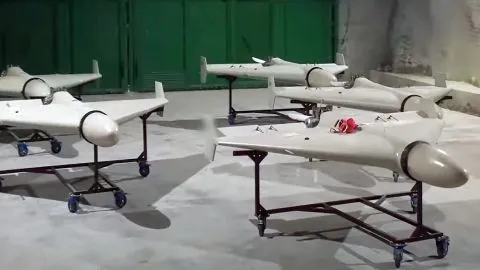
In the Russian “Alabuga” Special Economic Zone, approximately 12,000 workers from North Korea have been enlisted to produce combat drones, including the “Shahed” model. According to a report by researchers from the Center for Strategic and International Studies (CSIS) and the George W. Bush Institute, the North Korean government takes a significant portion of their earnings, and working conditions may indicate serious human rights violations. The authors also warn of possible signs of human trafficking at the facility.
The recruitment of workers from North Korea and possible violations of their rights are discussed in the report “Human Rights Abuses in Drone Production at Yelabuga.” It was published on October 14, 2026, by the Center for Strategic and International Studies (CSIS) and the George W. Bush Institute.
According to the authors, the Russian “Alabuga” Special Economic Zone in Tatarstan manufactures Iranian-designed “Shahed”-type drones, which Russia is using in the war against Ukraine. The researchers claim that the facility has become a site of serious labor rights violations and possible cases of human trafficking.
The report notes that approximately 12,000 North Korean citizens work at the facility. The authors attribute this data to information from Ukrainian intelligence services. According to the report, North Koreans are paid about $2.50 per hour. At the same time, the researchers claim that the North Korean government confiscates between 70% and 90% of their earnings. As a result, workers cannot freely dispose of a significant portion of the money they earn.
The authors describe this system as the exploitation of people under conditions akin to forced labor. However, the figures and estimates provided are the report’s conclusions and should not be confused with independently verified data for each individual worker.
Who Is Helping Russia Produce Combat Drones
Researchers view “Alabuga” not only as a Russian factory but also as a platform for cooperation among several countries. They use the acronym CRINK—an abbreviation of the English names for China, Russia, Iran, and North Korea. According to the authors’ findings, each of these countries plays a distinct role in drone production:
Russia provides territory and manufacturing capacity in Tatarstan.
Iran has transferred the technology for the Shahed-136 drone, which serves as the basis for Russian drones.
China, according to the report, supplies dual-use components—including batteries, electronics, motors, and navigation systems.
North Korea provides the factory with labor.
The authors believe that this cooperation enables Russia to ramp up production of the drones needed for the war against Ukraine. At the same time, the exchange of technology, components, and labor strengthens the interdependence among the four countries.
How Many Drones Are Planned to Be Produced
According to data cited in the original article, Alabuz plans to manufacture approximately 60,000 combat drones and another 50,000 decoy drones in 2026. Decoy drones are used, in particular, to distract Ukrainian air defenses and deplete their resources. They can force the military to spend time and resources detecting and intercepting targets that do not necessarily carry a warhead.
Such production volumes indicate Russia’s desire to increase the number of drones it can deploy during the war. However, the planned figures do not mean that all these drones have already been manufactured or delivered to the troops.
Young people from other countries are also being recruited for the work
The report does not focus solely on North Korean citizens. According to the researchers, the facility also employs Russians and foreigners from Latin America, Africa, and Asia. The authors pay particular attention to young women between the ages of 16 and 22. As noted in the report, some of them may have been lured into the work with promises of an education or a safe job in the service sector.
After moving to Tatarstan, people may find themselves working in a factory without the conditions they had expected. Researchers believe that such recruitment methods, if accompanied by deception, coercion, or exploitation, may constitute human trafficking. At the same time, the mere fact that foreigners are employed at the factory does not constitute proof of human trafficking. To make such an assessment, it is important to establish the circumstances of recruitment, working conditions, the ability to freely leave the job, and other details highlighted by the report’s authors.
Why Researchers Cite Human Rights Violations
The report focuses not only on weapons production but also on the conditions under which the company obtains its workforce. The authors emphasize that North Korean workers’ dependence on their own government and the confiscation of a significant portion of their earnings may indicate systemic exploitation.
The researchers also link the cooperation between Russia, China, Iran, and North Korea to shared strategic interests. In their view, these states are increasingly supporting one another in the areas of security, technology, and military production. As noted in the report, this poses challenges for the United States and the international order based on international law.
Overall, the authors urge attention not only to where Russia sources components for its drones but also to the cost at which their production is carried out. According to their findings, the situation at “Alabuga” demonstrates how Russia’s military needs can be combined with the exploitation of foreign workers and the violation of their rights. This is reported in the Human Rights report.
Ukrainian President Volodymyr Zelenskyy commented on a possible conversation between the leaders of the U.S., China, and Russia that would exclude Kyiv. According to him, the process of Vladimir Putin emerging from international isolation has already begun.




