
Venus may have swallowed a moon due to slow rotation — Cyprus Mail
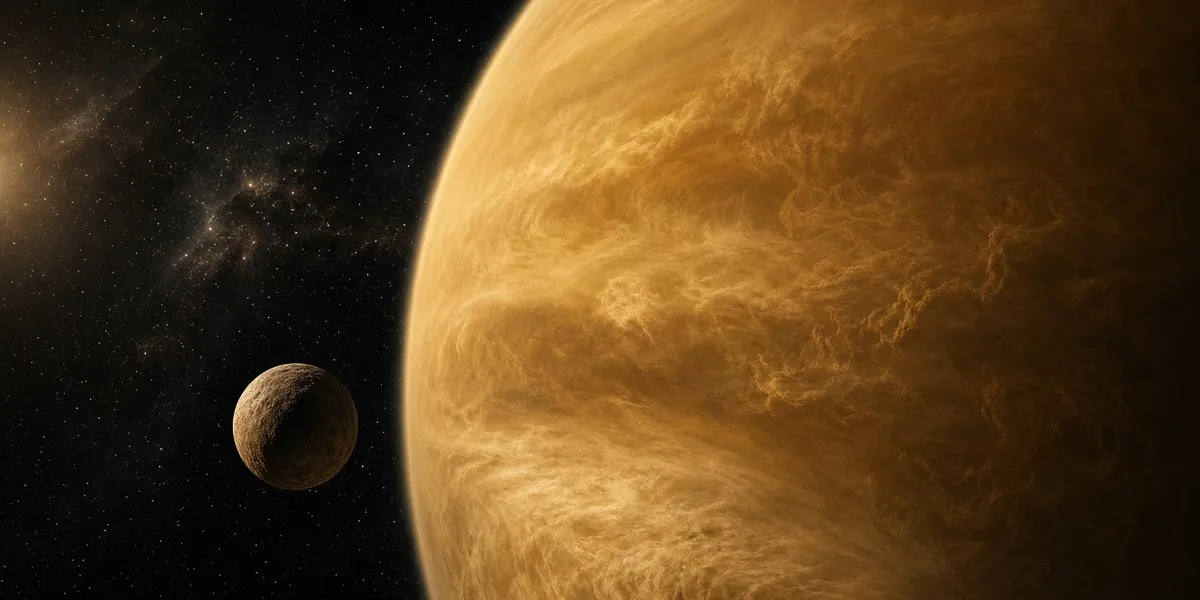
Scientists at the University of California, Riverside, in the United States, have suggested that Venus may have lost its natural satellite because of its extremely slow rotation around its axis. Under this hypothesis, the satellite would have gradually moved closer to the planet and eventually collided with it. Cyprus Mail reports on the study published in The Astrophysical Journal.
Models predict a satellite’s fall
The study’s lead author, astrophysicist Stephen Crane, said that computer models accounted for planetary physics and the gravitational interaction of hypothetical Venusian satellites of varying sizes. In all scenarios considered, the satellites would sooner or later have fallen onto the planet.
According to Crane’s estimate, the likely collision could have occurred within the first billion years of Venus’s history. At the same time, scientists have no evidence that Venus actually had a satellite. Earlier explanations for its absence included the possibility that the planet never had a satellite or that it was destroyed during a major collision with another celestial body.
More current news is available on the UA.News Telegram channel Telegram.
Difference from the Earth–Moon system
The researchers identified the planet’s rotation speed as the key factor. Venus completes one rotation around its axis in 243 Earth days, which is slightly longer than its orbit around the Sun. Earth, meanwhile, rotates in about 24 hours, meaning it rotates more than 200 times faster.
The energy of Earth’s rapid rotation gradually moves the Moon away from our planet: it recedes by about 4 centimetres each year. This is measured using mirrors that Apollo 11 astronauts left on the Moon’s surface in 1969. For Venus, the modelling concluded, slow rotation would have had the opposite effect on a possible satellite.
NASA plans to launch the DAVINCI+ and VERITAS missions in the late 2020s or early 2030s to study Venus’s atmosphere and geological features.




