
Israeli drone strikes roundabout in Kfar Tebnit — Asharq Al-Awsat
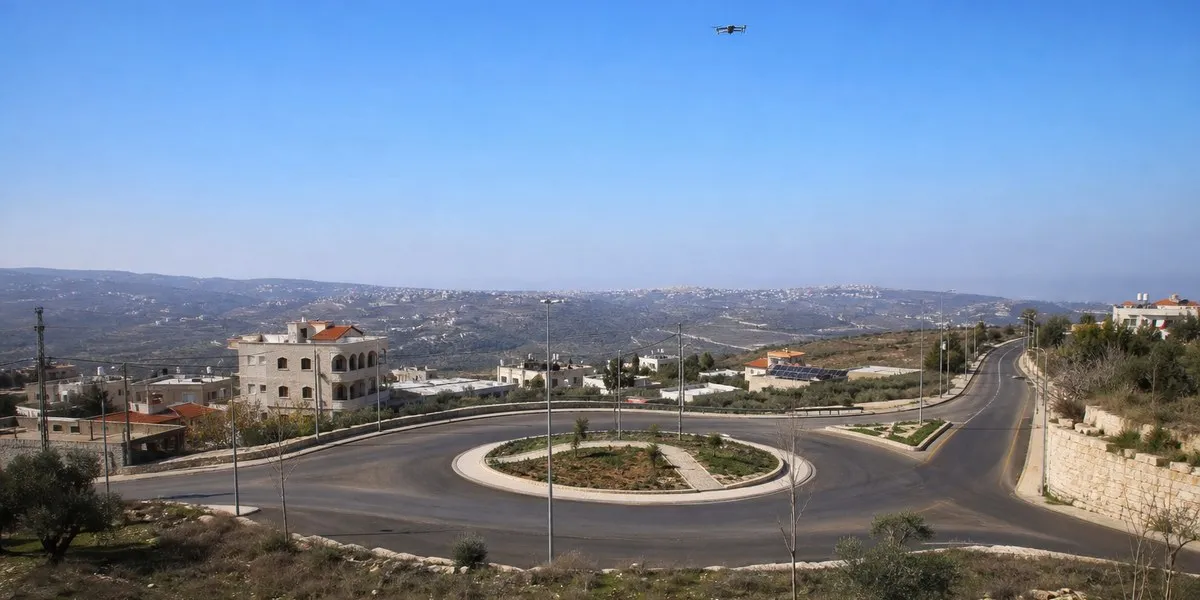
An Israeli drone struck a roundabout in Kfar Tebnit, in the Nabatieh district of southern Lebanon. According to preliminary reports, there may have been casualties as a result of the strike, Asharq Al-Awsat reports.
At the same time, Israeli forces carried out two detonations: on the outskirts of Kfar Tebnit and in Mansouri, in the Tyre district. Israeli forces also set fire to forested areas in Qantara and fired machine guns at Wadi al-Hujeir. Near Kfar Shouba, a drone dropped a stun grenade, while drones flying at low altitude were reportedly seen over Beirut's southern suburbs, Tyre and adjacent areas.
Control through positions and firepower
Israeli Defense Minister Israel Katz has repeatedly mentioned an area of approximately 700 square kilometers in the context of Israeli control in southern Lebanon. Defense and security expert Riad Kahwaji told Asharq Al-Awsat that this territory is not a continuous strip of the same depth along the border. According to him, in some places the control zone extends north of the Litani River, due to terrain features and distances.
More current news is available on the UA.News Telegram channel Telegram.
Kahwaji estimated the number of Israeli military positions at around 20; each of them can accommodate a unit of up to company size. In his assessment, drones constantly monitor movement in the interior, and identified targets may be attacked by artillery or from the air. The expert stressed that the ability to conduct surveillance, carry out strikes or send patrols does not mean a permanent physical military presence throughout the entire area.
Heights and possible expansion of operations
According to the publication, Israeli operations covered the Naqoura area on the coast, as well as settlements in the central sector, including Beit Yahoun, Haddatha, Haris and Aita al-Jabal. Their zone also extends toward Beaufort Castle and the Ali al-Taher heights, which overlook the Nabatieh, Iqlim al-Tuffah and movement-route areas.
Retired Brigadier General Fadi Daoud suggested that a further expansion of Israeli operations could reach the Awali River or the heights controlling it. He linked the possibility of such an advance to control over the Rihan, Iqlim al-Tuffah and Jabal Safi heights. According to Daoud's assessment, positioning forces on the heights makes it possible to control lower areas with firepower without permanently stationing troops in every settlement.




