
China tests airborne wind energy system reaching up to 4 km — ECNS
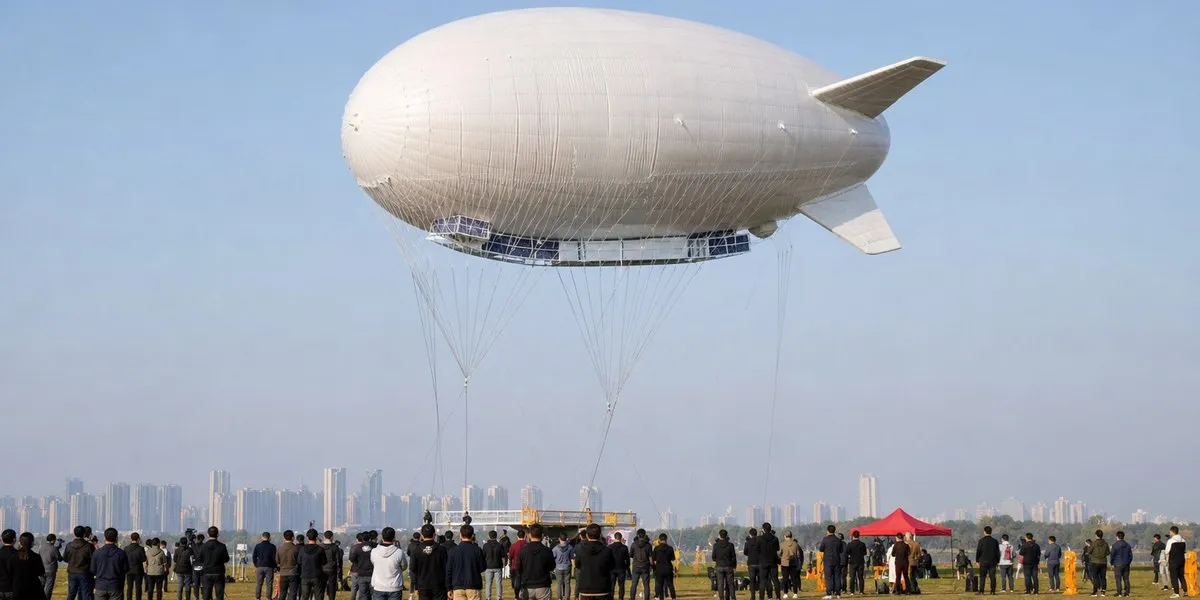
In Yueyang, in China’s Hunan Province, a test flight of an airborne wind energy generation system with a maximum operating altitude of 4,000 meters has been completed. This was the installation’s first test in urban conditions, ECNS reports.
A platform with helium and generators
The Stratosphere Airborne Wind Energy System was developed by Beijing SAWES TO ONE Technology. According to the developer, it is 67 meters long, 40 meters wide and 23 meters high. The system’s output voltage ranges from 10 to 35 kilovolts, and its stated service life is 20 years.
The installation uses a helium-filled airborne platform that lifts lightweight generation modules several kilometers into the air. It is designed to use stable high-altitude winds, while the electricity generated is planned to be transmitted to the ground through tether cables.
More current news is available on the UA.News Telegram channel Telegram.
Testing operation in a city
During the launch in Yueyang, the stability of the platform’s control under complex airflows was tested, as were its characteristics under conditions of a complex magnetic field. The company’s founder and CEO, Dun Tianrui, said the urban test was intended to assess the safety and reliability of the system’s operation near residential areas and crowds.
According to the developer, the system is being designed for direct connection to cities’ main power grids. It is also being considered as a possible source of electricity for remote mountainous areas, islands, mining areas and industrial parks where access to electricity is limited or its cost is high.
Cai Rong, a researcher at the Aerospace Information Research Institute of the Chinese Academy of Sciences, noted that the urban test assessed the reliability of the entire airborne system, its ability to be rapidly deployed on site, and the feasibility of engineering implementation in real conditions near cities.




