
ETH Zurich creates quantum memory based on mechanical vibrations — ScienceDaily
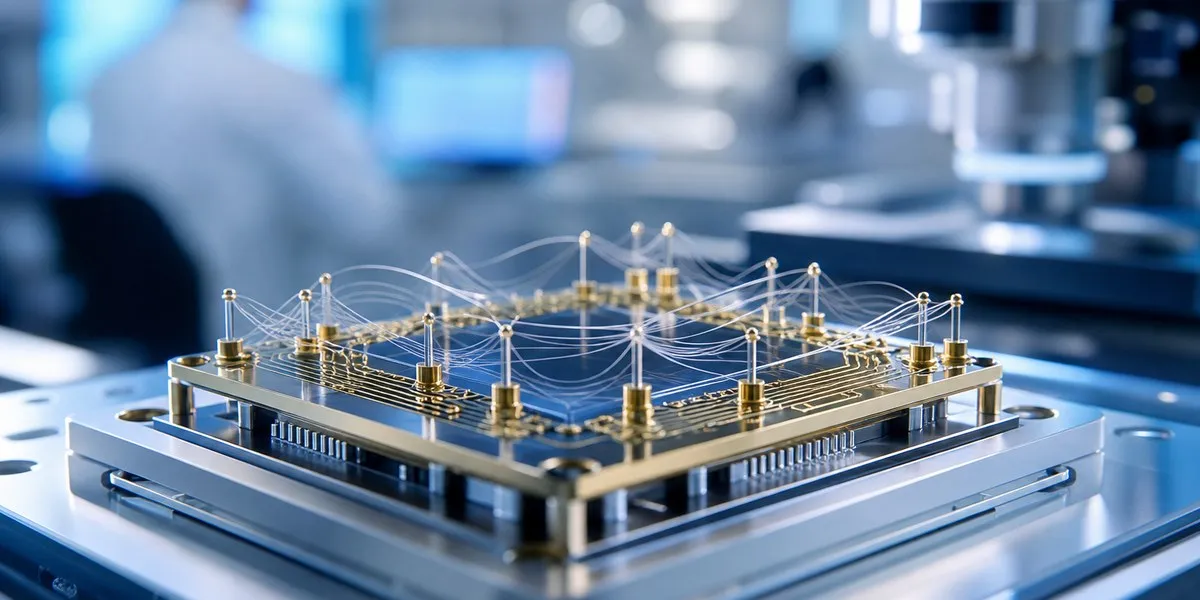
Researchers at ETH Zurich have demonstrated a quantum computer architecture in which working memory stores information in the form of microscopic mechanical vibrations. In the system, a superconducting qubit serves as the processor and control unit, while mechanical resonators temporarily hold quantum states for subsequent calculations, ScienceDaily reports.
Memory in oscillations
The team led by physicist Yiweng Chu compares the operating principle of such memory to guitar strings, although the vibrations in the chip occur at frequencies inaccessible to human hearing. Information in this system is stored not electromagnetically, but in specific modes of mechanical oscillation.
When the superconducting qubit needs data, it accesses the stored vibrational state, performs an operation, and returns the modified information to memory. This division of functions resembles a conventional computer, in which the central processor performs calculations while random-access memory separately stores the data needed for them.
More current news is available on the UA.News Telegram channel Telegram.
Testing quantum operations
The authors of the study, published in the journal Science, tested the system using the quantum Fourier transform and a period-finding algorithm. These procedures require precise control of several quantum states and the preservation of coherent connections between them.
The experiments showed that mechanical resonators together with a superconducting qubit can perform quantum computations rather than merely store information. According to the researchers’ assessment, this architecture is in principle capable of implementing the basic operations required for arbitrary quantum computations.
Mechanical resonators can be more compact than electromagnetic memory systems and support many different vibration modes. They can also potentially preserve quantum states for longer. The team’s next task is to scale up the technology while maintaining accuracy and operational reliability.




