
Rystad: Trump order could hit battery supplies for data centers — OilPrice
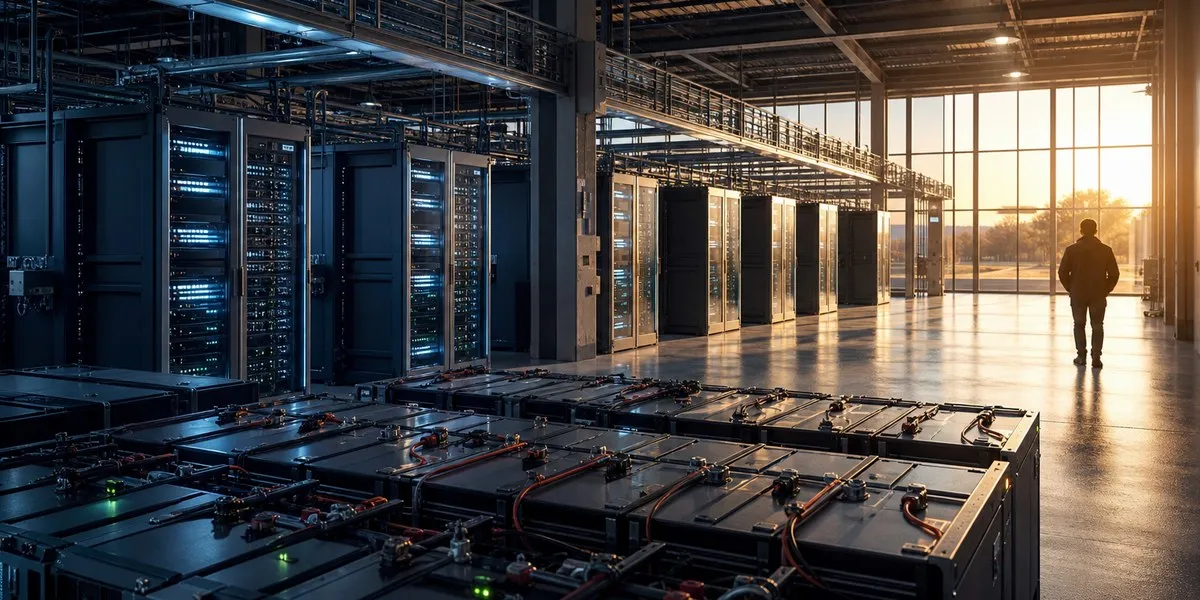
In the United States, President Donald Trump’s executive order on protecting the power grid from Chinese-made equipment could primarily complicate supplies of energy storage systems needed for the development of data centers and artificial intelligence infrastructure. This is stated in an analysis by Rystad Energy published by OilPrice.
Executive Order No. 14421, signed on August 26, 2026, applies to substation transformers, grid inverters, battery energy storage systems, high-voltage circuit breakers, and generator turbines. The document explicitly names the growth of data centers and artificial intelligence as a factor making supply-chain disruptions capable of having national security implications.
Dependence on Chinese batteries
According to Rystad Energy, China accounted for 50% of the value of U.S. lithium-ion battery imports in the 12 months through June 2026. South Korea had a 15% share and Japan 13%, but no alternative supplier can replace Chinese volumes at the required scale.
Jeffrey Gebertson, a senior analyst for renewables and power at Rystad Energy, said the supply-chain risk concerns batteries most of all. Meanwhile, U.S. dependence on Chinese transformers and high-voltage circuit breakers has already declined significantly.
More current news is available on the UA.News Telegram channel Telegram.
Lower dependence on other equipment
China accounted for only 3% of the value of U.S. transformer imports and less than 1% of high-voltage circuit breaker imports in the 12 months through June 2026. The combined share of South Korea, Mexico, and Canada was 74% for circuit breakers and 48% for transformers.
At the same time, the declared value of Chinese inverter exports to the United States fell by 34% in 2022–2025. Rystad Energy links this to the U.S. 45X manufacturing tax credit, which encouraged the relocation of inverter assembly to the country. U.S. inverter manufacturing capacity is expected to reach 126 GW by 2028, according to analysts’ estimates.
A key stage will be the drafting of rules, which must be completed by December 24, 2026. According to Rystad Energy, whether restrictions extend to manufacturers in South Korea and Mexico that use China-controlled components or capital may depend on how broadly the U.S. Department of Energy defines the term Covered Foreign Entity.




