
Hera spacecraft sees asteroid Dimorphos separately for the first time — Space.com
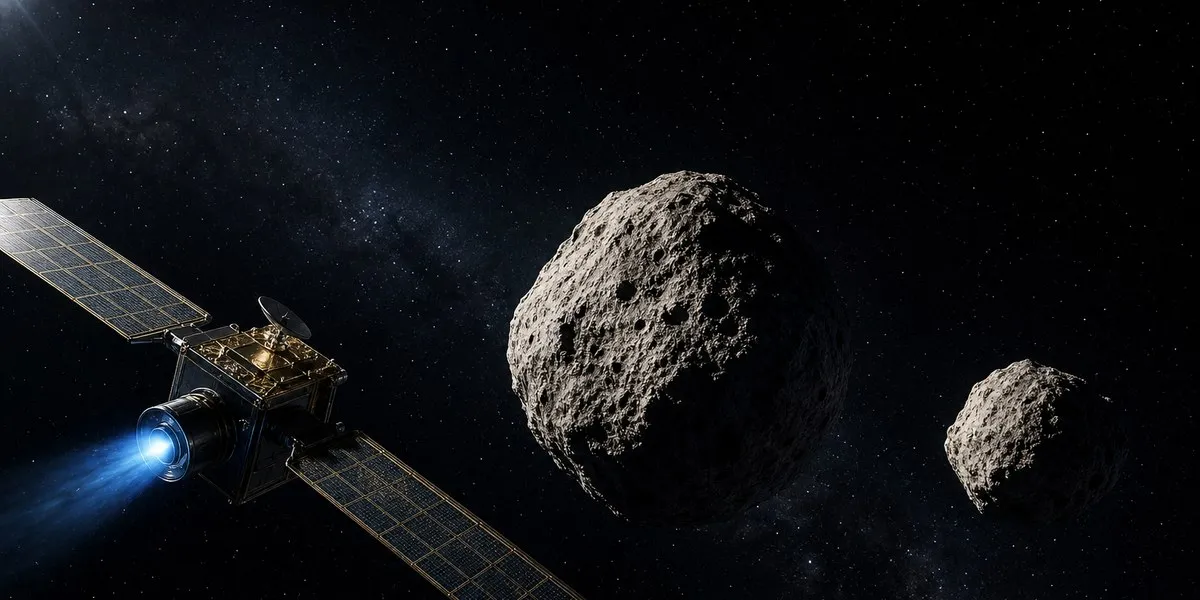
The European Hera spacecraft, which is heading to the binary asteroid system Didymos and Dimorphos, has for the first time been able to distinguish both celestial bodies separately in an image. The photo was taken on October 18 from a distance of 1,280 kilometers from the asteroids, which at that time were approximately 197 million kilometers from Earth.
Dimorphos is visible separately from Didymos
In the first image, the smaller asteroid Dimorphos occupies only about one pixel, but is already clearly separated from the larger Didymos. Previously, the spacecraft recorded the system as a single point of light. This was reported by Space.com, citing the European Space Agency.
Hera project scientist at ESA Michael Küppers noted that Dimorphos became visible for the first time in this particular image. According to him, although the asteroid is about one pixel in size in the frame, it is well separated from its parent body.
More current news is available on the UA.News Telegram channel Telegram.
The mission will study the consequences of the DART impact
Hera is nearing the end of its journey to the Didymos system. The spacecraft was launched by a SpaceX Falcon 9 rocket in October 2024. In early October, it carried out braking maneuvers to slow its approach and enter a trajectory for a rendezvous with the asteroids.
In September 2022, NASA's DART spacecraft collided with Dimorphos as part of a planetary defense technology demonstration and changed its orbit. Hera's task is to study the consequences of this impact and refine data about the asteroids themselves.
The spacecraft has 12 payloads for further observations. The mission also carries two CubeSats, which are to conduct closer studies and eventually land on Dimorphos, which is about 151 meters across. ESA mission manager Ian Carnelli said that the first detailed images of Dimorphos are planned to be presented on November 25.




