
White dwarf WD J1330+6435 may be the first known green star — Space.com
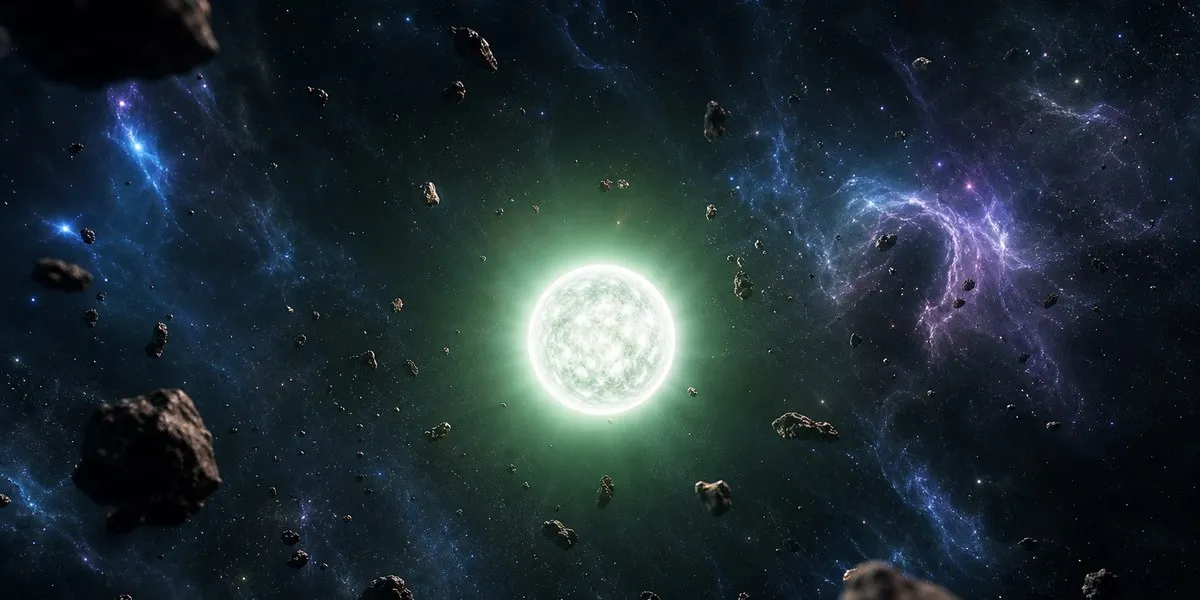
Astronomers have determined that the white dwarf WD J1330+6435 may be the first known star with a green hue. This cool stellar remnant is located about 326 light-years from Earth and is accumulating rocky material from a planetary companion, Space.com reports.
How the green hue arises
According to the researchers, the material absorbed by WD J1330+6435 enriched its atmosphere with calcium, lithium and sodium. The team’s model showed that traces of sodium absorb the orange part of the spectrum, which is why the star may appear green.
White dwarfs form when stars of approximately solar mass exhaust their fuel and can no longer resist their own gravity. Their extremely high density allows elements such as carbon, calcium and sodium to interact with dense helium plasma and absorb light differently than at lower density.
More current news is available on the UA.News Telegram channel Telegram.
Not only white and blue
The research team concluded that the color of white dwarfs depends not only on temperature but also on the chemical composition of their atmospheres. White dwarfs with large amounts of carbon may appear pink or purple. Objects whose atmospheres are enriched with debris from asteroids, comets and ancient planetary systems may be yellowish.
Cool white dwarfs with mixed hydrogen and helium atmospheres can glow blue or cyan: this effect occurs when hydrogen molecules collide with helium atoms. Separately, the team studied WD J1011+2845, located 48 light-years from Earth. Convection brings carbon from its core to the surface, while carbon molecules give the object a rich salmon-pink hue.
Unusual coloration is rare, according to the scientists: among 151 white dwarfs within about 65 light-years of Earth, only five had atypical colors. Extrapolating these data, the team suggested that about one in 30 white dwarfs may have an unusual hue. The results were published in the journal RAS Techniques and Instruments.




