
Fire Point Has Learned to Operate Without Starlink During Attacks on Russia — Reuters
Ukrainian weapons manufacturer Fire Point has stated that its systems can carry out combat missions without Starlink satellite communication. The company has developed technological solutions that allow the weapons to navigate without an external signal and continue flying toward their targets. At the same time, full access to Starlink over Russian territory could significantly expand the capabilities of Ukrainian strikes.
Fire Point CEO Iryna Terekh discussed this in an interview with Reuters on October 30. According to her, the company anticipated the possibility of satellite communication disruptions, so its systems can complete their missions even without a connection to Starlink. SpaceX’s satellite communications play a crucial role in the operations of the Ukrainian Armed Forces. They are used for communication between military units, drone control, and the execution of combat missions. At the same time, Starlink’s capabilities over Russian territory are limited, creating additional challenges for long-range operations.
According to Reuters, in early October, Ukraine faced speed limitations with Starlink for approximately ten days. This affected both missions to defend against Russian drones and operations to engage targets.
Iryna Terekh explained that Fire Point developed its systems with these limitations in mind. One of the company’s main areas of focus is navigation that does not rely on an external signal. “We designed our systems with this in mind. Fire Point’s systems are designed to complete missions without satellite communication. Navigation that works without any external signal is a priority,” she said.
At the same time, Terekh did not disclose technical details on exactly how the company managed to circumvent the problem. She noted that the current solutions allow for only a fraction of the tasks that would be possible if Starlink were fully operational over Russia. “We’ve found a way to technologically overcome this problem, but it likely covers only 15–20% of what we could do if Starlink were operating over Russia,” explained the head of Fire Point.
According to her, full access to SpaceX’s satellite systems over Russian territory could significantly expand Ukraine’s long-range strike capabilities. In particular, this would help target Russian ballistic missile launchers.
Terekh also called for more predictable cooperation with the United States in the areas of technology and defense. She emphasized that Ukraine needs to understand the rules for using such systems in advance, rather than facing new restrictions every few weeks. “We want an alliance with America where the rules are known in advance, so that the question of whether we can defend ourselves doesn’t come up again every few weeks depending on someone’s mood,” Terekh said.
New Fire Point Missiles
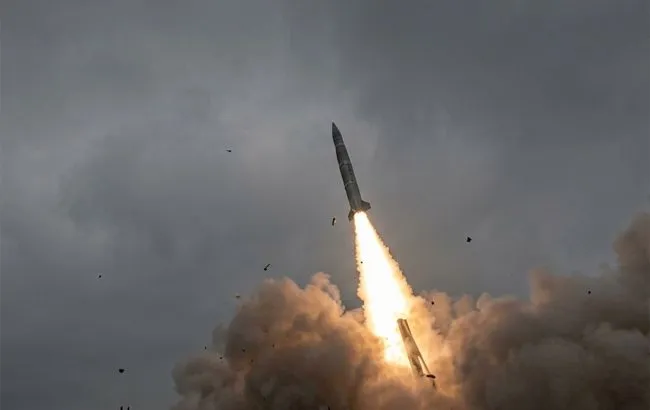
In addition to working on navigation systems, Fire Point is developing its own line of missiles. This month, Ukraine reported the first combat use of the FP-7 tactical ballistic missile, which was developed by the company. According to available information, it was used to strike a target in the temporarily occupied territory of Ukraine. According to Iryna Terekh, the FP-7 has a range of about 300 kilometers. In particular, the missile can be used to strike Russian launchers of “Iskander” short-range ballistic missiles.
The company’s CEO described the FP-7 as a potential addition to Ukraine’s arsenal of weapons. She also highlighted the cost of such missiles. According to her, using them could be more cost-effective than deploying American Patriot interceptor missiles. “Our new FP-7 missile could, among other things, be a valuable addition to the arsenal of weapons that help defend our cities,” Terekh said.
This is important given the cost of air defense. Patriot missiles are designed to intercept complex aerial targets, including ballistic missiles. Using less expensive systems where conditions permit could help conserve expensive interceptors for the most challenging threats. However, Terekh did not provide specific details about the cost of the FP-7 or the results of its combat use in her statement.
Fire Point is developing the FP-9 missile
Another of the company’s projects is the FP-9 ballistic missile. Its stated range is approximately 800 kilometers. This is a significantly more complex project than the FP-7, and, according to Terekh, such a range poses additional challenges during the missile’s development and testing.
Despite this, the head of Fire Point believes that the FP-9 could be close to operational readiness by the end of 2026. However, this is currently just her assessment: the company has not announced the completion of all tests or the official adoption of the missile into service.
Fire Point Is Working on European Missile Defense
Another area of the company’s work is the Freyja project. Its goal is to create a pan-European missile defense system, and Fire Point is involved in coordinating this effort. According to Terekh, the project is proceeding according to plan. By the end of 2026, the team expects to conduct tests involving the interception of a virtual target using the missile system. The next stage will involve intercepting an actual physical target, which is scheduled for mid-2027.
Thus, Fire Point is working on several fronts simultaneously: developing navigation that does not rely on satellite communications, testing its own missiles, and participating in the creation of a European missile defense system. At the same time, statements regarding the capabilities of these developments and the planned launch dates are currently based solely on the company’s CEO’s statements, according to Reuters.
The Ukrainian Armed Forces struck the Novokuybyshevsk oil refinery in the Samara region of the Russian Federation using FP-1 long-range kamikaze drones. This was reported on October 30 by Fire Point, the company that develops and manufactures these drones.
On the night of September 11, Ukrainian FP-5 “Flamingo” missiles struck the Volgogradpromproekt facility in Volgograd, Russia. A fire broke out on the premises following the strike.




