
Law enforcement officials are investigating how former prosecutor Dmytro Verbytskyi earned his Ph.D.
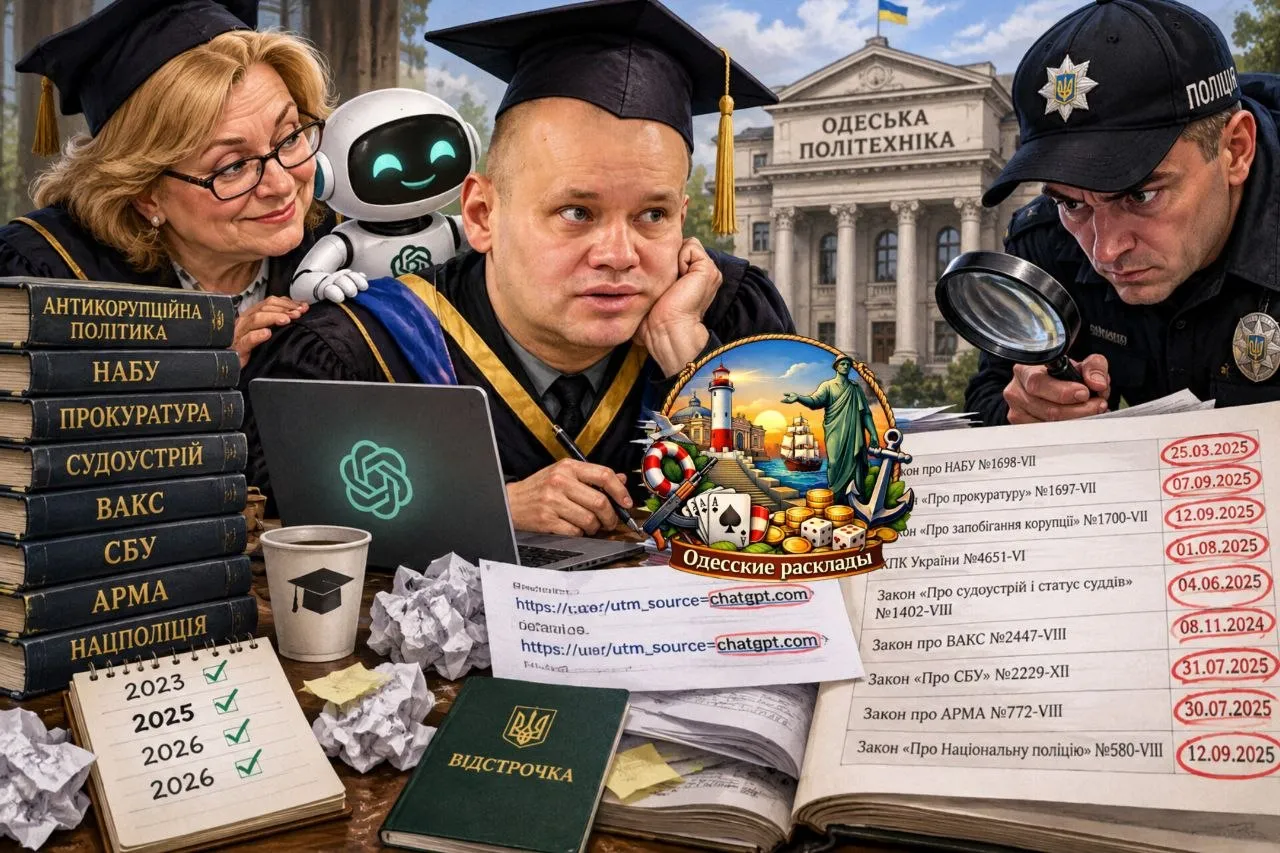
It has been reported that on July 17, 2026, Dmytro Verbytskyi, the former Deputy Prosecutor General of Ukraine who is notorious for his undeclared assets, successfully defended his dissertation. The Specialized Council of Odessa Polytechnic University, where Verbytsky has been pursuing his doctoral studies for several years, decided to award him a Doctor of Philosophy (PhD) degree. Now, law enforcement agencies have taken an interest in the new PhD.
The
topic allegedly researched by the controversial prosecutor concerns Ukraine’s anti-corruption policy and the mechanisms for its implementation. Professor Lidiya Karpenko served as his academic advisor.
To confirm his academic degree, Verbytskyi had to fulfill certain formal requirements by publishing several articles in academic journals. Verbytsky persistently published them: one came out in 2023, one in 2025, and two at once in 2026, shortly before his dissertation defense.
The first article is a collaborative work by four authors. The second is also a collaborative work, co-authored with his academic advisor, Professor Lidiya Karpenko. And in 2026, two individual works by Dmytro Anatoliyovych were published.
Verbytsky’s Dissertations
The former prosecutor’s
scientific work spans 261 pages. In the official PDF from Odesa Polytechnic University, the bibliography contains at least two references with the ChatGPT domain. This suggests that part of the “scientific work” was generated using artificial intelligence.
One reference with a “ChatGPT tail” leads to material from the National Agency for Corruption Prevention (NAZK), while the second leads to a monograph from Dnipropetrovsk State University of Internal Affairs.
And it gets even more interesting. The dissertation on anti-corruption policy turned out to contain a whole string of strange dates for Ukrainian laws. For example, Law No. 1698-VII on the National Anti-Corruption Bureau of Ukraine (NABU) is listed in Verbytskyi’s table as a law dated March 25, 2025, although it was actually adopted on October 14, 2014.
Similar anomalies were found with the dates of laws concerning the Prosecutor General’s Office, corruption prevention, the judicial system, the High Anti-Corruption Court, the Security Service of Ukraine, the Asset Recovery and Management Agency, the National Police, and the Criminal Procedure Code. For example:
- Law No. 1697-VII on the Prosecutor’s Office – September 7, 2025, instead of October 14, 2014.
- Law on the National Police No. 580-VIII – September 12, 2025, instead of July 2, 2015.
- Law on the Security Service of Ukraine No. 2229-XII – July 31, 2025, instead of March 25, 1992.
Despite explicit references to ChatGPT, and the incorrect dates cited when referring to the laws—this did not prevent Verbytskyi from successfully defending his dissertation before the specialized council at Odesa Polytechnic University, which decided to award him the degree of Doctor of Philosophy.
Law enforcement agencies
Students and veterans who appealed to Education Ombudsman Olena Gorbach expressed a
different opinion. She forwarded the materials she had uncovered regarding the circumstances of Verbytskyi’s graduate studies to the National Police for investigation.
In particular, the appeals raise the issue of the possible use of the doctoral program to obtain a deferment.
It should be noted that former Deputy Prosecutor General of Ukraine Dmytro Verbytskyi is among students aged 25 and older. He is reportedly enrolled in a full-time graduate program at the National University “Odessa Polytechnic,” which officially entitles him to a deferment from mobilization.
The Ministry of Education refused to provide information about the education of the controversial former prosecutor Dmytro Verbytskyi, citing confidentiality.
However, it all ended with the National University “Odessa Polytechnic” and its separate structural unit, the Odessa Automobile and Road Technical College, becoming the subjects of unscheduled inspections by the State Service for the Quality of Education of Ukraine in 2025. The inspection focused, in particular, on how these institutions admitted students and organized the educational process for men subject to military service.




