
Shelters covering Kyiv's monuments have begun to be removed due to the risk of damage
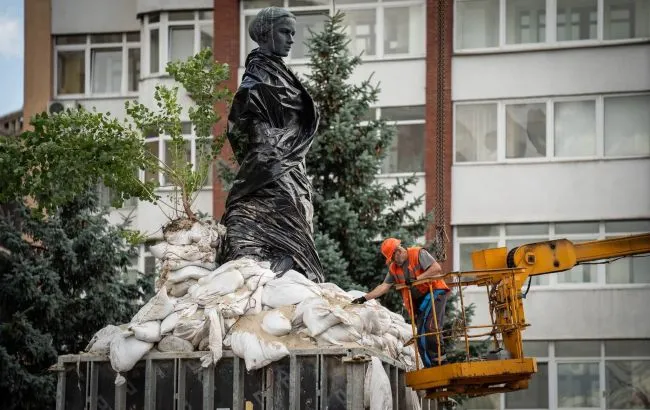
In Kyiv, protective structures installed on monuments after the start of Russia’s full-scale invasion are being partially dismantled. Under the protective covers, experts discovered mold, vegetation, and other hazards that could damage the monuments. Experts are now inspecting the condition of the monuments to determine where the protective structures should be left in place, modified, or reinstalled.
After the full-scale invasion began, efforts were launched in Kyiv to protect monuments from shock waves and debris from Russian missiles and drones. To this end, special structures were installed on the monuments and shelters were set up. In total, city services, together with volunteers and donors, protected 18 monuments in this way. However, prolonged exposure to these protective measures can also have negative consequences. Due to increased humidity, temperature fluctuations, and disrupted natural air circulation, the materials from which the monuments are made may gradually deteriorate. In particular, there is a risk of mold growth and corrosion.
That is why authorities in Kyiv have begun partially removing the protective structures. This is necessary so that experts can inspect the monuments, assess their condition, and determine whether the protective coverings are doing more harm than good. “Currently, experts are evaluating the balance between the protective function of the structures and the potential risks posed by their prolonged exposure, taking an individualized approach to each monument,” the department noted.
What Was Found Under the Protective Structures
During the inspection, experts have already identified several problems. In particular, mold was discovered on the marble monument to Princess Olga. It formed due to moisture buildup under the sand covering. Another problem arose near the monument to Bohdan Khmelnytsky. Plants had grown beneath the protective scaffolding, and their roots had begun to damage the structure of the pedestal.
In addition, due to the so-called greenhouse effect, conditions unfavorable to the monuments’ materials may develop under the protective coverings. Efflorescence and signs of corrosion may appear on the bronze elements. Such changes can damage the surface of the monuments and complicate their future preservation. At the same time, the Kyiv City State Administration emphasizes that the protective structures are indeed fulfilling their purpose. They help shield the monuments from debris during Russian attacks.
As an example, the department cited the monument to Mykhailo Hrushevsky on Volodymyrska Street. During one of the attacks, the protective scaffolding absorbed the impact, thereby protecting the monument itself from damage. Therefore, the problem is not that the protective structures are ineffective. While they can protect monuments from debris, prolonged use without proper oversight creates other risks. For this reason, each structure must be inspected individually.
Will the protective structures be reinstalled on the monuments?
The future of the protective structures will be determined on a case-by-case basis for each monument. Experts will assess its technical condition, potential damage, and the security situation. Depending on the results of the inspection, the structures may be dismantled, modernized, or reinstalled. The Kyiv City State Administration notes that there is no one-size-fits-all method for protecting cultural heritage during wartime. It is necessary to simultaneously consider the threat of Russian shelling and the risks arising from the prolonged exposure of monuments to heavy protective materials.
In other words, dismantling does not mean that the city is abandoning the protection of monuments. The primary goal is to assess their condition and find a solution that will help preserve the monuments without exposing them to further damage.
How Kyiv Is Preserving Its Cultural Heritage During the War
In addition to physical protection, the capital is using digital technologies to preserve information about the monuments. Specifically, experts are using 3D scanning, photogrammetry, and detailed measurements. These methods make it possible to create accurate digital documentation of the monuments. If a monument is damaged as a result of shelling, the collected data will help experts study its previous condition and use this information during restoration or reconstruction.
According to the Kyiv City State Administration, Kyiv’s experience in protecting cultural heritage during regular airstrikes is attracting the attention of the international professional community. Currently, the city’s main challenge is to strike a balance between protecting monuments from Russian attacks and preserving the monuments themselves. Therefore, decisions regarding each monument will be made following an inspection, rather than based on a one-size-fits-all rule. This was reported by the Department of Cultural Heritage Protection of the Kyiv City State Administration.
In Tatarbunary, Odesa Oblast, a bust of the Russian poet Alexander Pushkin was covered with a decorative metal structure instead of being dismantled. Published photos show that the monument has been completely concealed under a metal dome with decorative patterns.
The Ministry of Culture and Strategic Communications issued an order regarding four monuments in the city of Kamianka, Cherkasy Oblast, which are not subject to inclusion in the register of cultural heritage sites. These monuments may now officially be dismantled.




