
The commander of the UAV unit recounted how he rescued his younger brother while under fire
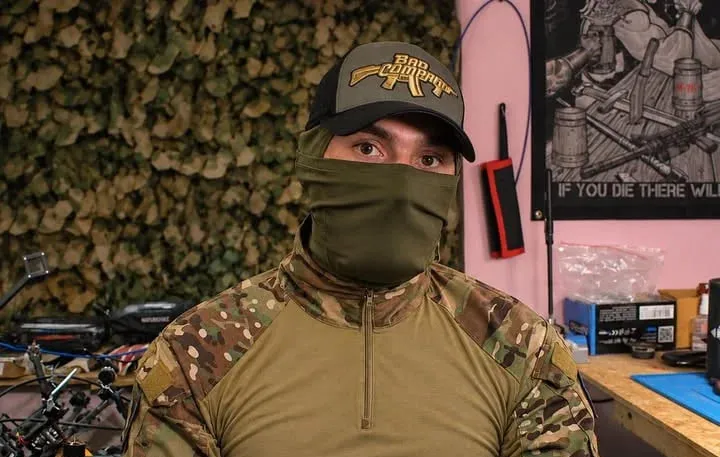
Oleksandr, call sign “Barista,” commander of the 122nd Brigade’s UAV unit, found himself in a burning basement during enemy shelling along with his younger brother and a comrade. At that moment, his only thought was to make sure his younger brother could get out.
Oleksandr, call sign “Barista,” found himself in a burning basement with his younger brother and a comrade during enemy shelling. The shelter quickly filled with thick black smoke, and the fire blocked the exit. Oleksandr suffered burns to his hands, neck, and face, but all three managed to escape. At that moment, his only thought was how to save his younger brother.
Today, “Barista” is a soldier in the 1st Battalion of the 122nd Separate Territorial Defense Brigade of the Armed Forces of Ukraine and the commander of a platoon of strike unmanned aerial vehicle systems. His journey in the military took him from a rookie at the FPV simulator to a staff sergeant and unit commander.
Oleksandr joined the Armed Forces of Ukraine in 2024 alongside his younger brother. Their oldest brother, who went to defend the country from the very first days of the full-scale invasion, served as an example for them. Both younger brothers were assigned to the unmanned systems unit within the battalion.
Oleksandr makes no secret of the fact that he initially chose this path out of fear of infantry service. At the same time, it was precisely this fear that motivated him to master a new specialty.
“I actually really wanted to be a pilot because I was afraid of joining the infantry. There’s nothing to be ashamed of here: I was scared, and I realized that I could do the job remotely and be useful. It was precisely this fear that motivated me to learn,” says “Barista.”
After basic military training, he completed a two-week FPV pilot course. At first, flying the drone wasn’t easy. To master the skills faster, Oleksandr bought his own remote control and laptop and spent nights training on a simulator.
However, he soon realized that the equipment alone wouldn’t make someone a professional pilot.
“Buying equipment doesn’t solve the problem. The problem lies in your hands and in understanding how everything is supposed to work,” the soldier explains.
Just three weeks after training, the crews were deployed to the Donetsk sector. There, Oleksandr began carrying out combat missions. During his fourth sortie, he struck an enemy “Muravey” tricycle loaded with ammunition and supplies.
“On the reconnaissance screen, I saw myself flying straight into the trailer, everything exploding and burning. My hands were shaking, but in that moment I realized: I’m where I’m supposed to be. Everything that had seemed impossible just fell into place,” recalls “Barista.”
The first sortie to the front lines was a test not only for the young pilot but also for him as an older brother. When it came time to decide who would go first, Oleksandr took on the task himself. He wanted to assess the situation and conditions himself and prepare his younger brother, who is four years his junior.
Eventually, they found themselves at the same position. During intense shelling, a neighboring building caught fire, and the flames spread to the entrance to the basement where the soldiers were stationed. The shelter was insulated with foam, which began to melt, filling the room with thick, toxic smoke.
At the critical moment, one of his comrades panicked in the face of the wall of fire. Then Alexander’s brother helped him snap out of his stupor, and all three managed to break through to the outside.
“I wasn’t thinking about myself at the time—I was only thinking about getting my younger brother out. We couldn’t breathe; we were on our knees. My brother literally kicked our comrade out of his daze, and we broke through the fire,” the soldier recounts.
Oleksandr suffered burns to his hands, neck, and face, but all three survived. This experience taught him that fear in war is a natural reaction that can help save lives, as long as you don’t let it paralyze your actions.
After additional training and assignments in other areas, “Barista” headed back to the Donetsk region. This time, the crew operated nearly on the front lines. Thanks to his short flight time and the experience he had gained, Oleksandr took out more enemy personnel and equipment in five days than he had in the previous year. The crew helped thwart Russian assaults on the approaches to Ukrainian positions.
Now, Oleksandr not only carries out combat missions himself but is also responsible for training and overseeing other crews. As a platoon commander, he trains young operators, shares his experience with them, and explains not only the technical aspects of piloting but also the principles of operating on the front lines.
He personally oversees the preparation of drones and equipment before they head out to the front lines. And when the crews are working directly on the front lines, he stays in constant contact with them. If technical problems arise, he helps find solutions remotely—via video or audio communication.
“We work with electronics, and they’re finicky: they work here, but not there; they’re affected by the weather and electronic warfare. At any time of day, the guys can call or text: ‘We have a problem.’ And we’ll figure it out online—via video or audio—and find a solution so the crew can continue their combat operations,” explains “Barista.”
For Oleksandr, the success of a commander is measured not only by successful strikes but also by the unit’s cohesion and the safety of its personnel. He strives to ensure that every operator is prepared for real combat conditions, knows their equipment, and can count on the support of their comrades.
Now, every successful sortie by his subordinates incorporates some of the experience “Barista” has gained himself—from his first simulator training sessions to combat sorties and dangerous situations at the front lines. And he considers his greatest responsibility to be training people so that they can effectively carry out their missions and return alive.
The brigade shared the soldier’s story on social media.




