
In St. Petersburg, drones attacked oil facilities, an Ozon warehouse, and a VK data center
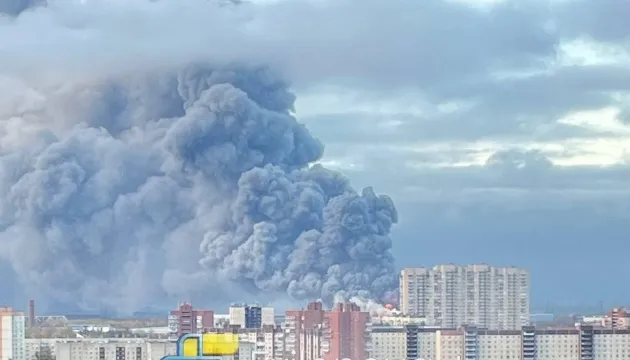
On the night of October 18, drones attacked St. Petersburg and the Leningrad Region. The strikes caused fires at oil facilities and the Ozon warehouse, and also damaged the data center of VK, the company that owns the social network VKontakte. In addition, an emergency power outage occurred in the region, leaving about 20,000 people without electricity.
On the night of October 18, St. Petersburg and the Leningrad Region came under attack by drones. Several facilities caught fire following the strikes, including an oil terminal, an oil depot, and an Ozon warehouse. Drones also attacked the VKontakte data center and struck a bridge that is part of one of the city’s main highways. St. Petersburg Governor Alexander Beglov confirmed the drone attack. According to him, a fire broke out at the St. Petersburg oil terminal. Fires were also reported at other infrastructure facilities in four districts of the city.
At the same time, according to the Russian Telegram channel Astra, St. Petersburg residents either did not receive warnings about the drone threat or received them with a significant delay. According to Astra’s OSINT analysis, the city’s largest fuel terminal was on fire following the attack. A fire also broke out at the “Strumki” oil depot in the Krasnogvardeisky District of St. Petersburg.
The oil depot has a total capacity of 3,900 cubic meters. It is used for the storage and shipment of AI-92 and AI-95 gasoline and diesel fuel. The reports do not provide information on the extent of damage to these facilities. Following the attack, the company Ozon also reported a fire at its warehouse in St. Petersburg. The company stated that there were no casualties. It did not provide any further details regarding the damage to the warehouse.
The data center of VK, the company that owns the social network “VKontakte,” was a separate target of the attack. It is located in the village of Novosergievka in the Vsevolozhsky District of the Leningrad Region, near the administrative border with St. Petersburg. The company stated that its services continue to operate as usual. However, according to Astra, following the attack, users reported widespread disruptions to VKontakte and its related services.
According to a Telegram channel, an electrical substation was also hit alongside the data center. At the same time, the exact extent of the damage to both facilities is currently unknown. Another target hit was the cable-stayed bridge across the Korabelny Channel in St. Petersburg. According to Astra, a drone struck the structure, located approximately 4.5 kilometers from the St. Petersburg Oil Terminal. The extent of the damage to the bridge is being assessed.
The bridge is part of the southern viaduct of the Western High-Speed Diameter—a toll highway connecting the southern and northern parts of St. Petersburg. The report does not specify whether the strike affected traffic on this section. Residents of the Leningrad Region also felt the effects of the attack. The region’s governor, Alexander Drozdenco, announced an emergency power outage. According to him, approximately 20,000 people were left without power.
Thus, the attack targeted several types of facilities at once—ranging from fuel infrastructure and warehouses to a data center and a transportation facility. The full extent of the damage in St. Petersburg and the Leningrad Region is still being assessed, according to the BBC’s Russian Service.
Russia is unable to provide full-scale air defense for all major industrial facilities on its territory. The reason cited is the large size of these facilities, which makes it difficult to fully shield them from Ukrainian strikes.




