
Four residents of Melitopol were convicted in Russia in a case involving bombings
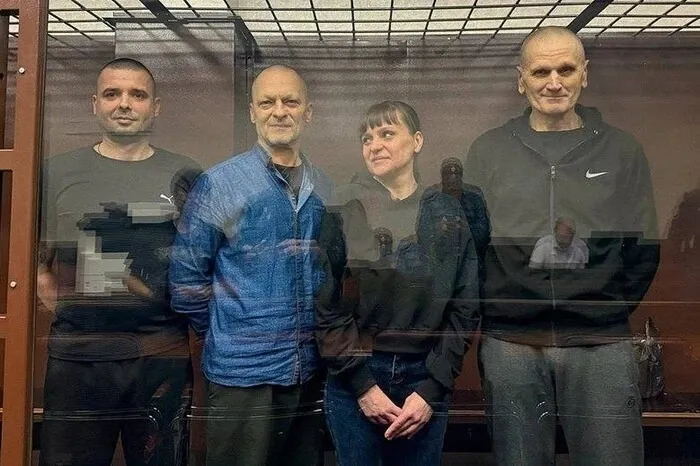
The Southern District Military Court in Rostov-on-Don, Russia, sentenced four residents of occupied Melitopol in a case involving explosions and assassination attempts against representatives of the occupying authorities. Igor Garanin, 38, was sentenced to life in prison, while the other three defendants were each sentenced to 25 years in a penal colony. During the trial, all four claimed they had been subjected to torture and pressure by investigators.
The Southern District Military Court in Rostov-on-Don handed down sentences to four residents of occupied Melitopol in Zaporizhzhia Oblast. They were accused of involvement in explosions and of plotting attacks against representatives of the Russian occupying authorities. Igor Garanin, 38, was sentenced to life in prison. Sergey Garkusha, 54, Sergey Yevtushenko, 58, and Olena Roy, 46, each received 25-year prison terms.
According to the publication, all four lived in occupied Melitopol. The Russian court claims that Garanin and Yevtushenko hold Ukrainian citizenship, while Garkusha and Roy hold Russian citizenship.
What were they accused of?
According to the Russian Federal Security Service (FSB), in 2022–2023 the defendants allegedly acted on orders from Ukrainian intelligence agencies and were planning assassination attempts against representatives of the occupation administration and law enforcement agencies. The investigation links them to several incidents. The first explosion occurred on November 15, 2022. Dmytro Trukhin, who was responsible for issues related to municipal property, urban planning, and property and land relations within the occupation administration, was injured in that incident.
The second explosion occurred on April 27, 2023. It resulted in the death of Oleksandr Mishchenko, deputy chief of the Russian Ministry of Internal Affairs’ “Melitopol” department. Another police officer was injured. Additionally, according to the FSB, from February to May 2023, an assassination attempt was being planned against Roman Pshenychny, deputy chief for operational work at the Main Directorate of the Ministry of Internal Affairs in Zaporizhzhia Oblast. At the same time, Pshenychny refused to acknowledge himself as a victim and to participate in the trial.
All these circumstances are outlined in the Russian investigation’s version of events. The charges and verdicts themselves do not constitute independent confirmation that the events unfolded exactly as described by Russian security forces.
The defendants alleged torture
According to “Mediazona,” during the trial, all four spoke of torture and pressure from law enforcement officials. According to them, investigators coerced confessions, and some of their testimony was given under duress. Serhiy Harkusha said that during his initial interrogations, he was beaten for several days in a basement. He said that after four or five days of beatings, he signed a statement without even reading it.
Igor Garanin reported that he was held in the so-called “garage.” “Mediazona” notes that this refers to a secret detention facility. Olena Roy, for her part, stated that the investigator fabricated her confession regarding her acquaintance with Yevtushenko. According to her, this testimony did not correspond to reality.
Serhiy Yevtushenko also spoke about the pressure he faced during the investigation. He said the investigator tried to convince him not to retract the confessions he had made under torture. At the same time, he was allegedly promised that he would be exchanged and that “nothing in his life would change” afterward. These statements by the defendants are cited by “Mediazona.” They pertain to the conditions of detention and the methods by which the investigation may have obtained testimony.
What They Said Before the Sentence
During his final statement, Igor Garanin identified himself as a Ukrainian serviceman who had been sent to Melitopol to conduct reconnaissance. Before the verdict was announced, Serhiy Harkusha asked to be included on the exchange lists. Olena Roy recalled that her husband was an officer and died, in her words, “for the territorial integrity of Ukraine.”
Despite claims of torture and coerced confessions, the court handed down guilty verdicts to all four defendants. Garanin received a life sentence, while Garkusha, Yevtushenko, and Roy each received 25 years in prison.
Earlier, two more residents of Melitopol were convicted in Russia
In September, the Southern District Military Court also convicted Gennady and Olga Kapralov, a married couple from occupied Melitopol. According to the Russian investigation, the Kapralovs, along with other members of an underground group, allegedly acted on orders from Ukrainian special services and were planning terrorist attacks in the city.
Thus, the case of the four Melitopol residents became yet another trial in Russia linked to allegations of underground activity in the occupied part of Zaporizhzhia Oblast. In this case, the defendants claimed they had been subjected to torture and pressure, but the Russian court nevertheless sentenced them to lengthy prison terms. This was reported by the court’s press service and also covered by “Mediazona.”
A court in the Moscow region sentenced a Russian serviceman who killed a civilian during the occupation of the Brovary District. The occupier served as a sniper in the 15th Separate Motorized Rifle Brigade of the Russian Armed Forces.
In the temporarily occupied territory of the Zaporizhzhia region, a Russian occupation court sentenced a local school employee to 13 years in a strict-regime penal colony. The man was accused of spying for Ukraine.




