
Ukraine has developed an aerial drone to evacuate the wounded from the front lines — Associated Press
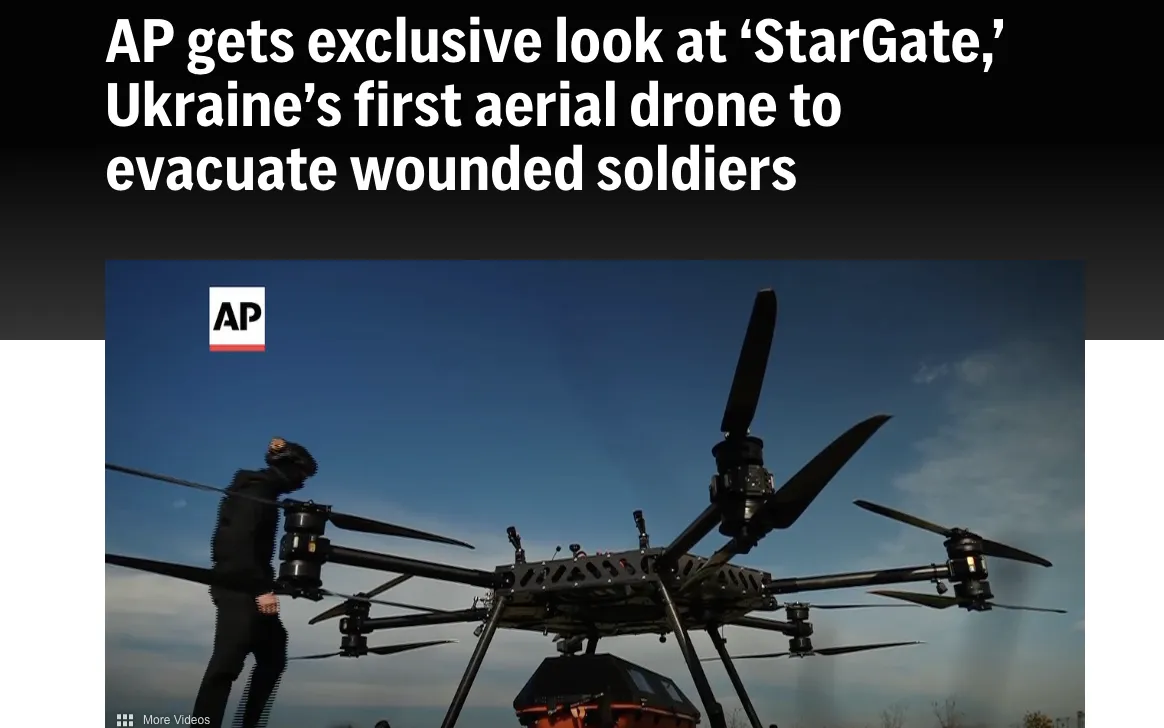
Ukraine has developed StarGate, an unmanned aerial vehicle designed to evacuate the wounded, according to the Associated Press. The drone can carry a payload of up to 150 kilograms, and its one-way flight range is 15 kilometers.
The drone was named StarGate in honor of the science fiction franchise in which portals connect distant worlds. According to the company, the drone can carry a payload of up to 150 kilograms. This is sufficient to transport a wounded soldier wearing body armor and carrying combat gear. A special compartment with a medical stretcher is provided for evacuation.
StarGate’s one-way flight range is 15 kilometers. This potentially allows it to reach seriously wounded soldiers who are deep behind enemy lines.
The drone’s cruising speed is 65 km/h, and its maximum speed is up to 105 km/h. According to SkyFall, the drone can be prepared for flight in about 10 minutes.
StarGate uses two communication channels—Starlink and the company’s proprietary L-Link system—as well as artificial intelligence algorithms that help maintain control in the absence of satellite navigation.
According to a company representative, the drone is controlled by an operator but is equipped with a range of AI-based functions. These allow it to operate in the absence of GPS, in cases of signal spoofing, or when frequencies are jammed.
In the event of a complete loss of communication, SkyFall states that the drone is capable of autonomously plotting a route back to a safe zone. The drone is designed to operate in rain and snow, and is equipped with thermal imaging cameras for nighttime missions.
SkyFall also reported that the drone can continue flying even after losing one of its “beams”—the drone’s supporting structures.
According to the company’s estimates, the cost of a single system will be at least $50,000, depending on the configuration. By the end of 2026, they plan to ramp up production to 1,000 units per month.
Ground-based robotic platforms are increasingly being used to evacuate the wounded and deliver supplies. However, they struggle to navigate mud, blast craters, and destroyed roads. Rivers, minefields, and drones can also bring their movement to a complete halt.
According to the commander of the 475th Separate Assault Regiment—known as the “Code 9.2” unit, with the call sign KVN—ground robots typically take two to three hours to reach their destination. The time depends on the distance, road conditions, and threats from the air.
He noted that evacuations are carried out regularly in his unit’s area of responsibility, but it is not always possible to transport the wounded on the same day. For a person with severe injuries, such a delay can be critical.
“Covering 10 kilometers in a matter of minutes would be a game-changer on the front lines,” the soldier said.
However, according to KVN, it is too early to draw conclusions. His unit needs at least a month of practical drone use before enough statistical data can be collected to assess its effectiveness.
“This is a completely new method of evacuation,” he said. “It’s difficult to discuss all the pros and cons in detail right now. We still need to work with it some more.”
Source: Associated Press
Earlier, Ukraine developed a new defense system against fiber-optic drones.
Previously, the Ukrainian ground-based robotic complex Varkhan was officially standardized and approved for use by the Defense Forces.




