
BepiColombo mission begins complex approach to Mercury
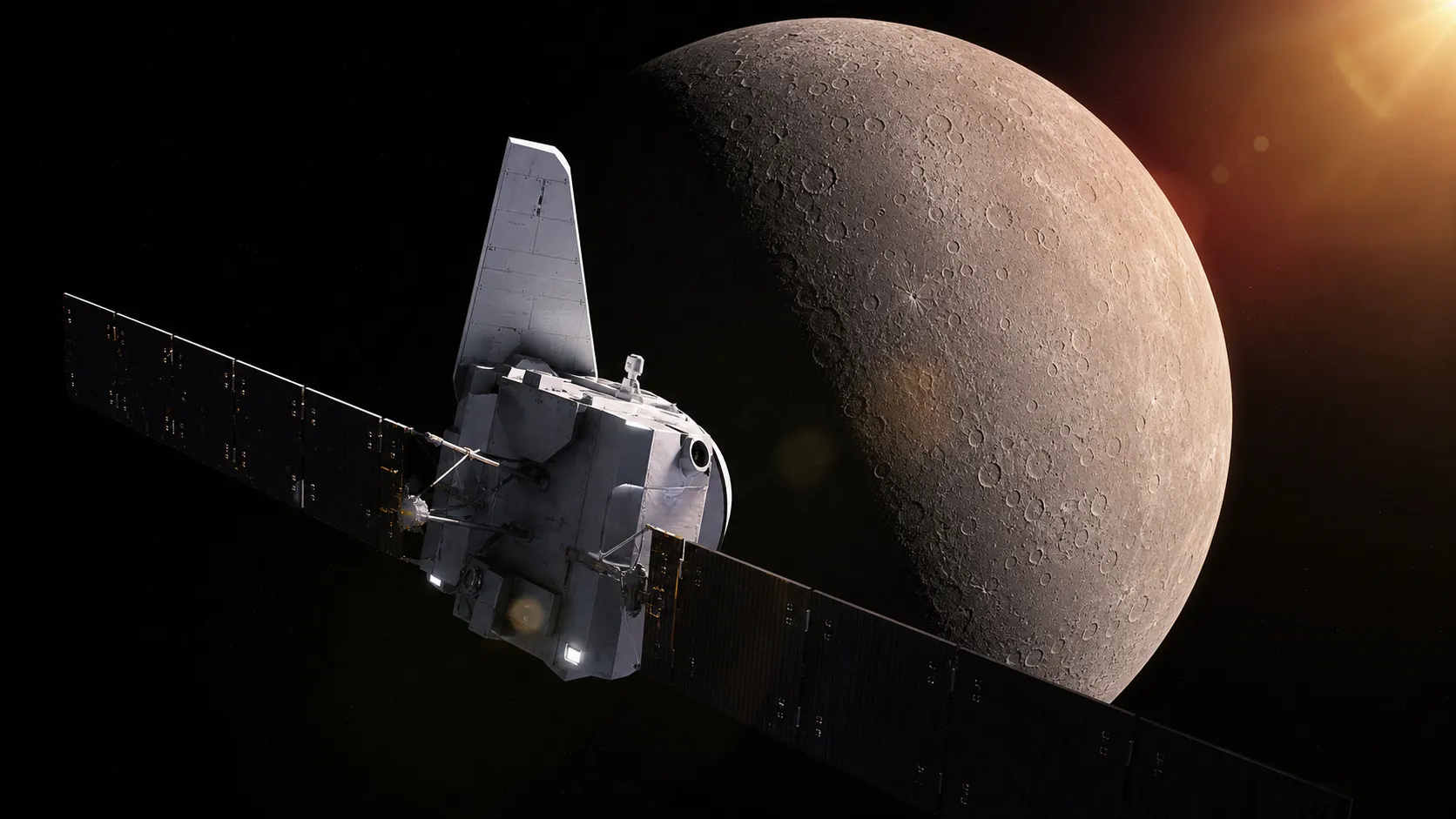
The European-Japanese BepiColombo mission has begun the final months-long phase of its approach to Mercury after an eight-year journey. On Thursday, the mission’s two spacecraft separated from the transfer module that had propelled them toward the least explored rocky planet in the Solar System.
As Asharq Al-Awsat reports, citing the European Space Agency, this stage has been described as one of the most complex planetary arrival operations ever performed. Due to Mercury’s relatively small mass, its gravitational pull is considerably weaker than that of the Sun, making it difficult to place a spacecraft on the required trajectory.
Separation from the transfer module
The spacecraft traveled more than 10 billion km and conducted nine flybys of celestial bodies to adjust its speed and trajectory. During the operation, it autonomously cut four mechanical struts connecting the orbiters to the transfer module. Spring mechanisms pushed them away at a speed of 40 cm per second.
More current news is available on the UA.News Telegram channel Telegram.
At the time of the maneuver, Mercury was about 63 million km from the Sun and 200 million km from Earth. At such distances, the delay between checks on Earth and the execution of commands by the spacecraft was around 30 minutes, so the separation had to take place autonomously. The signal confirming the successful completion of the operation reached the control center in Darmstadt, Germany, almost two hours later, at 13:53 GMT.
Orbital insertion and scientific tasks
The spacecraft are expected to enter Mercury’s orbit on November 21. The next key stage is scheduled for December 9–10: the European Mercury Planetary Orbiter and Japan’s Mercury Magnetospheric Orbiter Mio are to separate and move to their operational orbits.
Starting in April, the European orbiter will study the planet closest to the Sun, flying at a distance of 480 km from its surface. The Japanese spacecraft will focus on studying Mercury’s space environment and magnetic field, traveling in an elliptical orbit at distances of up to 11,000 km from the surface. The mission has 16 scientific instruments and is intended to help investigate the planet’s magnetic field, iron core, and surface features.




