
The drought on the Rhine threatens freight transport and the German economy
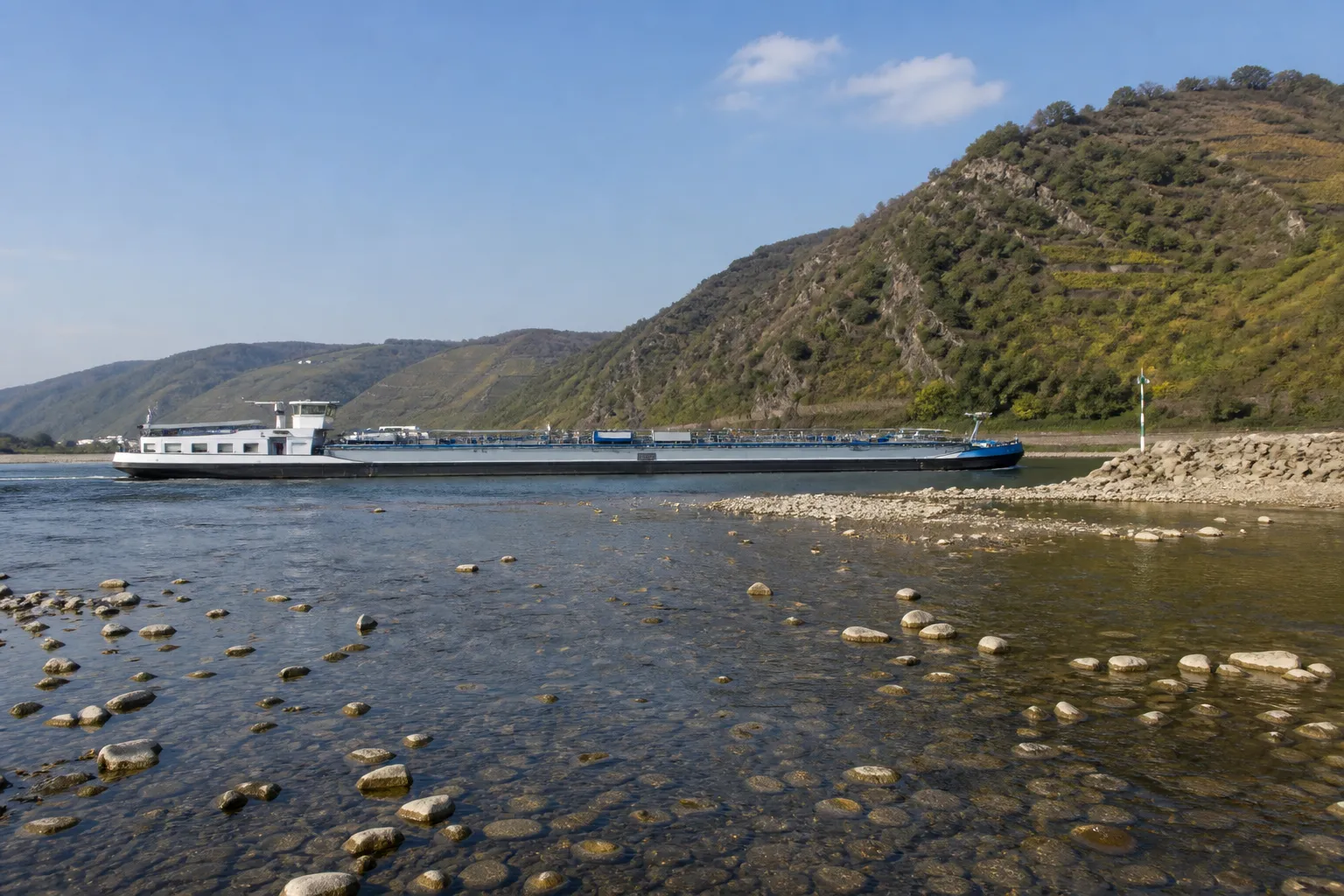
After several weeks of drought, water levels in the Rhine have dropped to critical levels, hampering cargo shipping and potentially affecting the German economy. In the shallow stretch near Kaub, between Mainz and Koblenz, the water level was about 16 centimeters at noon on Monday, according to Deutsche Welle, citing Germany’s Federal Waterways and Shipping Authority.
The actual navigable channel at this location is about one meter deeper, but 40 centimeters is considered the minimum depth for standard commercial vessels. Based on the readings at Kaub, operators determine how much cargo barges can safely carry and whether passage is possible. According to local media, in recent weeks, carriers have in many cases reduced vessel loads to one-fifth of their usual capacity.
Historically low water levels are also being recorded near Cologne, Düsseldorf, Duisburg-Ruhrort, and Emmerich. Jens Schwannen, president of the BDB inland waterway shipping association, told the Rheinische Post that the Rhine near Kaub could become impassable by the end of the week. If that happens, the river will effectively be divided into two sections for commercial traffic.
Inland waterways carry about 5% of Germany’s cargo, including iron ore, coal, sand, and petroleum products. According to the BDB, in 2024, 173 million metric tons of cargo were transported via these routes out of a total of 3.28 billion metric tons. In 2023, Eurostat estimated that the Rhine corridor from the port of Rotterdam to the German-Swiss border accounts for approximately 40% of freight traffic in ton-kilometers.
For more breaking news, follow the UA.News Telegram channel.
In 2023, the Kiel Institute for the World Economy calculated that every 30 days of low water levels on the Rhine reduce Germany’s industrial production by approximately 1%. The German Economic Institute forecasts a 0.4% contraction in GDP, which could nearly offset this year’s expected growth of 0.5%. Other experts have warned of potential losses of €1–2 billion in the third quarter, primarily in the steel, chemical, and energy sectors.
If shipping is disrupted, companies will have to shift some of their cargo to road and rail transport. One large barge can carry a volume equivalent to 50–150 trucks, so this could cause traffic jams and increase costs. Baden-Württemberg has announced its intention to join four other German states in easing restrictions on Sunday truck traffic. Transport Minister Steffen Bilger also announced measures to support supply chains, including simplifying the transport of heavy cargo by road and coordinating with DB Cargo.
The current situation marks the third significant period of low water levels in eight years, following the droughts of 2018 and 2022. The Copernicus Climate Change Service reported that Western Europe experienced its warmest June and July on record, and low precipitation reduced water levels in the Rhine, Danube, and Seine. In 2023, the German Federal Institute of Hydrology predicted that severe low-water conditions, similar to those in 2018, could recur every five to ten years until the middle of the century.


