
Ring depicting the Lighthouse of Alexandria found in Egypt — Live Science
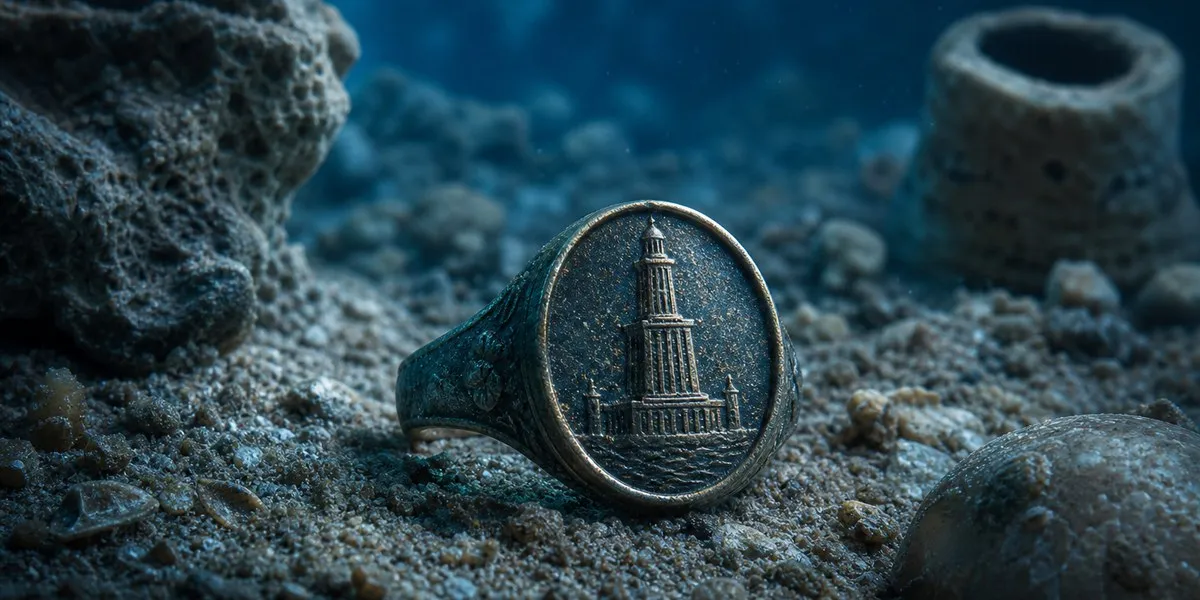
A bronze signet ring that likely depicts the Lighthouse of Alexandria has been discovered in the Mediterranean Sea off Alexandria, Egypt. The artifact was found by a joint expedition of the European Institute for Underwater Archaeology and Egypt’s Ministry of Tourism and Antiquities in the ruins of a palace on the now-submerged island of Antirhodos, Live Science reports.
Image of the lighthouse on the ring
Representatives of the European Institute for Underwater Archaeology said this is the first signet ring found with an image of the lighthouse. The engraved motif resembles depictions of the Lighthouse of Alexandria on coins from the second century.
Although the engraving on the ring has partially worn away, Doris Behrens-Abouseif, professor emerita of art history and archaeology at the University of London, believes it likely does indeed reproduce the lighthouse. Researcher Andrew Chugg pointed to an asymmetrical detail at the top of the image: in his view, it may be a plume of smoke from an oil lamp held by a statue at the top of the structure.
More current news is available on the UA.News Telegram channel Telegram.
Professor emerita Margaret Miles suggested that the ring may have been used by an Alexandrian merchant for whom the lighthouse was a symbol of the city.
Palace on the island of Antirhodos
According to the institute’s president, Franck Goddio, the palace on Antirhodos was once a center of power. It was used by Egyptian pharaohs of the Ptolemaic dynasty, which ruled from 304 to 30 BC. Signet rings were used to create impressions on soft materials, including clay and wax. Institute representatives suggested that the find may indicate administrative functions of the palace connected with the lighthouse.
The Lighthouse of Alexandria was built on the island of Pharos around 280 BC. It stood more than 100 meters high, and ancient authors, including Pliny the Elder, counted the structure among the wonders of the world. The lighthouse was used until the Middle Ages, when earthquakes and erosion led to its destruction and disappearance beneath the water.




