
Israel reunites three volumes of the Lisbon Mahzor — Jerusalem Post
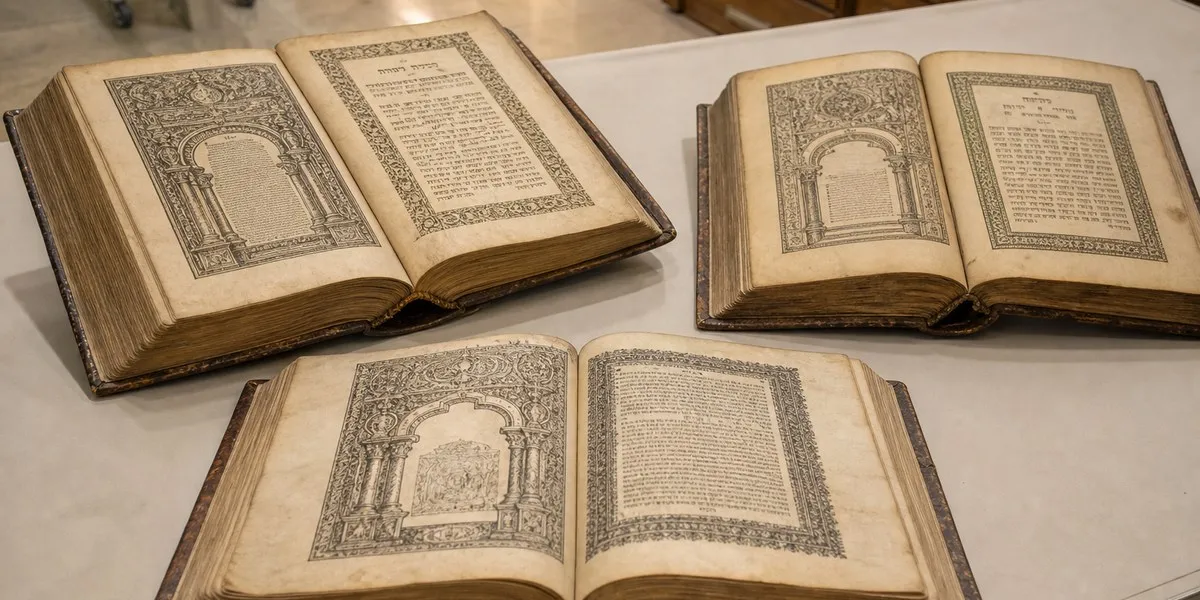
The National Library of Israel has reunited all three volumes of the Lisbon Mahzor, a prayer book that later ended up in the Jewish community of Aleppo. The whereabouts of two volumes had long remained unknown, but they recently appeared in the catalogue of the Kedem auction house. The library acquired them without holding a public auction, the Jerusalem Post reports.
The three-volume edition contains liturgy for the entire Jewish year: one volume is devoted to daily prayers, while the other two cover services for Rosh Hashanah and Yom Kippur. In 1957, the Jewish community of Aleppo presented one of the volumes to Israel’s then-president, Yitzhak Ben-Zvi. It was kept in the archives of Yad Ben-Zvi. The acquisition of the other two volumes was supported by the Haim and Hanna Solomon Judaica Foundation and the Zucker family. All three volumes are now available online.
History of the Lisbon Mahzor
According to Dr. Haim Neria, curator of the Haim and Hanna Solomon Judaica Collection, the prayer book was created in Lisbon in the period after the expulsion of Jews from Spain. At that time, Jews were temporarily allowed to settle in Portugal, but restrictions later intensified there. Jewish children were taken to Portuguese colonies, while families had to pay substantial sums to retain the right to remain in Lisbon; forced baptisms also occurred.
More current news is available on the UA.News Telegram channel Telegram.
Some manuscripts of the Jewish community disappeared, while others were taken out of the country. Eventually, the Lisbon Mahzor reached the Aleppo community, where it was kept together with the famous Aleppo Codex.
A Cairo Geniza fragment
Among other exhibits connected with Yom Kippur, the library holds a fragment of a page from an ancient prayer book from the Cairo Geniza. It was copied in the late 11th or early 12th century by Hillel ben-Eli, a cantor from Baghdad who moved to Egypt and worked as an official scribe of the Cairo rabbinical court.
One side of the fragment contains an excerpt from a piyyut, a liturgical poem, by Rabbi Eliezer Kalir, while the other contains prayers connected with the Yom Kippur service in the ancient Temple. The prayer book from which this fragment originated is the oldest in the National Library of Israel’s collection and one of the oldest in the world.


