
An 18th-century plague cross was found in the Khmelnytskyi region
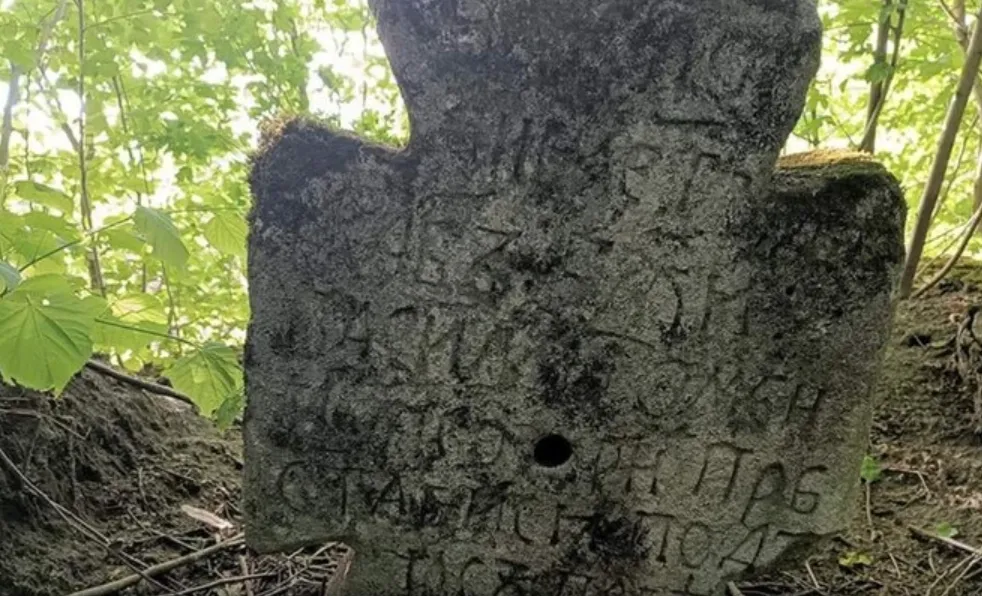
Near the village of Zelenche in the Khmelnytskyi region, local historians discovered a stone tombstone erected over the grave of a person who likely died during the plague epidemic. Researchers were able to decipher part of the inscription and determine the date of burial—1719.
The following inscription has been preserved on the cross: “Servant of God Vasyl Tomen… Passed away during the ‘povetra.’” The word “povetra” in the vernacular of that time meant an epidemic or plague.
The monument is located on the eastern outskirts of the village, near Dunaivtsi. Nearby, researchers noticed irregularities in the terrain that may be the remains of ancient structures. According to one theory, a farmstead once stood on this site, whose inhabitants perished from the plague.
The discovery is of particular significance, as 18th-century plague crosses are rare historical artifacts. According to researchers, just over three dozen such gravestones are currently known.
Prior to this, only one plague gravestone, dated 1719, was known to exist in the Khmelnytskyi region. It is located in the village of Kamianka near Sataniv.
Source: Zahid.net
Earlier, archaeologists discovered that the kings of Urartu used bronze bowls for propaganda purposes.
As a reminder, gold jewelry made before the Bronze Age Catastrophe was found in Cyprus.
In the village of Husiatyn in the Chortkiv District of the Ternopil Region, researchers from Lviv have begun full-scale excavations of a previously unknown Trypillian dwelling discovered on private property. Archaeologists speculate that an entire Trypillian settlement may have been located on this site, which covers an area of about one hectare along the Zbruch River.




