
Planetary scientist creates model of Earth without life to search for living planets — Space.com
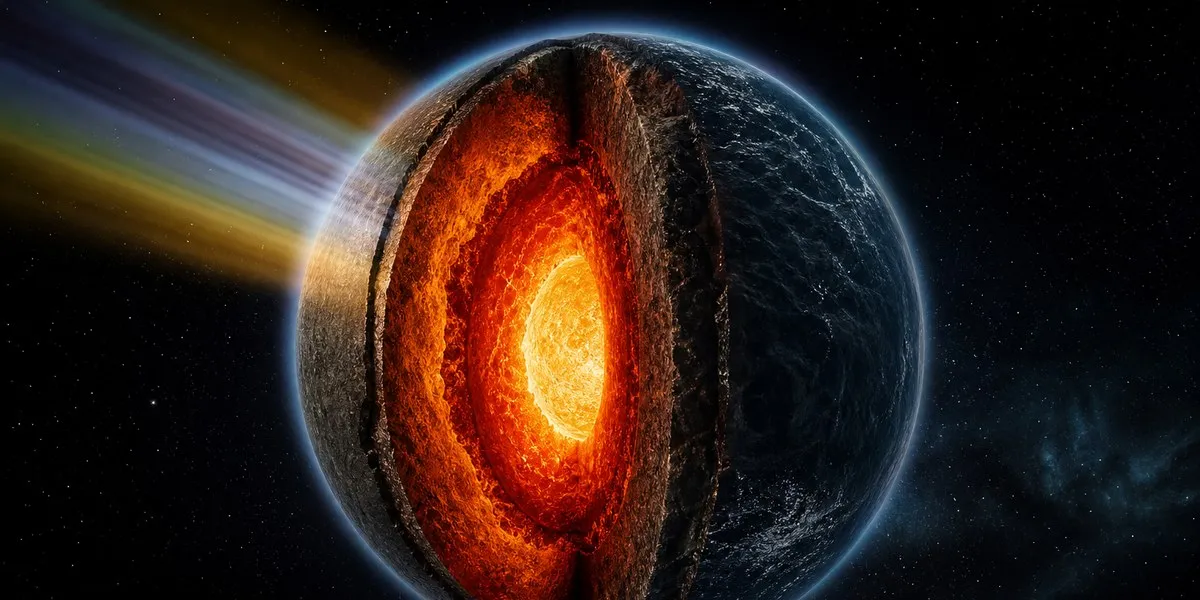
Planetary scientist Samantha Gilbert-Janisewicz has developed a computer model that reproduces the evolution of Earth or another rocky planet in the absence of life. The tool is intended to help astronomers distinguish planets where life may exist from habitable but lifeless worlds, Space.com reports.
Living organisms can alter a planet’s atmospheric composition by producing gases through biochemical processes. At the same time, some of these gases can also arise without the involvement of life, through geological processes. Therefore, detecting certain gases in an atmosphere alone is insufficient to confirm the presence of life on a distant planet.
Model of a planet without life
Gilbert-Janisewicz, who conducted the research while studying as a graduate student at the University of Washington, expanded a model previously created by planetary scientist Rory Barnes. The earlier version described a planet’s core, mantle and crust, while the new one also takes its surface and atmosphere into account.
The model simulates 19 characteristics of a rocky planet that are not related to life. In particular, it accounts for the amount of heat a planet receives from its star, the transport of heat and chemicals from the core to the surface, and the release of gases from the interior.
More current news is available on the UA.News Telegram channel Telegram.
As one scenario, the researcher modeled the evolution of Earth on which life had never emerged. The simulation covered the period from Earth’s formation 4.5 billion years ago to 500 million years into the future. The result was a lifeless planet that still had oceans and an atmosphere.
Comparison with observations
Researchers will be able to enter the properties of specific exoplanets into the model and compare the calculated atmosphere with spectroscopic observations. Sources of such data may include the James Webb Space Telescope, future ground-based telescopes with diameters of more than 30 meters, and NASA’s planned Habitable Worlds Observatory.
If the atmosphere of a modeled lifeless planet matches observations, its composition will likely be explainable without life as we know it. If the model does not match real data, this may indicate a possible influence of life on the atmosphere, but it will not be conclusive proof of its existence. A description of the model was published in The Planetary Science Journal.




