
Hydrogel that strengthens under stress created in the US — ScienceAlert
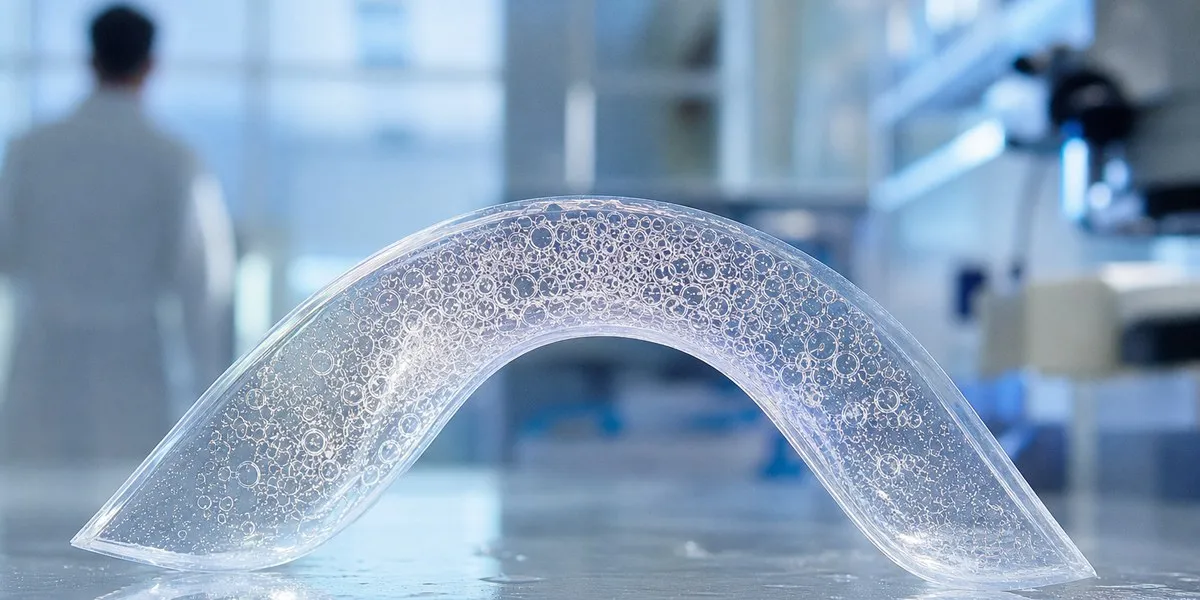
Scientists in the United States have developed a hydrogel that becomes stronger precisely in the areas of greatest stress when bent and stretched. The senior author of the study is chemist Chengfeng Ke of Washington University in St. Louis. ScienceAlert reports on the results of the work, published in the journal Nature Materials.
Mobile molecular rings
The new material is a hydrogel, a soft, flexible substance saturated with water. It was made from cyclodextrins and polyethylene glycol (PEG). Cyclodextrins are ring-shaped sugar molecules derived from starch, while PEG is capable of retaining water.
The hydrogel's structure resembles a toy with beads that slide along a wire. PEG chains form a base along which cyclodextrin rings can move. Under stress, these rings leave their initial clusters, redistribute into stress zones, and make the polymer network more ordered.
According to Ke, the polymers in the hydrogel become more uniform and organized, so the material strengthens precisely where stress occurs.
More current news is available on the UA.News Telegram channel Telegram.
Tests and properties
To test its properties, the hydrogel was applied to a knee-like joint and subjected to 12,000 bending cycles. During the experiment, the material was kept in silicone oil to prevent it from drying out. The researchers found that stiffness, tensile strength, and fracture resistance increased by up to tenfold, while Young's modulus increased by more than 20 times under certain conditions.
Additional use of ultrasound during stretching increased the gel's ability to stretch and its resistance to tearing, as it promoted the organization of the sugar rings. In another version of the material with dangling PEG chains, the hydrogel absorbed cyclodextrins from a chemical solution under stress, mimicking the strengthening of biological tissues.
The material can be printed on a 3D printer. Its structure can also be altered with a solvent, effectively “erasing” its previous mechanical memory and reprogramming it for another type of stress. The authors are considering possible applications of the development, including in biomedical implants.




