
More than 200 Celtic silver coins found in Hungary — Live Science
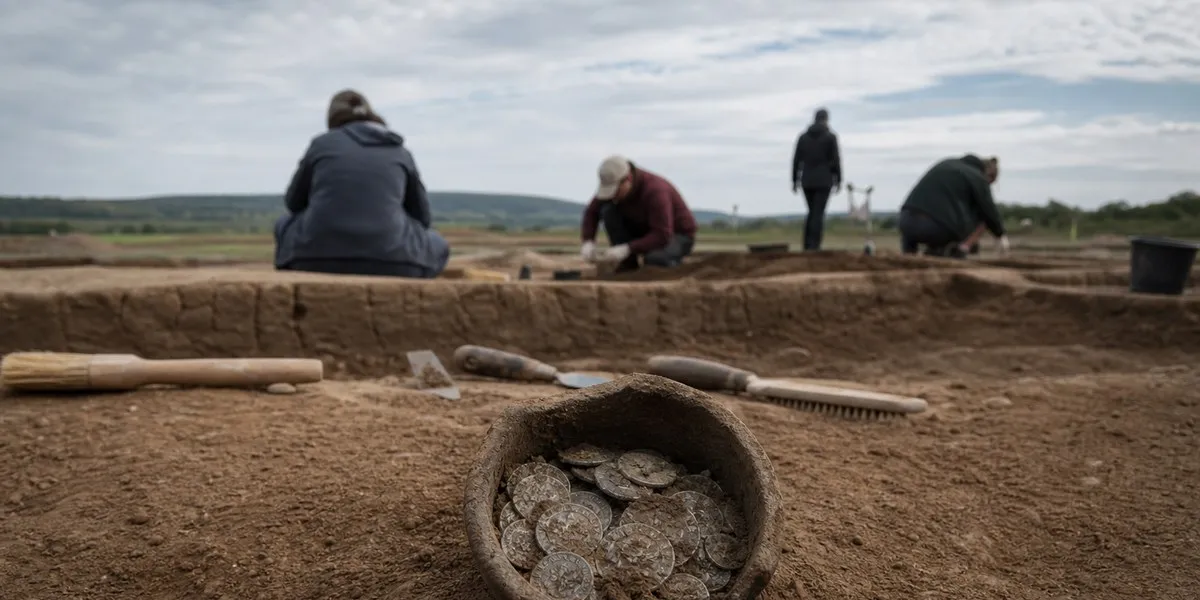
In western Hungary, archaeologists have discovered a hoard of more than 200 Celtic silver coins dating from the late 2nd to early 1st century BC. The find was made during surveys ahead of the construction of an electrical substation in the Szombathely region, Live Science reports.
Coins in a ceramic vessel
Excavations at the site were conducted from 2023 to 2025. It was previously a farm, and individual coins had been found there during plowing over recent decades. Archaeologists initially uncovered several specimens, then surveyed the area with metal detectors and found the hoard.
The coins were kept in a small ceramic vessel at a depth of about 40 centimeters. The total weight of the find is about 2 kilograms. Eszter Krajter, an archaeologist at Hungary's National Archaeological Institute, called such a find rare for Europe and noted that the last similar hoard in Hungary was discovered in the late 1960s.
More current news is available on the UA.News Telegram channel Telegram.
Celtic copies of Greek tetradrachms
The silver coins belong to the Velem type — Celtic imitations of Greek tetradrachms. They were named after the fortified Celtic settlement of Velem-Szent-Vid, located about 15 kilometers west of the excavation site. One side of the coins depicts a stylized head, likely that of the Greek god Apollo, while the other shows a helmeted rider and a horse.
During the site investigation, evidence was also found that the area had been inhabited for more than 7,000 years. Among the artifacts are an almost 7,000-year-old polished stone chisel for woodworking and a glass bead with a “peacock eye” pattern, dated to the 6th or 7th century BC.
In later centuries, a Roman villa was built at the site. According to Krajter, it did not damage the buried hoard. Archaeologists were able to reconstruct the building's plan, including its underfloor heating system, and also found a Roman brick bearing a dog's paw print. The discovered objects are to become part of a museum exhibition.




