
47-million-year-old fossil owl may have been diurnal — Live Science
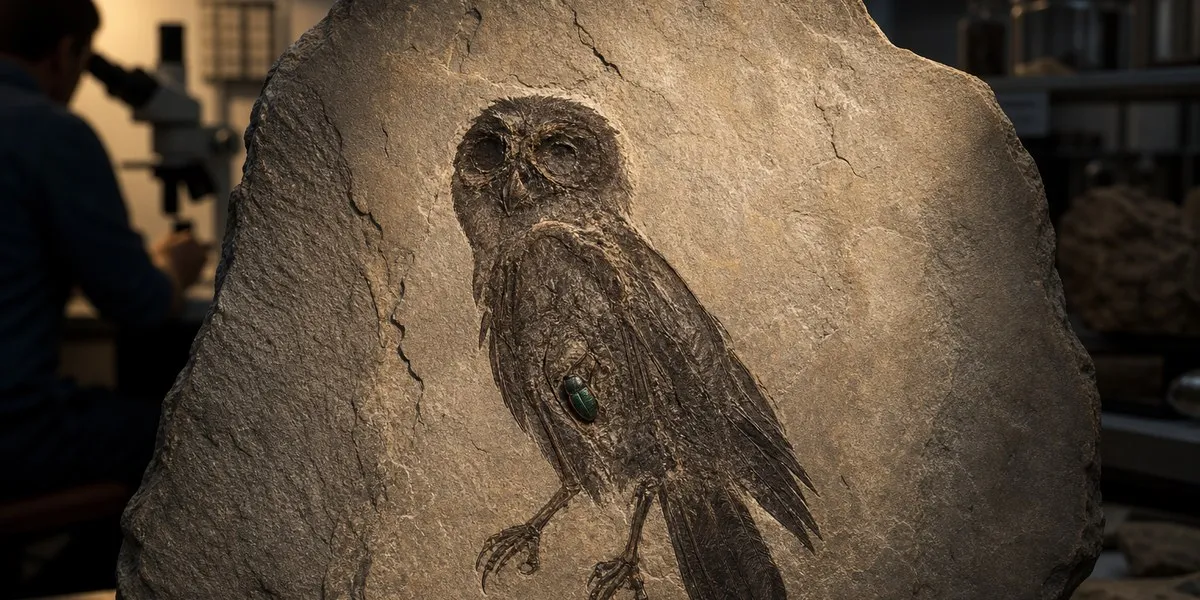
In the Messel Quarry in Germany, researchers discovered the nearly completely preserved remains of a young owl that lived 47 million years ago. The new species was named Masillastrix blattophaga. The bird’s probable last prey — a greenish-blue iridescent cockroach — was preserved in its stomach. As Live Science reports, the find helps clarify when owls largely shifted to a nocturnal lifestyle.
Signs of a diurnal lifestyle
The fossil owl’s skull was not preserved, but the remains of its body gave scientists several reasons to suggest that it was active primarily during the day. The bird was less than 12 cm long. The cockroach’s iridescent coloration is associated with a diurnal lifestyle, so researchers believe the owl may have hunted in daylight.
Additional signs included the appearance of some feathers and massive upper wing bones — the humeri. According to the study’s authors, robust humeri indicate diurnal flight. In contrast, modern nocturnal owls have thinner humeri and fly almost silently.
More current news is available on the UA.News Telegram channel Telegram.
Period of transition to nocturnal activity
If this assumption is correct, owls shifted to predominantly nocturnal activity between 47 million and 35 million years ago. The oldest known species of nocturnal owls date to about 35 million years ago and already have elongated humeri similar to those of modern owls. The oldest known owl in the fossil record, Ogygoptynx wetmorei, is dated to about 60 million years ago.
Study author Gerald Mayr, a paleontologist and head of ornithology at the Senckenberg Research Institute and Frankfurt Natural History Museum, noted that there is a consensus among scientists that owls descended from a diurnal ancestor. At the same time, the reason these birds transitioned to a nocturnal lifestyle remains unknown. Previous explanations linked this to avoiding competition with diurnal birds of prey or the spread of nocturnal mammals, but both groups began to develop actively much later — about 20–25 million years ago.




