
Qinghai solar parks have increased some herders’ incomes — Taipei Times
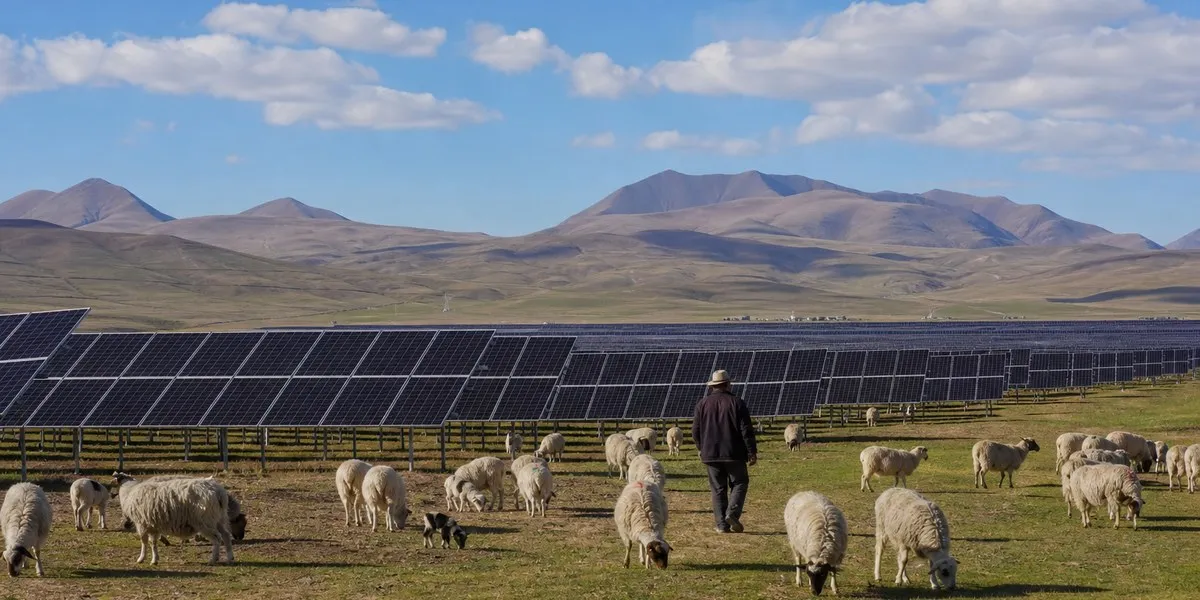
In China’s Qinghai province, solar power plants have changed the working conditions of some herders: they are allowed to graze sheep in fenced areas with panels, making livestock care easier. Some herders estimate that this approach has also increased their incomes. This was reported by Taipei Times.
Li Yonglin, a 25-year-old herder from Gonghe County, said that in the morning it is enough to release the sheep from their pen, and in the evening they return on their own. In his assessment, the new grazing method has noticeably increased his earnings.
Grazing among solar panels
China’s state media reported in July that 6,330 households in five townships had used 56 grazing plots in the Hainan Tibetan Autonomous Prefecture, which includes Gonghe. At the same time, they did not specify how many households had gained access to grazing.
The complex where Li grazes livestock covers more than 60,000 hectares. Cao Jun, a project representative for the state-owned State Power Investment Corporation, said that sheep help reduce grass-cutting costs. Electricity from the facility is transmitted to various regions of China, including Beijing and Shanghai.
More current news is available on the UA.News Telegram channel Telegram.
Researchers’ concerns
Researchers note that not everyone views the development of solar energy on the Qinghai-Tibet Plateau positively. According to one study, the region, where nomadic communities have grazed livestock for thousands of years, has nearly half of China’s solar energy potential.
Tsewang Dorje, a researcher at the Tibet Policy Institute in Dharamsala, India, believes that pastures near the panels do not provide adequate conditions for nomads and herders. Another researcher studying the region’s environmental policy and energy infrastructure said that such facilities divide open pastures into separate plots and make livestock monitoring more difficult.
Meanwhile, 43-year-old herder Wen Yujun said that he can now care for a flock of 700–800 animals almost on his own, while his annual income, by his own estimate, has increased eightfold.




