
Astronomers detect the most distant fast radio burst — ScienceAlert
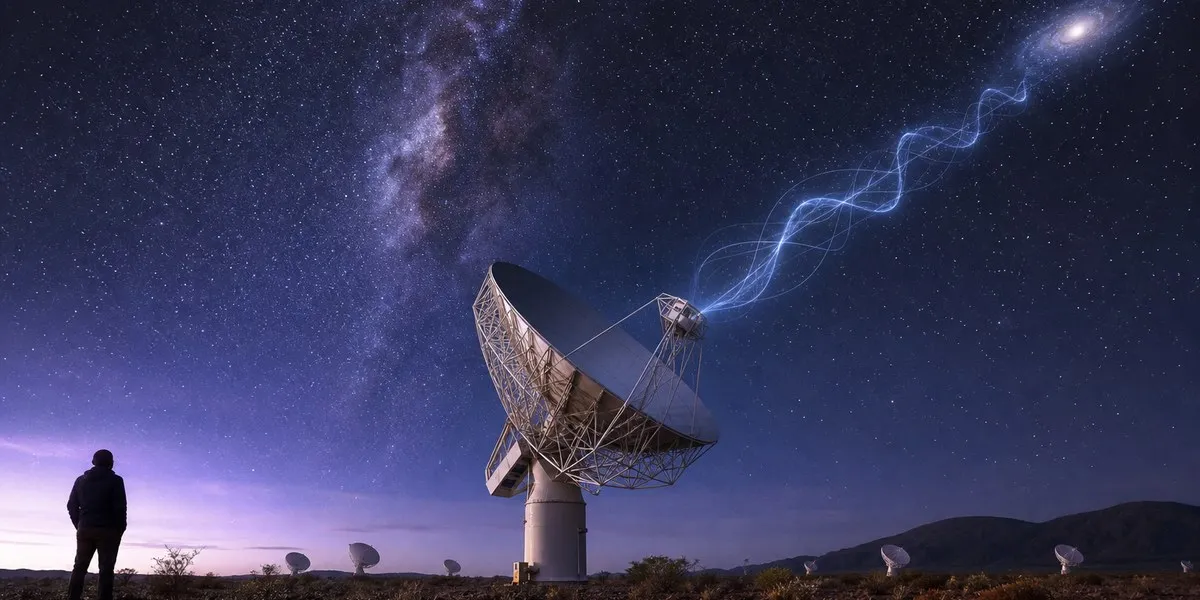
Astronomers have detected the most distant known fast radio burst, FRB 20240304B, using the MeerKAT radio telescope in South Africa. The signal was emitted approximately 3 billion years after the Big Bang and traveled through space for about 80% of the Universe’s history. ScienceAlert reports on the results of the international study published in the journal Science.
A signal from cosmic noon
Fast radio bursts are short pulses of radio waves from deep space that last only fractions of a second. FRB 20240304B was emitted in approximately one thousandth of a second. It was detected in March 2024 using MeerKAT, a radio telescope with 64 antennas located in MeerKAT National Park in South Africa.
Researchers initially could not see the signal’s source galaxy with ground-based telescopes. It was identified by the James Webb Space Telescope due to its high sensitivity to infrared radiation. An analysis of spectral lines, including oxygen and hydrogen, made it possible to determine the redshift and establish that the galaxy existed during the era of “cosmic noon,” when star formation in the Universe was at its peak.
A young dwarf galaxy
Instead of a large, mature galaxy, astronomers found a small dwarf system where stars are actively forming. According to the team’s estimate, it is 1,000 times less massive than researchers expected, and 90% of its stellar mass formed over the past 30 million years.
More current news is available on the UA.News Telegram channel Telegram.
These characteristics strengthened the hypothesis that the burst’s source could have been a magnetar, a neutron star with an extremely powerful magnetic field. Unlike the collision of two neutron stars, which can occur billions of years after their formation, magnetars can arise and release energy within millions of years, including in metal-poor galaxies with massive stars.
A trail of gas along the signal’s path
During the radio burst’s journey through ionized gas, low-frequency waves were delayed more strongly than high-frequency waves. Turbulent gas, likely in the source galaxy, also stretched the signal by several milliseconds. Data from FRB 20240304B helped investigate an unknown group of galaxies at a distance of about 3.5 billion light-years, and also contained the ionic trace of the Virgo Cluster, located approximately 54 million light-years from Earth.
Source galaxies have now been confirmed for about 100 fast radio bursts. The origin of such signals has still not been definitively established, although there are nearly 100 theoretical models of their formation.




