
Astronomers identify 2% threshold for delayed black hole jets — ScienceDaily
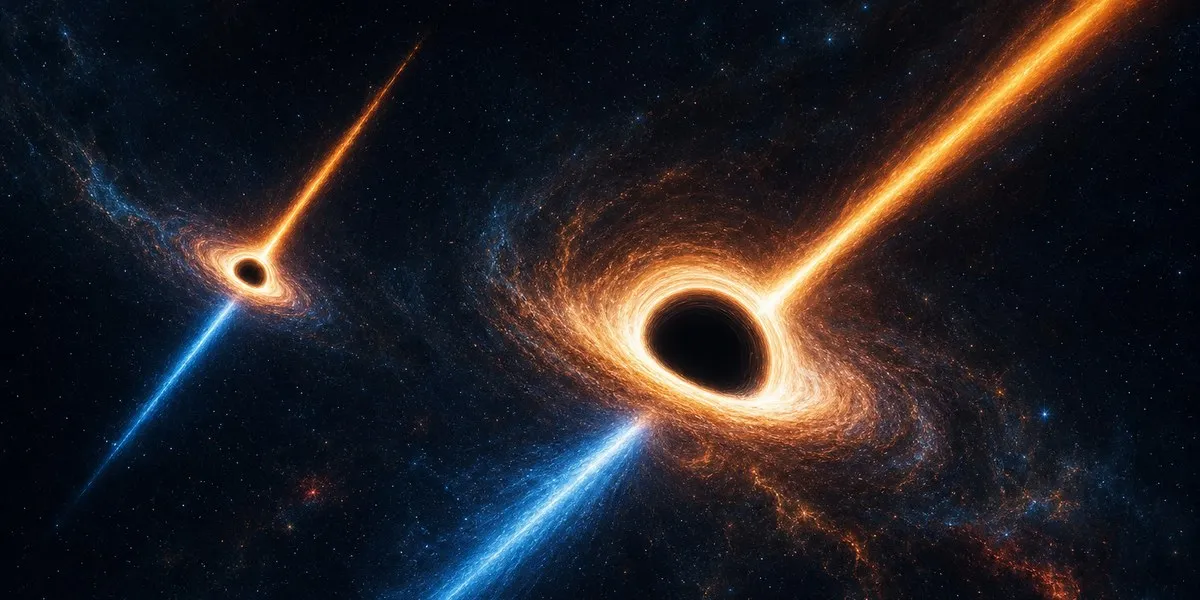
Astronomers have found that supermassive black holes can launch delayed jets of matter when their rate of matter accretion falls to about 2% of the Eddington limit. The same relative threshold was previously associated with jet formation in much smaller black holes in the Milky Way, ScienceDaily reports. The study’s results were published in Nature Astronomy.
The work was led by astrophysicist Adele Goodwin of the Curtin University node of the International Centre for Radio Astronomy Research, together with Andrew Mummery of the Institute for Advanced Study in Princeton. The scientists studied why, after a star is destroyed by a supermassive black hole, a radio jet sometimes appears almost immediately and sometimes only months or years later.
Data on stellar disruptions
The researchers analyzed 20 tidal disruption events — phenomena in which a star passes too close to a supermassive black hole and is torn apart by its gravity. Part of the stellar debris falls into the black hole, temporarily increasing its feeding rate.
More current news is available on the UA.News Telegram channel Telegram.
For ten such events, data were available that made it possible to reliably estimate the rate of matter accretion and the timing of radio emission. Observations were conducted in visible light, ultraviolet, X-ray and radio bands using telescopes in Australia, the United States, India, South Africa and space.
Two stages of jet formation
The observations indicated two periods when black holes can form jets. The first occurs at an early stage, when the black hole absorbs matter at an exceptionally high rate. The second may occur hundreds or thousands of days after the star’s destruction.
It was in this late phase that jets appeared when the feeding rate fell to about 2% of the Eddington limit — a theoretical indicator at which radiation pressure balances gravitational attraction. According to the researchers’ estimate, this ratio may help plan radio telescope observations and more accurately determine when to search for delayed outflows.




