
Three active black holes found in a distant galaxy — ScienceDaily
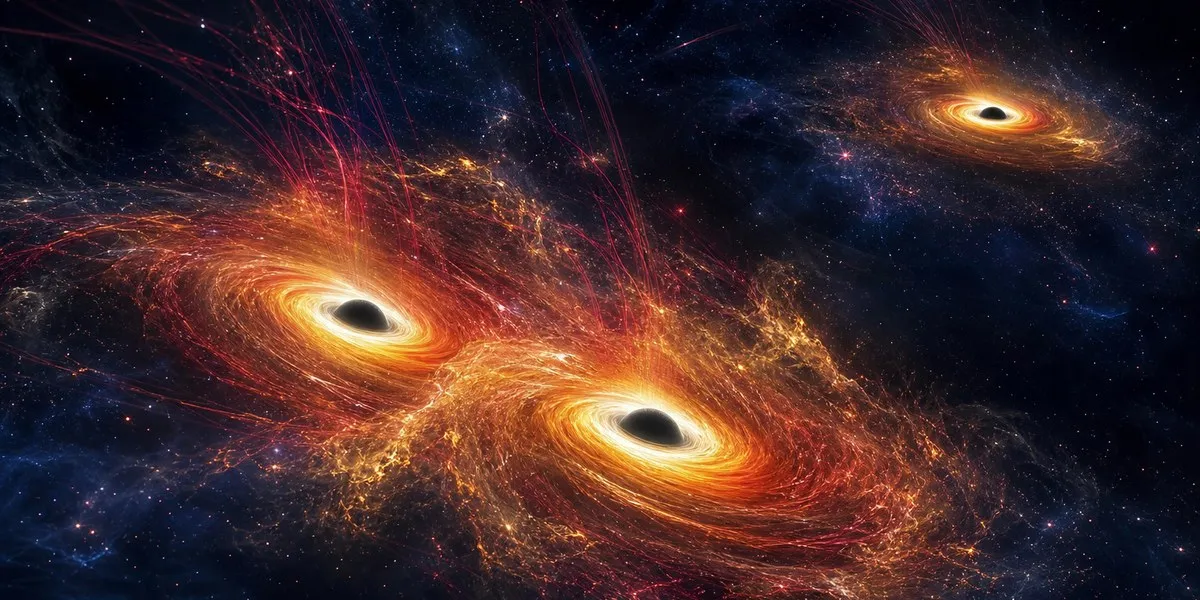
An international team of astronomers has discovered three active supermassive black holes in the galaxy J0148-4214, located more than 12.5 billion light-years from Earth. Light from this object traveled to Earth for about 12.5 billion years, so researchers see the galaxy as it was 1.2 billion years after the Big Bang, ScienceDaily reports.
All three black holes are actively accreting matter from disks of gas and other material around them. Researchers determined that J0148-4214 has a redshift of z=5.02, an indicator caused by the stretching of light as the Universe expands.
Two black holes near the center
Two of the detected black holes are located near the center of the galaxy. Their projected distance from each other is only 620 light-years. The third object is located much farther away, about 5,500 light-years from the galactic center.
More current news is available on the UA.News Telegram channel Telegram.
Scientists established the presence of the black holes through characteristic spectral features of light emitted by hydrogen. Gas near a black hole moves at very high speed, leaving a noticeable trace in the spectrum. To separate the signals of the two central objects, the team used spectroastrometry: this method made it possible to track slight shifts in the positions of spectral lines, although the telescope did not resolve the black holes as separate points of light.
Different masses and rapid growth
According to the researchers' calculations, the masses of the three black holes are approximately 80 million, 600,000, and 2 million solar masses. The most massive object is not, however, the one accreting matter the fastest. The black hole with a mass of about 600,000 Suns is growing much more intensively: its estimated accretion rate exceeds the limit predicted by basic models of black hole growth — the Eddington limit.
The two central black holes, scientists estimate, may merge within the next several hundred million years. The third black hole may either be the remnant of a previous merger that was thrown away from the center by a gravitational kick, or an object gradually moving toward the galaxy's center. The observations were made using the NIRSpec instrument in integral field spectroscopy mode on the James Webb Space Telescope.




