
Webb helped locate a record-distant radio burst — Live Science
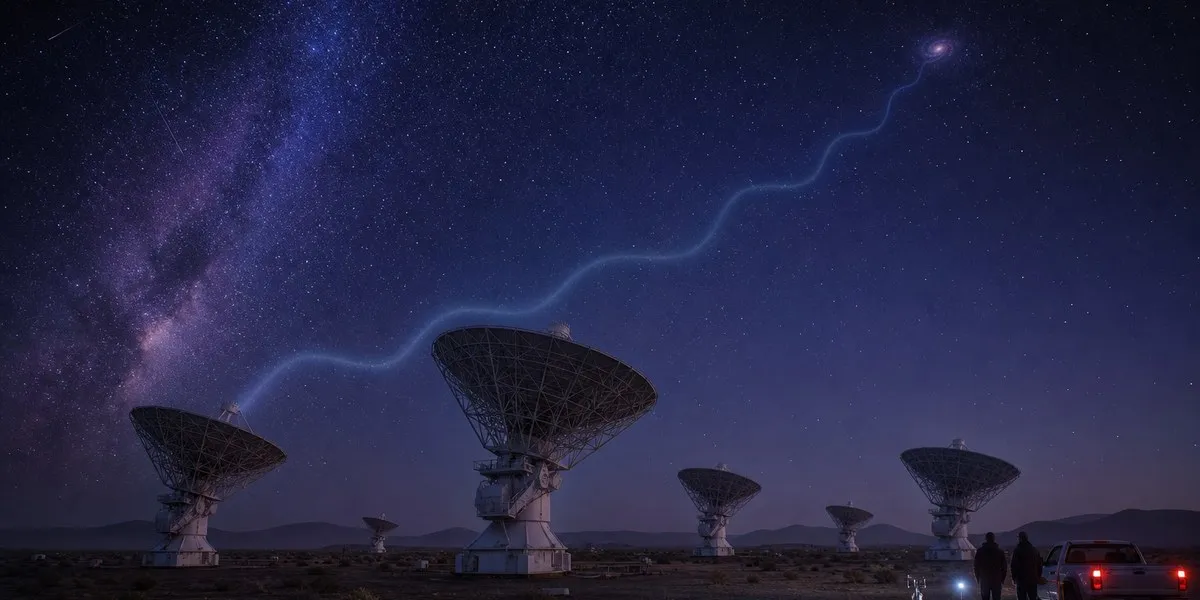
Astronomers using the MeerKAT radio telescope array in South Africa and the James Webb Space Telescope have located the most distant fast radio burst ever recorded — FRB 20240304B. The signal came from more than 10 billion light-years away, and the Webb telescope helped identify its host galaxy, Live Science reports.
Record signal from the early Universe
Fast radio bursts, or FRBs, are extremely brief pulses of radio emission that last only milliseconds. Astronomers have already recorded thousands of such events, but their origin remains unclear. The new observation more than doubles the previous distance record for an FRB.
MeerKAT, which consists of 64 radio telescopes, first detected the burst and determined its precise position in the sky. Due to the significant dispersion of the radio signal, researchers understood that the source was located very far away. At the same time, initial searches with ground-based telescopes did not reveal a likely host galaxy because it was too faint.
More current news is available on the UA.News Telegram channel Telegram.
A faint host galaxy
For further observations, the team was granted time on the James Webb telescope under a target-of-opportunity program. Its near-infrared camera captured a faint galaxy almost exactly at the location where the host of the radio burst was expected to be found. The telescope's spectrograph detected spectral signatures of hydrogen and oxygen, making it possible to determine a redshift of approximately 2.15.
This means that the galaxy is seen as it was when the Universe was about 3 billion years old — roughly one-fifth of its current age. Observations show that the galaxy is smaller than scientists expected, contains few elements heavier than hydrogen and helium, and is actively forming stars.
Researchers suggest that FRB 20240304B may have been associated with a magnetar — the extremely magnetic core of a star that remains after a supernova explosion. The galaxy's young age and active star formation support the idea that at least some FRBs may be produced by magnetars. The team plans to continue combining data from ground-based radio telescopes and James Webb to search for new radio bursts.




