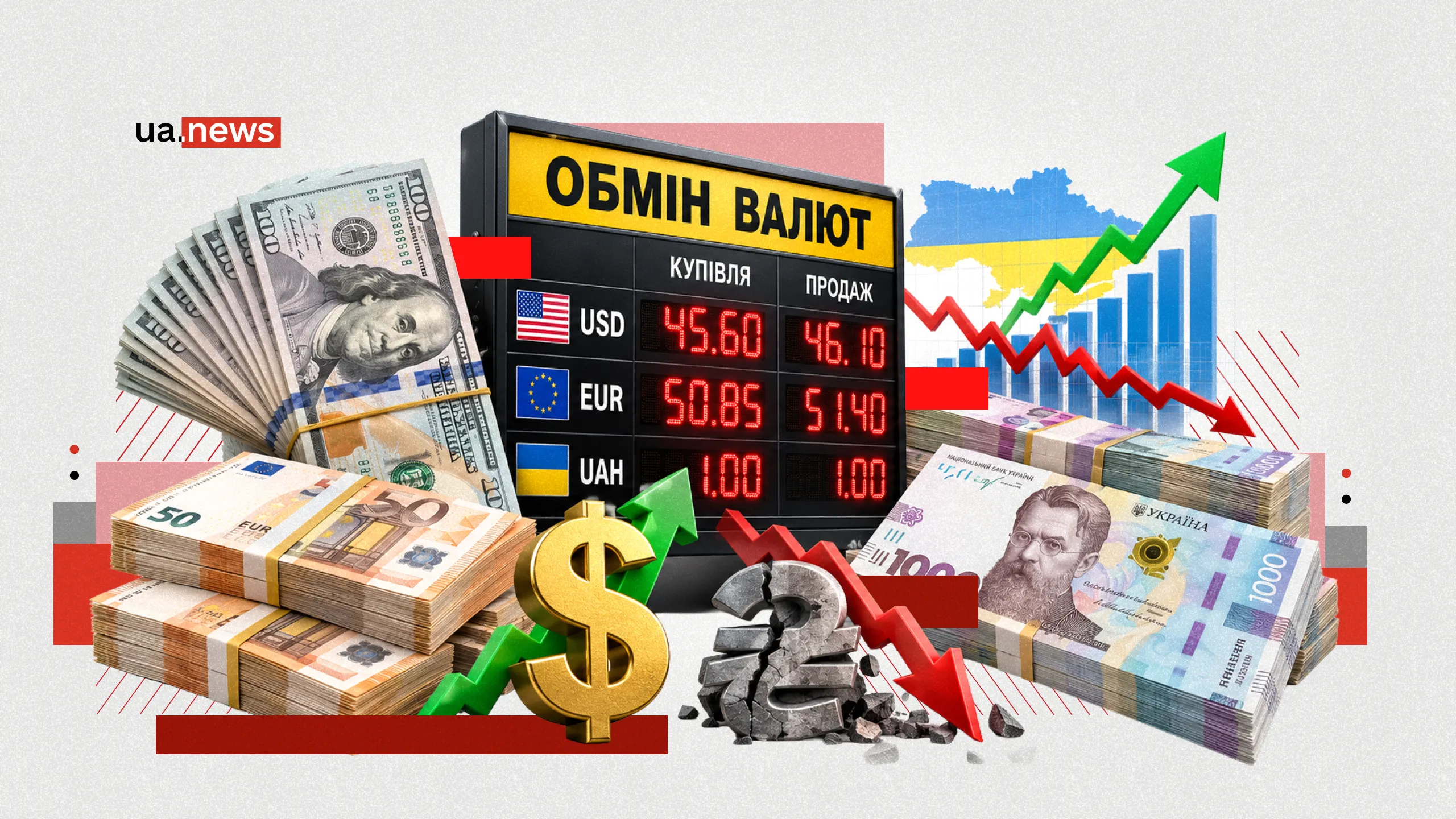
As of Wednesday, October 28, the official dollar exchange rate set by the National Bank reached 45.60 hryvnia. This is a new all-time high and yet another record low. Back in early October, the dollar was trading at around 45 hryvnias, but now it is being sold on the cash market at currency exchange offices for 46.05–46.35 hryvnias. At the same time, the euro, which just a few days ago stood at 50.95 hryvnia, has slipped slightly to 50.85 hryvnia. Such divergent trends may seem somewhat unusual, but they are driven by very specific and objective processes in the Ukrainian economy (as well as in global markets).
The hryvnia is slowly but steadily depreciating, and this is no longer just a fluctuation but a sustained trend, as evidenced by both official statistics and Ukrainians’ own experiences at currency exchange offices. The question on everyone’s mind right now—from ordinary citizens to major importers—is: What’s happening with the exchange rate, and what should we expect next? UA.News political analyst Mykyta Trachuk, together with experts, examined the issue.
What’s Happening in the Market: Controlled Devaluation, Not a Collapse
What we’ve been seeing over the past few weeks can confidently be called a managed devaluation. This means that the National Bank isn’t simply allowing the hryvnia to fall under market pressure, but is in fact actively “guiding” it downward: gradually, in a controlled manner, and in line with its own objectives.
As early as October 26, the regulator raised the official exchange rate by 33 kopecks at once, and since then, the dollar has been hitting new highs almost every day. Trading volumes on the interbank market have also increased. Whereas they previously stood at around $300–308 million per day, they now exceed $330 million and, in some cases, reach $380 million. At the same time, according to market participants’ estimates, the National Bank sells about $300–350 million from its reserves every day to cover the demand that exporters are unable to meet.
And this is where the key paradox lies. On the one hand, the NBU appears to be “letting go” of the hryvnia on its own, allowing it to weaken. On the other hand, it is forced to spend its gold and foreign exchange reserves to prevent this process from spiraling out of control.
Exporters, seeing that the exchange rate is rising, are naturally in no hurry to sell their foreign currency proceeds. They wait for the NBU to “call a halt”—that is, to set an upper limit beyond which the exchange rate will either roll back or stabilize at a new level. As a result, the supply of foreign currency on the market shrinks, and the regulator has to cover the shortfall with its own reserves. The longer this “wait for the stop” game goes on, the more of the national reserves the NBU spends. The cost here can run into the billions of dollars.
So why does the regulator go along with this at all? The answer, as always, lies in budgetary and macroeconomic considerations.
First, the devaluation of the hryvnia automatically increases the hryvnia equivalent of international aid, which is received in dollars and euros. For the Ministry of Finance, which is chronically seeking funds to cover an equally chronic budget deficit, this is very advantageous: the same amount in dollars yields significantly more hryvnias. Apparently, no one is thinking about inflation in this context.
Second, a weaker hryvnia makes Ukrainian exports cheaper for foreign buyers. In theory, this should support domestic producers.
Third, there is a purely technical point: as early as tomorrow, Thursday, October 29, the National Bank is set to make a decision on the discount rate and publish an updated macroeconomic forecast. As a reminder, the rate currently stands at 16% per annum, and the market does not rule out a hike to 16.5%. It would be logical to “align” the exchange rate with such a move—so that the rate hike appears to be a justified effort to combat inflation, rather than simply a reaction to panic.
But there is another side to the story. Pressure on the hryvnia stems not only from the NBU’s actions but also from entirely objective, even fundamental, factors. Ukraine’s trade deficit remains significant; imports (particularly energy imports) are rising, while exports are suffering from the blockade of seaports, the collapse of the metallurgy sector, and the broader consequences of the war. Agricultural exports are also declining. At the same time, airstrikes on businesses continue unabated; the enemy is systematically “wiping out” warehouses; it is becoming increasingly difficult for businesses to operate; and workers are being “siphoned off” by mobilization and new reservist rules, among other factors.
All of this combined creates sustained demand for foreign currency that is not met by supply. That is precisely why devaluation is not a whim of the regulator, but rather a necessary step that allows the country to avoid a sharp collapse and maintain some degree of control over the process.

Why the euro is falling in value while the dollar is rising: the global currency pair
The divergent dynamics of the dollar and the euro against the hryvnia are not unique to Ukraine but reflect what is happening in the global foreign exchange market. The euro is weakening against the dollar: while the euro/dollar pair was trading at 1.1162 just a few days ago, it now stands at 1.1145. This means that the dollar is strengthening not only against the hryvnia but also against the euro. Consequently, the hryvnia, which tracks the dollar, automatically weakens against it but may even strengthen slightly against the euro. That is precisely why the official euro exchange rate fell by 10 kopecks on October 28—to 50.85 hryvnia.
For the average Ukrainian, this means that the dollar should be the primary reference point: not only because it has traditionally served as a measure of value and savings, but also because the dollar is currently driving the currency trend. If the dollar continues to strengthen on the global market, the hryvnia will weaken against it even without additional intervention by the NBU. If, on the other hand, the euro begins to regain ground, the hryvnia’s exchange rate against the European currency may stabilize or even decline.
In the cash market, these processes are reflected with a certain delay and follow their own logic. The difference between the official exchange rate and the rate at which currency can actually be purchased is about 50–60 kopecks, and sometimes even higher. This is a normal market reaction to expectations of further growth: banks and currency exchange offices factor risks—and, of course, their own margins—into the price.

Expert
Opinions
Economic expert Yuriy Gavrilechko notes: everything is normal with the exchange rate—it’s falling. What’s more, according to the expert, that’s exactly how it should be.
“We have a constantly growing trade deficit against the backdrop of rising indirect taxation (increased regulation) within the country and the lack of state support for businesses, which are currently suffering from rocket and drone attacks that are destroying warehouse inventories and production facilities. Worse still: businesses are preparing for a significant reduction in operations or closure within a month, because starting December 4, they will be unable to operate during air raid alerts due to the lack of shelters—which the government failed to build throughout the years of the war and instead mandated that business owners construct within less than three months, a deadline that is utterly unrealistic.
The exchange rate is already showing the first results of this policy. Add to this the taxation of parcels, which will lead to a rise in retail prices for imports. Consequently, we will see further devaluation of the hryvnia, which the NBU will periodically halt. However, the volume of international loans flowing into Ukraine will also influence this. They, too, will help stabilize the hryvnia exchange rate. As for next year—the government needs devaluation to meet its tax revenue targets. So its actions will be aimed at fueling this process, but within the limits of the budget targets,” noted Yuriy Gavrylechko.
Economist and director of the Economic Discussion Club, Oleg Pendzin, is confident that nothing alarming is happening. What’s more, the expert believes the situation is even better than it should have been.
“Anyone worried about the exchange rate—take a look at the 2026 budget and check the macroeconomic forecasts. Then we’ll see that the average annual exchange rate is set at 45.7 UAH. What does that mean? It means that, theoretically, we were supposed to have reached this exchange rate back in June. But now, excuse me, it’s the end of October. In other words, our exchange rate is even stronger than what was planned in the 2026 draft budget. So personally, I don’t see any tragedy here. As long as our partners are providing funds, the NBU will have the resources to maintain the exchange rate. And to find out what the exchange rate will be going forward and what the forecasts are, you need to open the 2027 draft budget and see what it says. The average exchange rate is set at 47.1 UAH, with a gradual increase to 48.3 UAH by the end of the year. There’s your answer,” said Oleg Pendzin.

In
summary, the exchange rate situation as of late October looks alarming, but not yet catastrophic. The hryvnia is depreciating, but this is happening in a controlled manner, at the initiative of and under the supervision of the NBU. The official dollar exchange rate has hit a historic high—45.60 hryvnias—and so far there are no signs that this trend will reverse anytime soon. At the same time, the euro has weakened slightly, which is more a result of global fluctuations than Ukrainian policy.
For Ukrainians, the main takeaway is simple: focus on the dollar. It’s also worth preparing for the possibility that in the coming weeks, the exchange rate may fluctuate back and forth within the range of 45.5–46.5 hryvnias. No market participants are forecasting a sharp collapse, but the baseline scenario calls for a gradual weakening of the hryvnia to approximately 46 hryvnias per dollar by the end of the year (with pessimistic forecasts reaching 47). However, much will depend on whether Ukraine manages to secure international financing in the promised amounts, whether exports are unblocked, what the NBU’s decision on the discount rate will be on October 29, and so on.
For now, we have what we have. Namely, a managed devaluation, which, unfortunately, is hitting people’s wallets hard but has not yet turned into an uncontrolled collapse.