
"The NACP Is to Blame Again": Verbytsky Releases the Fourth Part of His Story About His Wealth

Former Deputy Prosecutor General Dmytro Verbytskyi continues his series of articles arguing that everyone around him allegedly misreads documents, is unable to do basic math, and takes an unfounded interest in the origins of luxury real estate and assets worth millions.
In the fourth installment of his column, the former prosecutor explains the story involving real estate in Odesa, cash, and the cryptocurrency USDT. As usual, the National Agency for the Prevention of Corruption was found to be at fault; according to the author, it flouts the law, ignores documents, and lacks basic arithmetic skills.
This is not Verbitsky’s first attempt to convince readers that his assets worth millions can be easily explained, and that the allegations made by anti-corruption agencies are the result of a conspiracy. UA.NEWS analyzed the previous installment of this media saga in the article “I Was Set Up”: Dmytro Verbytskyi Wrote a New Blog Post About His Millions.
The only problem with this new “compelling” story is that the National Agency for Corruption Prevention (NAZK) has already completed a full audit of Verbytskyi’s 2023 financial disclosure statement. As reported by UA.NEWS, the agency identified inaccurate information amounting to 2,379,310 UAH and signs of illicit enrichment totaling 30,266,502 UAH. The audit materials were forwarded to the National Anti-Corruption Bureau of Ukraine (NABU).
In addition, on February 25, 2026, the Kyiv District Administrative Court dismissed Verbytskyi’s lawsuit against the NACP. The former prosecutor filed an appeal; however, the mere filing of the appeal does not overturn the lower court’s decision nor does it render the agency’s findings “invalid.”
But on his personal blog, court decisions apparently work a little differently.
A Loan to His Ex-Wife: The Paperwork Is There—There Should Be No Questions
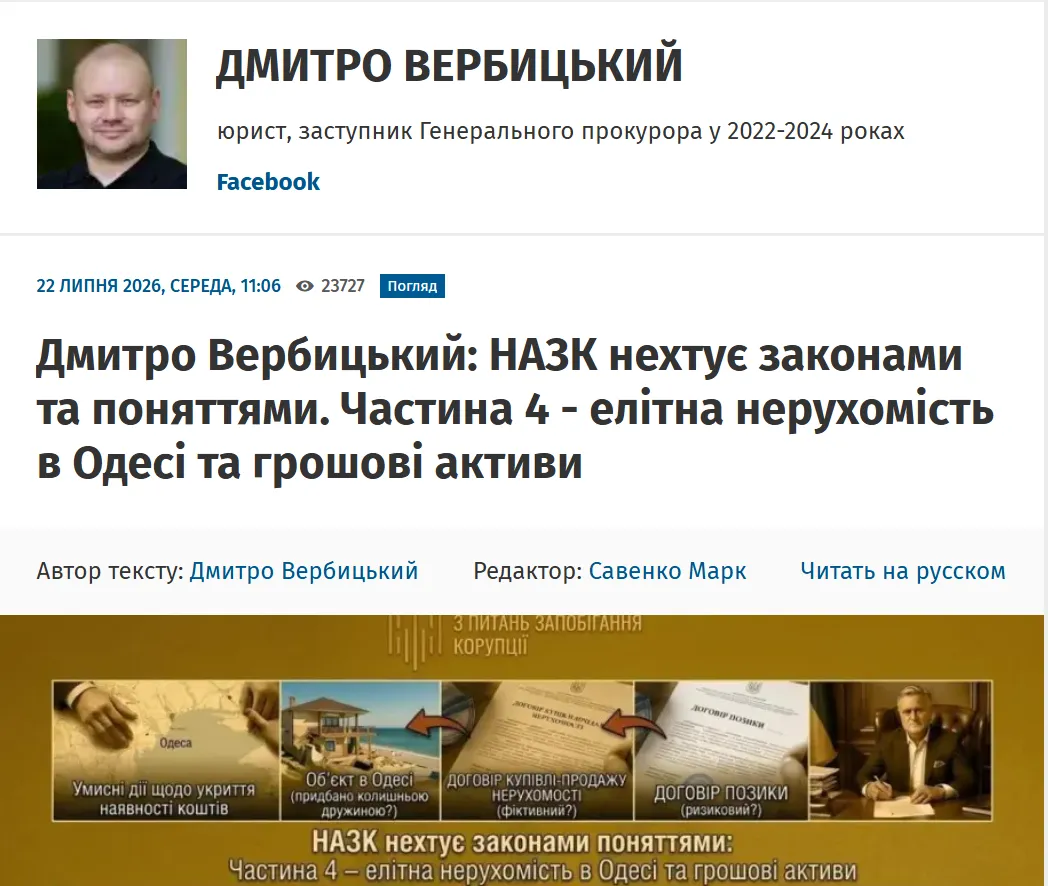
The first part of the new column is devoted to luxury real estate in Odesa, registered in the name of Verbytsky’s ex-wife.
The former prosecutor explains that the woman did not have sufficient income, so she received a loan from an acquaintance. A loan is not considered income, the contract exists, and the lender allegedly had enough money. Therefore, according to the author’s logic, the NACP should have reviewed the document, politely thanked him, and concluded the investigation.
The assertion that a loan is not income is, in and of itself, correct. But it does not answer the main question: Was the transaction genuine, and were the borrowed funds actually used to purchase the property?
During an anti-corruption audit, it is not enough to simply have a contract with the correct title. Investigators may examine the lender’s financial capacity, the actual flow of funds, the relationships between the parties, and the circumstances surrounding the acquisition of the asset. Otherwise, the origin of any asset could be explained by a single, catch-all document: “A wealthy acquaintance gave me the money.”
Preferably, an acquaintance who is taciturn and doesn’t ask unnecessary questions.
Verbytsky is outraged that the NACP classified the loan as high-risk. But the mere existence of a contract does not oblige the regulatory authority to unconditionally accept the entire story set forth in it, especially when it involves a person close to the declarant, high-end real estate, and funds whose origin has already become the subject of an investigation.
“I Wasn’t There”: A New Standard for Non-Involvement in Real Estate
Verbytskyy goes on to state that he did not purchase the Odesa property, did not conduct negotiations, did not call the sellers, and has never even been there.
It sounds convincing. However, anti-corruption agencies do not investigate an official’s travel activities or the number of calls they make to a real estate agent.
A person can be linked to the acquisition or use of an asset without visiting a notary or taking a photo at the gate. That is precisely why the investigation focuses not only on the formal owner but also on the sources of funding, related parties, actual use of the property, and the ability to directly or indirectly control the property.
Particularly interesting is the attempt to portray his ex-wife as a complete outsider, when Verbytsky himself listed properties registered in her name as assets in his own use in his declaration.
This creates a convenient arrangement: when it comes to explaining the declaration, the connection to his ex-wife is close enough. But when the NACP investigates the origin of the property, this connection suddenly vanishes.
Independent auditors who, strangely enough, agree with the client
Verbytsky reinforces virtually every section of his column with references to independent auditors, expert assessments, and commissioned judicial economic expert opinions.
But the word “independent” in the text does not automatically make the conclusion the ultimate truth. It is important to understand who commissioned the studies, what questions were posed to the experts, what documents were provided to them, and whether they verified the actual existence of the transactions—rather than merely checking the arithmetic accuracy of the figures in the documents provided.
An auditor can confirm that the amount in the loan agreement equals the value of the property. But that in itself does not prove that the money was actually transferred, belonged to the lender, and was used specifically for this purchase.
Incidentally, UA.NEWS previously published the results of an independent appraisal of the value of a business center in Odesa linked to the Verbytsky family. According to that appraisal, the property’s value could have been higher than what was stated in the documents. Apparently, independent experts aren’t always convincing—only when their conclusions please the author of the column.
Cash Magic: Sell a Car—and You Don’t Have to Account for the Money Anymore
The next section of the column is devoted to cash. Verbytsky writes that as of the end of 2023, he had declared $60,000. According to his explanation, he received $43,000 from the sale of a car, and another $24,000 remained from the beginning of the year.
That comes to a total of $67,000. In other words, arithmetically speaking, the required $60,000 seems to have been covered with some to spare.
But a simple addition does not prove that the person did not spend money during the year on housing, transportation, travel, property purchases, and other needs. To determine the actual ability to build up savings, one must analyze all cash flows, not just two convenient inflows.
The conclusion of the defense expert report regarding 100,000 UAH is particularly striking: the source of the cash “could have been” a withdrawal from a bank account.
When the NACP uses the phrase “could have been,” according to Verbytsky’s logic, it indicates mere speculation and unprofessionalism. When the experts he brought in write the same thing—that’s already evidence.
Cryptocurrency from a Payroll Card: The Bank as a Universal Alibi
Regarding USDT, Verbytskyi states that the cryptocurrency was purchased non-cash via a bank, and the funds came from a payroll card.
However, making a payment through a bank account primarily confirms the method of the transaction. It does not automatically prove that, after all other expenses, there was enough official income left to form the declared assets.
A payroll card does not make the origin of every hryvnia indisputable simply because the funds once passed through a bank.
Most interesting is Verbytskyi’s claim that during a full audit of the 2023 declaration, the NACP allegedly found no violations related to cryptocurrency. Even if a specific USDT transaction was not singled out as a separate violation, this does not mean that the entire declaration passed the audit successfully.
The official result is the opposite: the NACP identified inaccurate information amounting to 2,379,310 UAH and signs of illicit enrichment totaling 30,266,502 UAH, after which the case materials were forwarded to the NABU.
Why the NACP’s figures may differ
Various amounts appear in the case materials concerning Verbytskyi: approximately 29–37.5 million UAH from the lifestyle monitoring and over 30.2 million UAH based on the results of the full declaration audit.
This does not necessarily mean that the NACP has gotten its own figures mixed up. Lifestyle monitoring and a full review of the declaration are different procedures. They may cover different time periods, assets, groups of related individuals, and legal criteria, so their results do not have to match down to the last hryvnia.
Verbytskyi mixes the results of different audits, isolated incidents, and his own expert documents, and presents any discrepancy as evidence of the agency’s unprofessionalism.
Convenient, but not very convincing.
The court case was lost, but in the column, victory has already been achieved
The biggest problem with Verbytsky’s text lies not even in the individual calculations. The author writes as if he has definitively proven the illegality of the NACP’s actions, although in the actual court proceedings the situation is currently the opposite.
On February 25, 2026, the Kyiv District Administrative Court denied his claim. Verbytsky filed an appeal, but a final decision in his favor has not yet been publicly announced. UA.NEWS has compiled a detailed history of the legal dispute and audits in a complete chronology of the case.
At the same time, the criminal proceedings regarding possible illicit enrichment remain open. In May 2026, the Specialized Anti-Corruption Prosecutor’s Office (SAPO) confirmed that NABU detectives are continuing the investigation under the procedural supervision of anti-corruption prosecutors.
Important clarification: the administrative court did not find Verbytsky guilty of illicit enrichment. It assessed the legality of the NACP’s actions and found no grounds to overturn the monitoring results. No public announcement was made regarding the notification of charges against Verbytskyi in this criminal proceeding, and only a court can determine guilt.
However, to call the agency’s claims baseless after losing the case in the court of first instance, a full review of the declaration, and the transfer of materials to the National Anti-Corruption Bureau (NABU) is, at the very least, premature.
The saga continues, but bloggers aren’t writing the finale
In the column’s conclusion, Verbytsky accuses the NACP of deliberately distorting the facts and attempting to artificially create a funding shortfall.
However, for now, this is merely the former official’s own position and the explanations prepared on his behalf. They have not overturned the NACP’s findings, failed to convince the trial court, and have not halted the criminal proceedings.
The defense strategy remains the same: if an asset is registered in a relative’s name, it doesn’t belong to him; if money appeared out of nowhere, it was borrowed from an acquaintance or earned by a family member; if the NACP disagrees, it doesn’t know how to count; if the court rules against him—it’s time to write the next column.
In the media series, Verbytsky traditionally defeats all his opponents at the end of each episode.
In legal reality, the NACP’s findings remain in effect, the appeal is ongoing, and anti-corruption agencies continue to investigate the origin of tens of millions of hryvnias.
And no number of opinion columns can replace a final court ruling.


