
The attempt to establish the Odessa People's Republic has gone to court
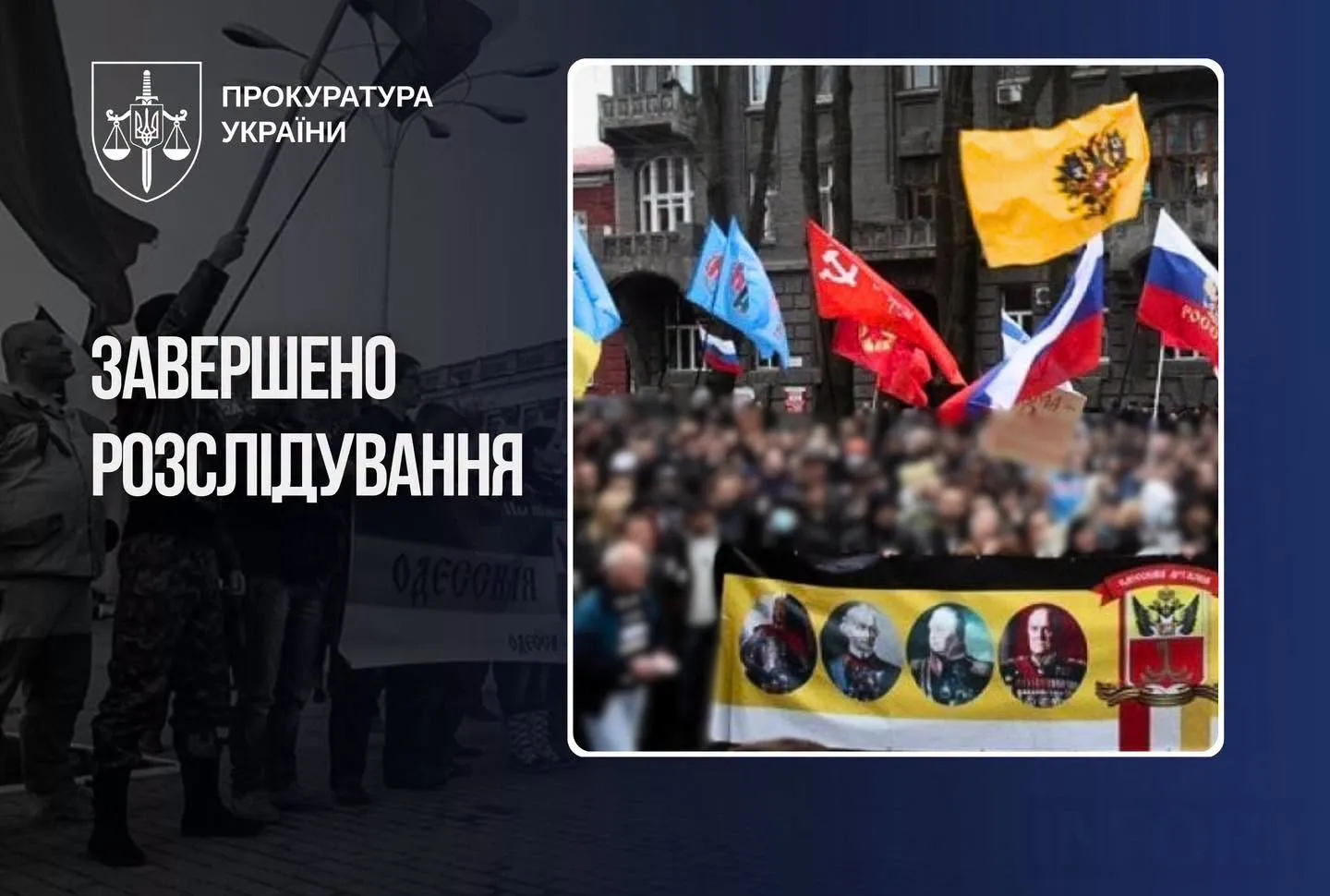
The Office of the Prosecutor General has referred to court a case against three representatives of pro-Russian organizations accused of attempting to establish the so-called “Odesa People’s Republic” in Odesa. According to the investigation, they acted with Russia’s support, attempted to force members of the regional council to declare the pseudo-republic, and were involved in organizing mass riots on May 2, 2014. If found guilty, they face charges of treason and violating Ukraine’s territorial integrity.
Prosecutors from the Office of the Prosecutor General have completed the investigation and submitted the indictment to the court. The case was opened against three representatives of pro-Russian organizations who, according to the investigation, attempted to secure Odesa’s secession from Ukraine with Russia’s support. Among the defendants are the head of a pro-Russian civic organization, the secretary of a diocese of the Ukrainian Orthodox Church, and the leader of the “Anti-Maidan” movement group on Kulikovo Field.
According to investigators, in late February 2014, they conspired with representatives of Russian political organizations. At that time, an event was organized in Odesa, during which participants called on Russia to send troops into Ukraine. They allegedly justified this by citing the need to “protect the Russian-speaking population.”
They attempted to force deputies to declare a pseudo-republic
The next stage, according to the investigation, took place on March 3, 2014. The defendants organized the arrival of pro-Russian activists at the Odesa Regional Council building. The protesters threatened to seize the building and tried to force deputies to proclaim the so-called “Odesa People’s Republic.” However, the plan failed: the deputies refused to support this initiative.
Investigators claim that the defendants subsequently received approximately 40,000 U.S. dollars from Russian representatives. According to law enforcement, these funds were linked to their activities.
The Camp on Kulikovo Field and Clashes with Euromaidan
In March and April 2014, according to the investigation, the defendants set up a camp on Kulikovo Field in Odesa for the “Orthodox Druzhina” and “Odesa Druzhina” groups. There, they promoted the ideas of the “Russian World,” advocated for Ukraine’s rapprochement with Russia, and denied the legitimacy of the Ukrainian government. Subsequently, members of these groups engaged in violent clashes with representatives of the “EuroMaidan” movement.
The investigation also established that prior to the mass riots on May 2, 2014, the organizers reached an agreement with the then-head of the Odesa Regional Public Security Police that law enforcement would not interfere with their activities. According to the investigation, following this agreement, pro-Russian groups organized the mass riots. A former police official linked to these events had previously been convicted in a separate criminal case.
What Are the Defendants Accused Of?
The actions of the three defendants have been classified under two articles of the Criminal Code of Ukraine. These are high treason—Part 1 of Article 111—and an encroachment upon the territorial integrity and inviolability of Ukraine—Part 2 of Article 110. Part 2 of Article 28, which pertains to the commission of a crime by a group of persons acting in concert, has also been cited.
According to the prosecutor’s office, the defendants have been in hiding in Russia and in the temporarily occupied territory of Ukraine for a long time. Therefore, the investigation into their cases was conducted under a special procedure—in absentia, that is, in the absence of the suspects or defendants. The indictment has now been submitted to the court. However, the charges have yet to be considered by the court, and the guilt of each defendant must be proven in accordance with the law. This was reported by .
Earlier in Kharkiv, a military police officer pushed a woman during a conflict.
A military checkpoint officer refused to pay 15 million hryvnias to the children of a deceased person due to their registration status.
Lubinec explained whether military police officers can confiscate phones and forcibly put people on vans.




