
Ukraine harvested 2.6% more grain than last year, according to the Ministry of Agrarian Policy
As of November 17, Ukrainian farmers had harvested 50.14 million metric tons of grains and legumes from an area of 9.56 million hectares. This represents 82.4% of the land planted with these crops.
By comparison, as of November 21 last year, 50.93 million metric tons of grain had been harvested from 10.23 million hectares, or 88% of the planted area. Two weeks earlier last year, the figure stood at 43.63 million metric tons from 9.30 million hectares.
Based on the average yield, this year’s grain harvest is approximately 2.6% higher than last year’s. This result was primarily driven by higher yields of early-maturing grain crops.
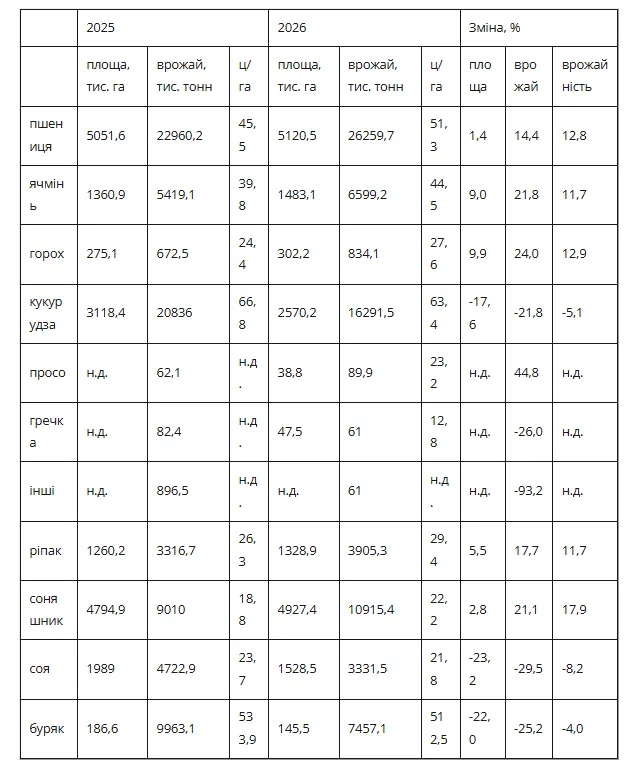
Over the past week, the gross corn harvest increased from 13.19 million to 16.29 million metric tons. Farmers have threshed 2.57 million hectares, which corresponds to 56.2% of the projected area.
At the same time, the average yield for this crop is 63.4 centners per hectare. For comparison, last year’s figure was 66.8 centners per hectare.
As of November 17, Ukraine had harvested 18.15 million metric tons of oilseeds, which is approximately 7.7% more than during the same period last year.
Specifically, 10.92 million metric tons of sunflower seeds were harvested from an area of 4.93 million hectares. This represents 94.1% of the projected area. The average yield is 22.2 centners per hectare, compared to 18.8 centners per hectare last year.
Soybeans were harvested from 1.53 million hectares, or 95.2% of the projected area. The total harvest amounts to 3.33 million metric tons, and the average yield is 21.8 centners per hectare. Last year, this figure was higher, at 23.7 centners per hectare.
Unlike grains and oilseeds, this year’s sugar beet harvest is significantly lower than last year’s figures.
As of November 17, farmers had harvested 7.46 million metric tons of sugar beets from an area of 145,500 hectares, which represents 85.2% of the projected area.
The average sugar beet yield is 512.5 centners per hectare. Last year, it was higher—533.9 centners per hectare. At the same time, as of November 21 of last year, 9.96 million metric tons of sugar beets had already been harvested from 186,600 hectares.
The harvest of grain crops is nearing completion in Ukraine. According to the Ministry of Agrarian Policy, 97.8% of the projected buckwheat acreage has been threshed, and its gross yield stands at 61,000 metric tons.
Millet has been harvested from 94.9% of the area, with the total harvest reaching 89,900 metric tons.
Last year, the ratio was different: farmers harvested 62,100 metric tons of millet and 82,400 metric tons of buckwheat.
The Ministry of Agrarian Policy reported that the harvest of wheat, barley, peas, and rapeseed has been completed.
The harvest figures are as follows:
- Wheat—26.26 million metric tons from an area of 5.12 million hectares. The average yield is 51.3 centners per hectare, compared to 45.2 centners per hectare last year.
- Barley — 6.60 million metric tons from an area of 1.48 million hectares. The yield reached 44.5 centners per hectare, compared to 39.8 centners per hectare last year.
- Peas — 0.83 million metric tons from an area of 0.30 million hectares. The average yield is 27.6 centners per hectare, compared to 24.4 centners per hectare last year.
- Winter and spring rapeseed — 3.91 million metric tons from an area of 1.33 million hectares. The yield is 29.4 centners per hectare, compared to 26.3 centners per hectare last year.
Thus, as of November 17, Ukrainian farmers have already completed the harvest of the main early grain crops and rapeseed, and are nearing completion of the harvest of sunflowers, soybeans, buckwheat, and millet. At the same time, corn still accounts for the largest share of work among the major grain crops.
This was reported by the Ministry of Agrarian Policy and Food.
As a reminder, Ukraine recorded a decline in exports of grains and legumes during the 2025/26 marketing year. Total exports amounted to 32.8 million metric tons, which is 5.4 million metric tons (or 14%) less than in the previous season. At the same time, the decline in shipments of certain crops was significantly steeper—in some cases, volumes fell by a factor of ten, and in one instance, by a factor of 54.
Meanwhile, Ankara is exploring options to resume food exports and prevent a spike in global food prices caused by the suspension of exports via the Black Sea. To this end, Turkey has intensified negotiations with Ukraine and Russia on establishing a new security mechanism in the transport corridor.




