
The Russian "Filin" Missile: Speed, Range, and Warhead
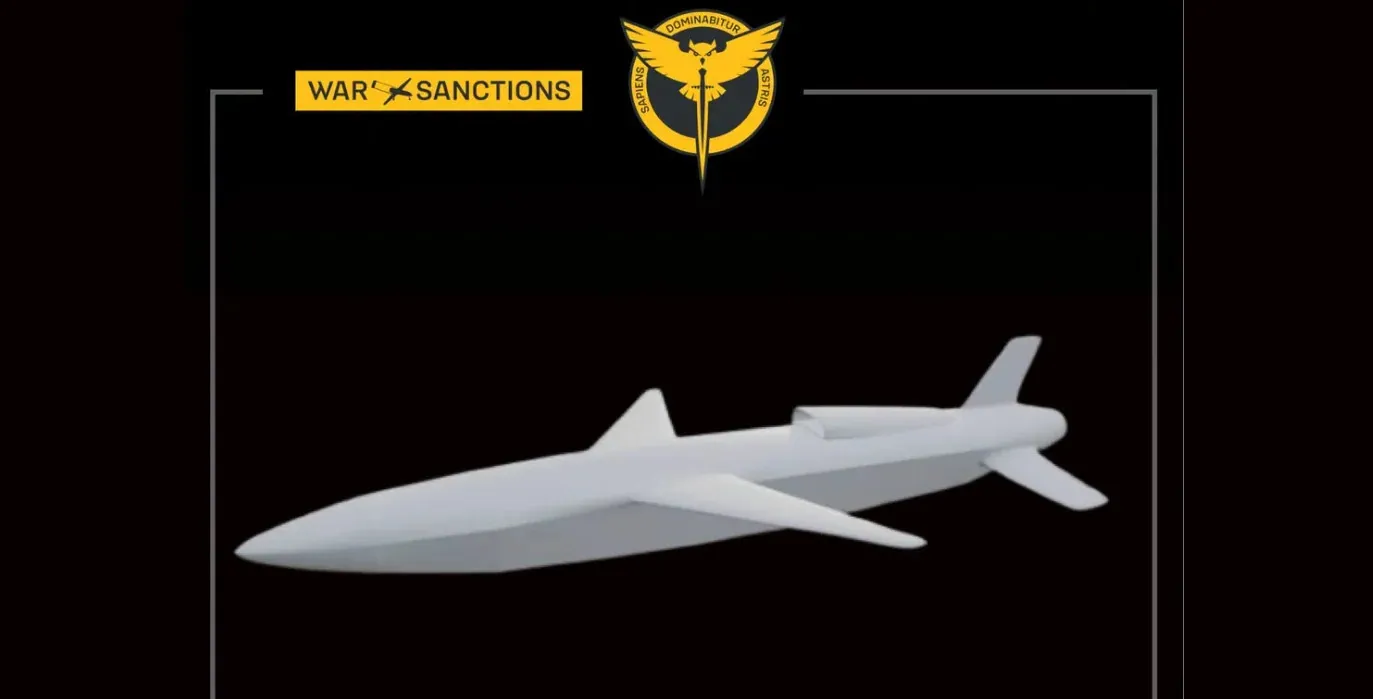
Russia has begun using a new “Filin” cruise missile against Ukraine, which, according to Ukrainian military intelligence, has a range of 600 to 1,200 km and can reach speeds of up to 800 km/h. Key features of this design include launch from a ground-based launcher, flight at low altitude, and the ability to be equipped with various types of warheads.
The Main Intelligence Directorate of the Ukrainian Ministry of Defense has released the technical specifications of the Russian “Filin” missile and information about its components. Details regarding its design, navigation equipment, engine, and foreign-made components allow for a more detailed assessment of the capabilities of this new Russian weapon and the technological base utilized by its manufacturer.
What are the characteristics of the Russian “Filin” missile?
The “Filin” belongs to the class of ground-launched cruise missiles. According to the GUR, its design incorporates a solid-fuel booster that helps the missile reach initial velocity after launch. The cruise engine then powers the missile’s flight.
Key characteristics of the missile:
- type — ground-launched cruise missile;
- range — 600 to 1,200 km;
- maximum speed — up to 800 km/h;
- maximum flight altitude — up to 6 km;
- body length — about 3.5 m;
- wingspan — approximately 3 m;
- maximum takeoff weight—up to 210 kg;
- warhead weight — 50 or 100 kg.
The combination of relatively compact dimensions and significant range allows the missile to be used to strike targets far from the launch site. Its ground-based launch also distinguishes it from cruise missiles launched from aircraft or ships and requires the use of appropriate ground-based equipment.
A range of up to 1,200 km means that the potential strike zone can cover a significant area. At the same time, the actual capabilities depend on the flight path, navigation, target type, and the conditions under which the missile operates.
Why the Ability to Fly at Low Altitudes Is Important
One of the “Filin”’s characteristics that Ukrainian intelligence has highlighted is its ability to fly at low altitudes. This flight profile makes it more difficult for ground-based radar systems to detect the cruise missile, as the curvature of the Earth and the terrain limit the distance at which radar can detect a low-flying target.
The lower the missile flies, the later individual ground-based radar stations can detect it. This reduces the time between threat detection and a potential interception. This factor becomes particularly important during massive attacks, when air defense systems are simultaneously tracking several types of aerial targets.
The “Filina” has a maximum specified flight altitude of up to 6 km. Its flight profile may vary depending on the mission and route. When assessing a threat, it is not only the maximum speed and range that matter, but also how the missile navigates different sections of its route and how accurately it can reach its intended target.
At the same time, low altitude alone does not make the missile invulnerable. The effectiveness of countermeasures depends on radar detection capabilities, the deployment of air defense systems, surveillance arrangements, and the operation of other air defense components.
What Warhead Can the “Filin” Carry?
According to the Main Intelligence Directorate (GUR), the missile can be equipped with warheads weighing 50 or 100 kg. Among the types listed are high-explosive fragmentation, penetrating, and thermobaric warheads.
The high-explosive fragmentation warhead is designed to destroy targets with a blast wave and shrapnel. Its effects can be dangerous to people, equipment, and infrastructure within the blast zone.
The penetrating warhead is designed to destroy targets that require overcoming certain obstacles prior to detonation. Its use may be directed against fortified structures or installations.
A thermobaric warhead utilizes a unique principle of explosive action involving the propagation of high-temperature explosion products and excess pressure. In enclosed spaces, this effect can be particularly dangerous.
The availability of various warhead options expands the range of missions for which the missile can be used. The choice of a specific warhead determines the nature of the damage and influences the potential consequences of an attack.
Who manufactures the “Filin” missile
According to materials from the Main Intelligence Directorate (GUR), the rocket’s manufacturer is the Russian joint-stock company “NPO ‘Molniya’.” Ukrainian intelligence has also released information about specific assemblies and electronic components identified during an examination of the product.
Among the identified components are the K-103-01 inertial navigation system unit, the “Kometa” navigation module, and the R500 turbojet engine. These elements perform various functions: the engine propels the missile, while the navigation systems help determine its position and maintain its course along a predetermined route.
The Main Intelligence Directorate (GUR) has published a list of 81 components identified in the rocket’s design. The list includes products from foreign manufacturers, such as Texas Instruments, Microchip Technology, ON Semiconductor, and STMicroelectronics, as well as components manufactured in China.
The presence of such parts demonstrates that the Russian defense-industrial complex continues to use electronics developed or manufactured outside of Russia. Building modern missiles requires not only a casing and an engine, but also electronic units, microchips, navigation modules, and other components that enable the control systems to function.
The supply of foreign electronics to the Russian military-industrial complex remains a key focus of sanctions policy. Components may enter Russia through intermediaries and resale networks, making it difficult to identify the end user and monitor their use.
The “Kometa” Navigation System and Jamming Protection
The “Kometa” navigation module draws particular attention in the “Filin” design. It is linked to the Russian company “VNIIR-Progress,” which develops navigation systems for military equipment and unmanned aerial vehicles.
Satellite navigation helps determine coordinates and correct the trajectory along a predetermined route. However, during combat operations, such systems can be affected by electronic warfare: satellite signals can be jammed or distorted, making it difficult to determine the missile’s location.
Therefore, the design of the navigation equipment and its resistance to interference are critical to the missile’s effectiveness. If a navigation system is better able to counter the effects of electronic warfare, it can improve its ability to stay on a predetermined route under challenging conditions.
However, navigation effectiveness depends on the entire control system, signal quality, the operation of other instruments, and flight conditions.
What the emergence of the “Filin” means for Ukraine
The combination of a range of up to 1,200 km, a speed of up to 800 km/h, the capability for low-altitude flight, and various combat loadout options makes the “Filin” yet another type of Russian missile weapon that Ukraine must take into account when organizing its air defense.
A separate issue is the use of foreign electronics in Russian weapons. Identified components can help trace supply chains and determine where stricter export controls and sanctions could limit Russian companies’ access to technology.
Thus, the “Filin” combines a significant claimed range, ground-based launch, various types of warheads, and navigation equipment essential for route guidance. Further assessment of this threat will depend on how Russia uses the missile in practice, as well as on data regarding its production, accuracy, and the effectiveness of Ukrainian countermeasures.




