
Chinese researchers propose underwater module for armored vehicle — South China Morning Post
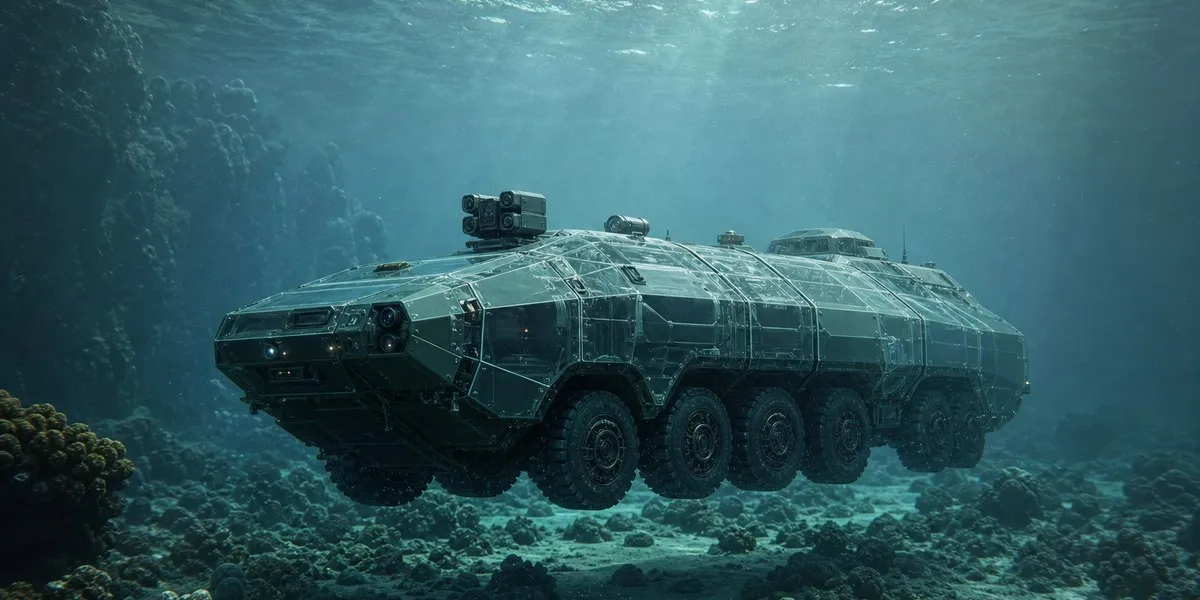
Chinese researchers have proposed the concept of a modular armored vehicle that can be adapted for operations on land, in water, in the air and in conditions of electromagnetic confrontation. One of the proposed modules, according to the authors’ plan, would enable the vehicle to operate underwater at depths of up to 50 meters for two hours.
The study, published on August 6 in the peer-reviewed Chinese journal Acta Armamentarii, was reported by the South China Morning Post. The work was prepared by specialists from Inner Mongolia First Machinery Group, a company involved in developing Chinese tanks and armored vehicles, together with the Beijing Institute of Technology.
Modules for different conditions
The authors call their development “heterogeneous” equipment. Under their concept, the vehicle is to quickly change physical modules and functions depending on the task. The researchers seek to reduce the observation, assessment, decision-making and action cycle to nine seconds — about five times compared with the figure they cite for existing systems.
More current news is available on the UA.News Telegram channel Telegram.
During module tests, the average connection time was 8.7 seconds, while the success rate was 98.3% across 1,000 tests. The tests were conducted at temperatures from minus 20 to plus 50 degrees Celsius, under conditions of strong electromagnetic interference and muddy terrain.
Parameters of the underwater version
The developers plan to carry out transitions between operating modes, including for the use of the water module, within up to 12 minutes. At the same time, the concept’s underwater characteristics were not tested: the study provides no data on speed or range of movement underwater.
On land, the basic module, according to the authors’ calculations, is to reach at least 70 km/h on roads and 40 km/h off-road. The stated range of the hybrid version is at least 600 km. The researchers also believe that combining underwater maneuvering with obstacle clearance using drones could reduce the time of a landing operation by 60%.




